U.S. Develops Small Nuclear Reactors and Microreactors to Power AI Data Centers
The United States is accelerating development of Small Modular Reactors (SMRs) and microreactors to meet rapidly growing electricity demand from AI data centers, advanced manufacturing, military installations, and remote communities. The country currently operates about 98 gigawatts (GW) of commercial nuclear capacity, but new large reactors remain expensive and time-consuming to build. Smaller modular designs are expected to offer a faster and more flexible alternative.
Unlike conventional nuclear plants that typically produce 550 to 1,500 megawatts (MW), SMRs generate up to 300 MW, while microreactors generally produce 20 MW or less. Most are factory-built and transported to their final locations for assembly, reducing construction time, lowering costs, and simplifying deployment. Many designs also incorporate passive safety systems and advanced reactor technologies.
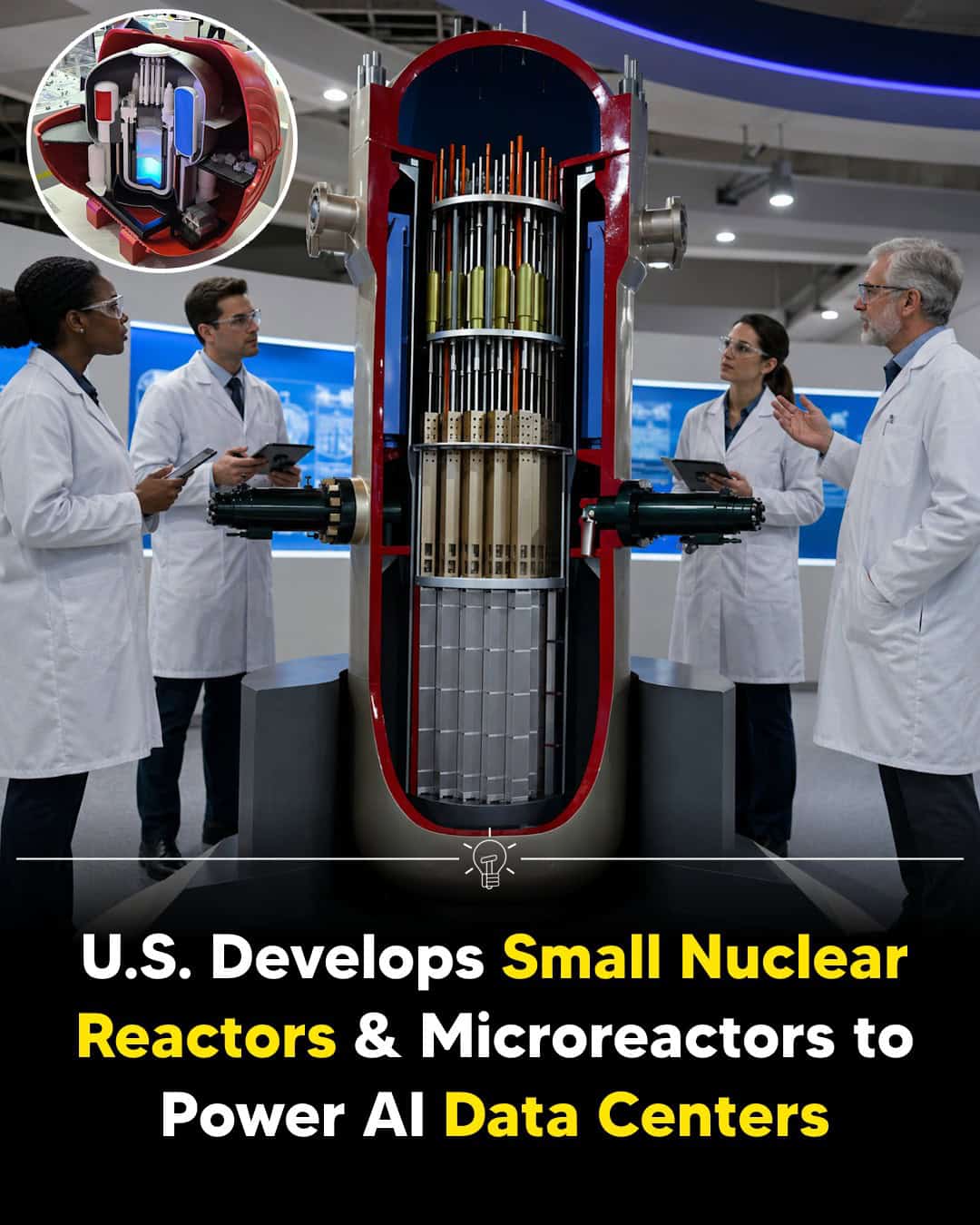
Reliable, around-the-clock electricity has become a priority as AI data centers expand across the United States. Advanced nuclear reactors are increasingly being considered for data centers because they can provide continuous carbon-free power without depending on weather conditions. However, industry analysts say most nuclear-powered AI facilities will likely come online after 2030, while natural gas, solar, and battery storage are expected to meet near-term demand.
Several advanced reactor technologies are under development, including light-water, high-temperature gas, molten salt, and sodium-cooled reactors. Many next-generation designs will use High-Assay Low-Enriched Uranium (HALEU) fuel, which enables more compact and efficient reactors. The Department of Energy is also expanding testing facilities, including the world’s first DOME microreactor test bed at Idaho National Laboratory.
Federal support for advanced nuclear energy continues to grow. In 2025, the U.S. Department of Energy reissued a $900 million funding program to accelerate commercial deployment of American-made SMRs. In 2026, DOE also awarded more than $94 million to eight companies to strengthen reactor licensing, manufacturing, supply chains, and site preparation for future deployments.
The U.S. military is also investing in microreactors to improve energy security. The Army’s Janus Program is evaluating reactors for selected military installations, while the Air Force is advancing a pilot project with Oklo at Eielson Air Force Base in Alaska for a fixed-site microreactor of up to 5 MW. These projects are designed to provide resilient, independent power for critical defense operations.
As electricity demand continues to climb, advanced nuclear technology is becoming an increasingly important part of the U.S. energy strategy. With growing government support, streamlined licensing, and continued investment in SMRs and microreactors, these compact reactors could play a major role in supplying reliable, carbon-free electricity for AI infrastructure, industry, and remote regions in the years ahead.
Sources:
- U.S. Energy Information Administration – 2026
- U.S. Nuclear Regulatory Commission (NRC) – 2026
- Monthly Nuclear Utility Generation by State and Reactor – 2026
- Department of Energy
- Department of War
-
 UK Battery Injects Hundreds of MW Power into Grid in 1 Sec
-
 Samsung Develops 50-MW Offshore Floating Data Center for AI
-
 UK Finally Makes Plug-In Solar Panels Legal at Home
-
 China Tests Underwater Solar Power Plant at 33 Ft Below Sea
-
 German Startup Turns Shop Awnings into Mini Solar Power Plants
-
 AI Firefighting Drones Target Wildfires Before they Spread