Panthalassa Develops Floating AI Data Center at Sea Powered by Ocean Waves
A U.S. startup is developing an unusual approach to the growing electricity demand of artificial intelligence. Panthalassa is building Ocean-3, an autonomous floating platform designed to run AI computing far offshore using energy generated directly from ocean waves.
Instead of bringing electricity from a land-based grid, the system is designed to generate power at sea and use it immediately for onboard computing. The company says the approach could allow AI infrastructure to operate in areas where land, grid connections and conventional cooling systems are difficult to provide.
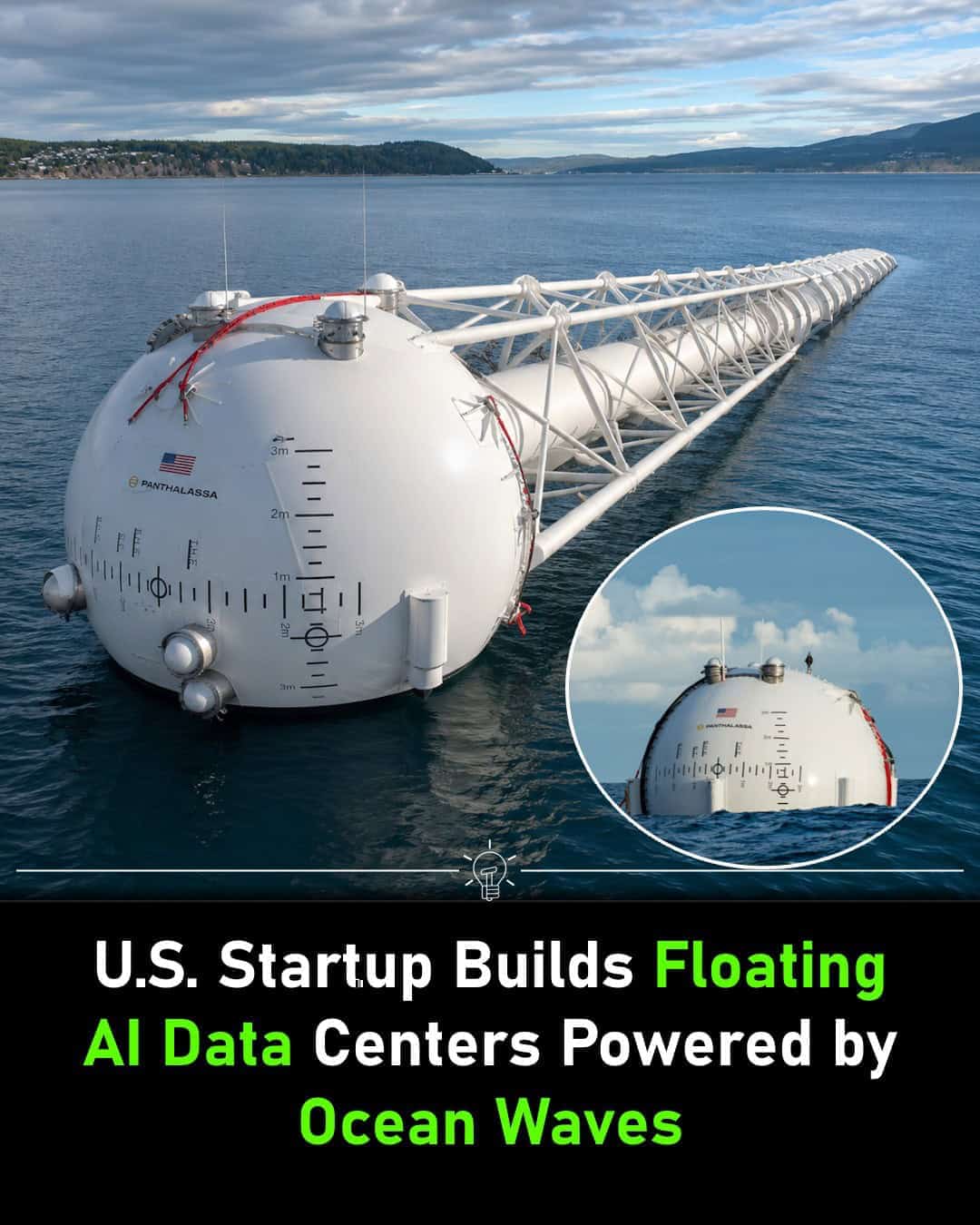
The basic system converts the natural movement of waves into electricity. Ocean-3 has a floating upper section connected to a structure extending below the water. As waves move the platform, seawater is driven through an internal system and turbine, generating electricity for the onboard computing equipment.
The design effectively combines a wave-energy converter and a data center in the same offshore platform. Because the electricity is consumed where it is generated, the concept avoids the need for long underwater transmission cables connecting the computing platform to shore.
Panthalassa also plans to use the surrounding seawater as part of the cooling system. AI processors generate substantial heat, and conventional data centers can require significant cooling infrastructure and, depending on the design, freshwater. At sea, the company intends to take advantage of the ocean environment to remove heat from the computing equipment.
The platform is also designed to operate without permanent anchors or power cables to the seabed, making it a self-contained system. Its computing results could instead be transmitted to customers through satellite communications.
The Ocean-3 concept builds on Panthalassa’s earlier wave-energy experiments. The company previously tested systems including Ocean-1 and Ocean-2, with Ocean-2 completing a three-week sea trial off Washington in February 2024.
The U.S. Department of Energy’s Pacific Northwest National Laboratory has also documented the Ocean-2 testing and identifies Ocean-3 as the company’s next autonomous platform for offshore computing. Panthalassa is now moving from earlier prototypes toward a larger system intended specifically for AI inference workloads.
In May 2026, Panthalassa announced $140 million in Series B funding led by Peter Thiel. The company said the investment would help complete a pilot manufacturing facility near Portland, Oregon, and accelerate deployment of Ocean-3 systems. The company planned to test Ocean-3 in the northern Pacific during 2026, with commercial deployment targeted for 2027.
South Korean technology company Naver also invested in Panthalassa in August 2026, although the amount was not disclosed. These investments indicate that the project has moved beyond an early laboratory concept, but its commercial performance still needs to be demonstrated at sea.
Panthalassa’s approach addresses several problems associated with building large AI data centers on land, including limited grid capacity, land requirements and cooling infrastructure. But operating computing equipment in the open ocean presents its own engineering challenges, including corrosion, storms, maintenance, communications and the difficulty of servicing equipment far from shore.
The company is therefore still testing whether wave-powered offshore computing can work reliably and economically at scale. If the Ocean-3 pilot succeeds, Panthalassa plans to move toward commercial systems that place AI computing directly alongside a renewable energy source in the ocean.
Related AI Infrastructure Updates:
- US Floating AI Data Center to Generate 40 MW & 30M L Water
- US Plans to Reuse Navy Nuclear Reactors for AI Data Centers
- Samsung Develops 50-MW Offshore Floating Data Center for AI
- Virginia’s Power Use Surges 30M MWh as AI Data Centers Grow
- AI Data Centers Could Boost US Fossil Power by 123 Billion kWh
- AI Data Centers May Raise US Power Bills by $6.3 Billion
- U.S. Data Center Energy Use Could Reach 818 Billion kWh by 2050
-
 US Floating AI Data Center to Generate 40 MW & 30M L Water
-
 France Requires 40% of New Building Roofs for Solar Panels
-
 Beijing Robot Serves 202 Coffees in 1 Hour, Sets New Record
-
 Tesla Ramps Up Optimus V3 Robot Production to 3 Shifts Daily
-
 Threehalves Builds 7-Foot “Centaur Robot” for Extreme Work
-
 Volkswagen Unveils Ultra-Efficient EV With 800-Mile Range