Rapid AI Data Center Growth Could Increase U.S. Fossil Fuel Power Generation by 123 Billion kWh
U.S. electricity demand is rising at its fastest pace in decades, driven largely by the rapid expansion of AI and cloud data centers. The U.S. Energy Information Administration (EIA) forecasts electricity demand to increase 1.9% in 2026 and 2.5% in 2027, with the strongest growth expected in ERCOT (Texas) and PJM, the country’s largest data center regions.
To examine the impact of even faster AI growth, the EIA modeled a high-demand scenario. It assumed electricity demand grows 50% faster than its baseline forecast in major data center regions while no additional power plants are built beyond those already planned. Existing generating resources would have to meet the extra demand.
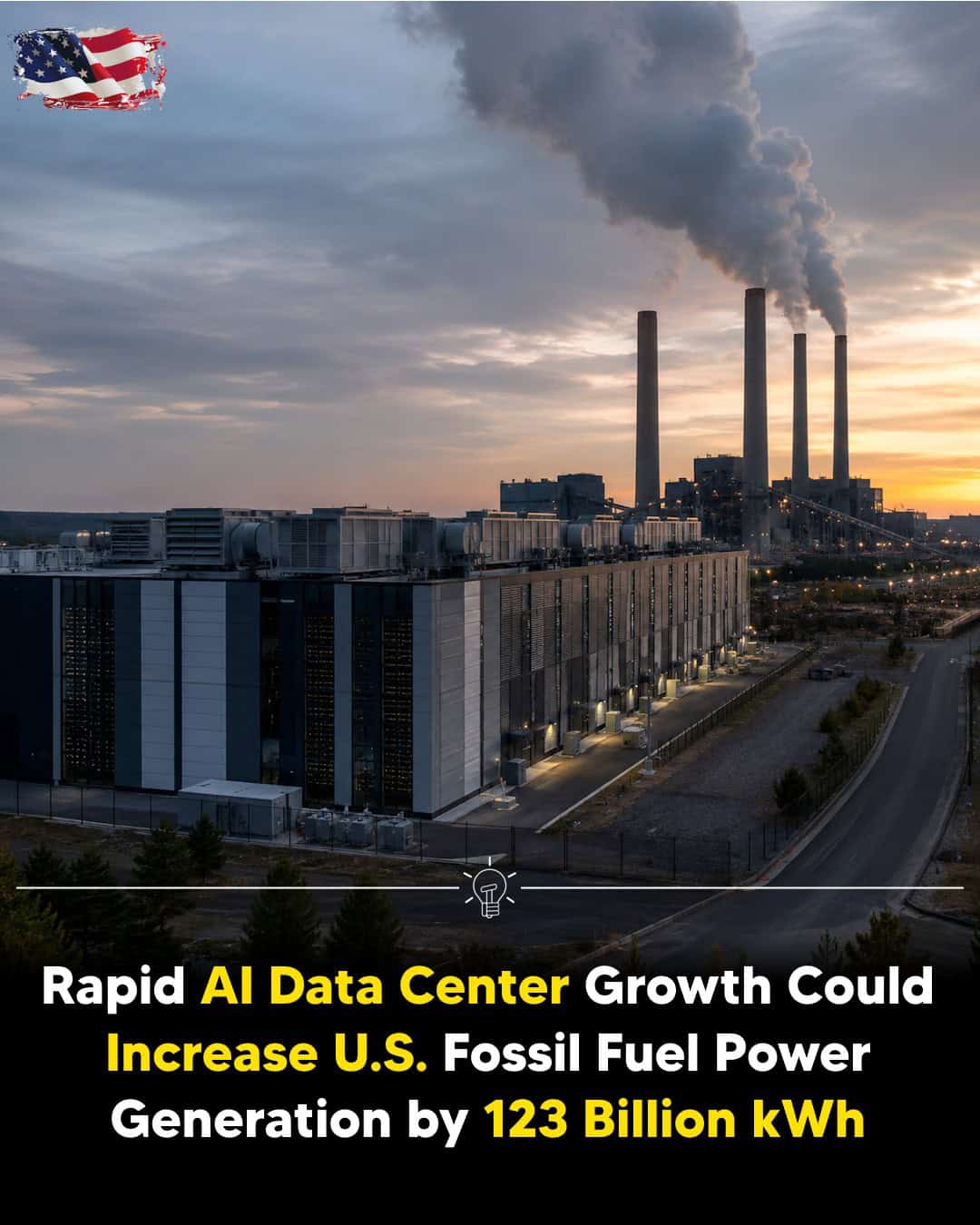
The study found that natural gas would supply most of the additional electricity because new power plants take years to build. Under the high-demand scenario, U.S. natural gas generation would increase 7.3%, or 123 billion kilowatt-hours (kWh), between 2025 and 2027. That compares with a 1.7%, or 29 billion kWh, increase in the baseline forecast.
Coal generation would still decline, but at a slower pace. Existing coal plants in PJM, MISO, and SERC would continue operating to help meet higher electricity demand because they still have unused generating capacity. Wind and solar generation would remain largely unchanged in the short term because their output depends on weather and no additional renewable capacity is assumed.
The biggest increase in fossil fuel generation is expected in ERCOT, where AI data center construction is expanding rapidly. The EIA also projects that ERCOT’s average wholesale electricity prices could rise by $37 per megawatt-hour, or 79%, in 2027 under the high-demand scenario. The increase reflects the region’s limited ability to import electricity from neighboring grids.
Other U.S. regions would experience much smaller price increases. Wholesale electricity prices could rise by about $2.60/MWh in PJM, $3.00/MWh in New England and New York, and $1.30/MWh in California and the Southwest. Natural gas generation would help meet much of the additional demand until new power plants, transmission lines, and storage projects come online.
The findings highlight the growing energy challenge created by AI infrastructure. While renewable energy continues to expand, the EIA says natural gas—and to a lesser extent coal—will play a critical role in maintaining grid reliability if AI data centers and industrial electrification grow faster than expected. Over the longer term, new generation and transmission capacity will be needed to meet demand while reducing emissions.
Sources:
- U.S. Energy Information Administration (EIA) – 2026
- Short-Term Energy Outlook (STEO) – 2026
- New York Independent System Operator (ISO)
- New England ISO, Florida, Southwest, Northwest
- California ISO, and Southwest Power Pool ISO regions.
-
 Amazon Puts 1st 27 Mercedes Electric Trucks On German Roads
-
 Chinese Scientists Build Robot Controlled by Human Brain Cells
-
 Digit 5 New Robot Offers 20-Hour Work After 9-Minute Charge
-
 Digit Robot’s Charging-Port Design Raises Design Questions
-
 China Builds First Factory Where Robots Build More Robots
-
 Robots Could Replace Humans in Every Physical Task by 2030 – CEO Says