University of Texas Engineers Build a Jacket that Produces Drinking Water Straight from the Air Using Only Sunlight
Engineers at the University of Texas at Austin have developed a wearable jacket that can collect drinking water directly from the air. The design is inspired by the “stillsuit” from Dune. It uses a special moisture-harvesting textile and does not require electricity while collecting water.
The jacket contains biomass-based hydrogel fibers that absorb humidity from the surrounding air. The collected moisture flows into detachable harvesting units built into the garment. These units are then placed in a foldable collector, where sunlight provides the heat needed to release and condense the water into safe drinking water.
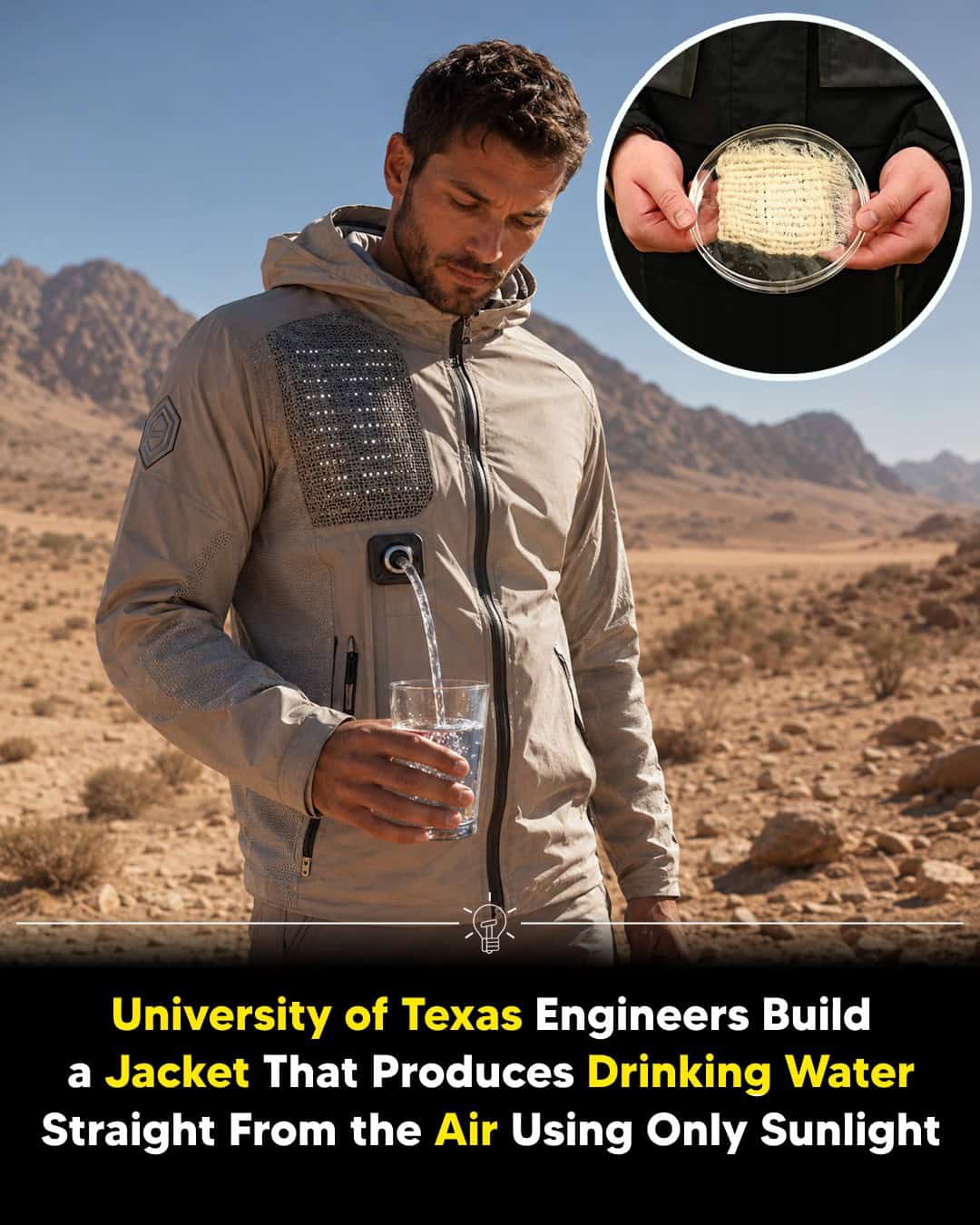
Outdoor tests showed the wearable system can produce 400 to 900 milliliters of drinking water per day, depending on humidity levels. Researchers say the new fabric performs three to ten times better than previous atmospheric water-harvesting textiles at a similar scale.
The technology is designed for hikers, campers, farmers, emergency responders, soldiers, and people living in water-scarce regions. Unlike the fictional Dune stillsuit, it does not recycle sweat or body fluids. Instead, it extracts fresh water directly from moisture in the surrounding air.
The same research team has also built a larger portable atmospheric water-harvesting system using the same gel-fabric technology. In field tests conducted in both humid Austin and the dry Chihuahuan Desert, the solar-powered device produced about 1.3 liters of drinking water per day, setting a new performance benchmark for portable systems.
Researchers believe the material can be integrated into backpacks, tents, emergency shelters, and other outdoor equipment. The University of Texas has already filed a patent application as it explores commercial applications for the technology.
Although the jacket is still a research prototype, scientists say it could become an important tool for improving access to clean water. As climate change and water shortages increase worldwide, wearable atmospheric water-harvesting technology may offer a practical solution for remote areas and emergency situations.
Sources:
- University of Texas
- Nature Water
- SciTechDaily
- Stanford Doerr School of Sustainability
Related Posts:
- Michigan State University Develops Clear Solar Glass That Generates Electricity
- Researchers Develop Magical Perovskite Solar Cell with a Record 11% Efficiency
- Colorful and Transparent Solar Panel to Replace Your Windows
- Nobel-Winning Chemist Turns Thin Air into Clean Drinking Water
-
 New U.S. Marines AI Weapon can also Track and Target People
-
 11 States Tighten Air Conditioner Rules Amid Heat Waves
-
 Samsung Develops 50-MW Offshore Floating Data Center for AI
-
 China Tests World’s Most Powerful 1MW Flying Wind Turbine
-
 UAE Uses Seawater & Solar Energy to Grow Crops in the Desert
-
 Virginia’s Power Use Surges 30M MWh as AI Data Centers Grow