US-Made Digit 5 New Humanoid Robot Can Work for 20 Hours after Just 9 Minutes Charging
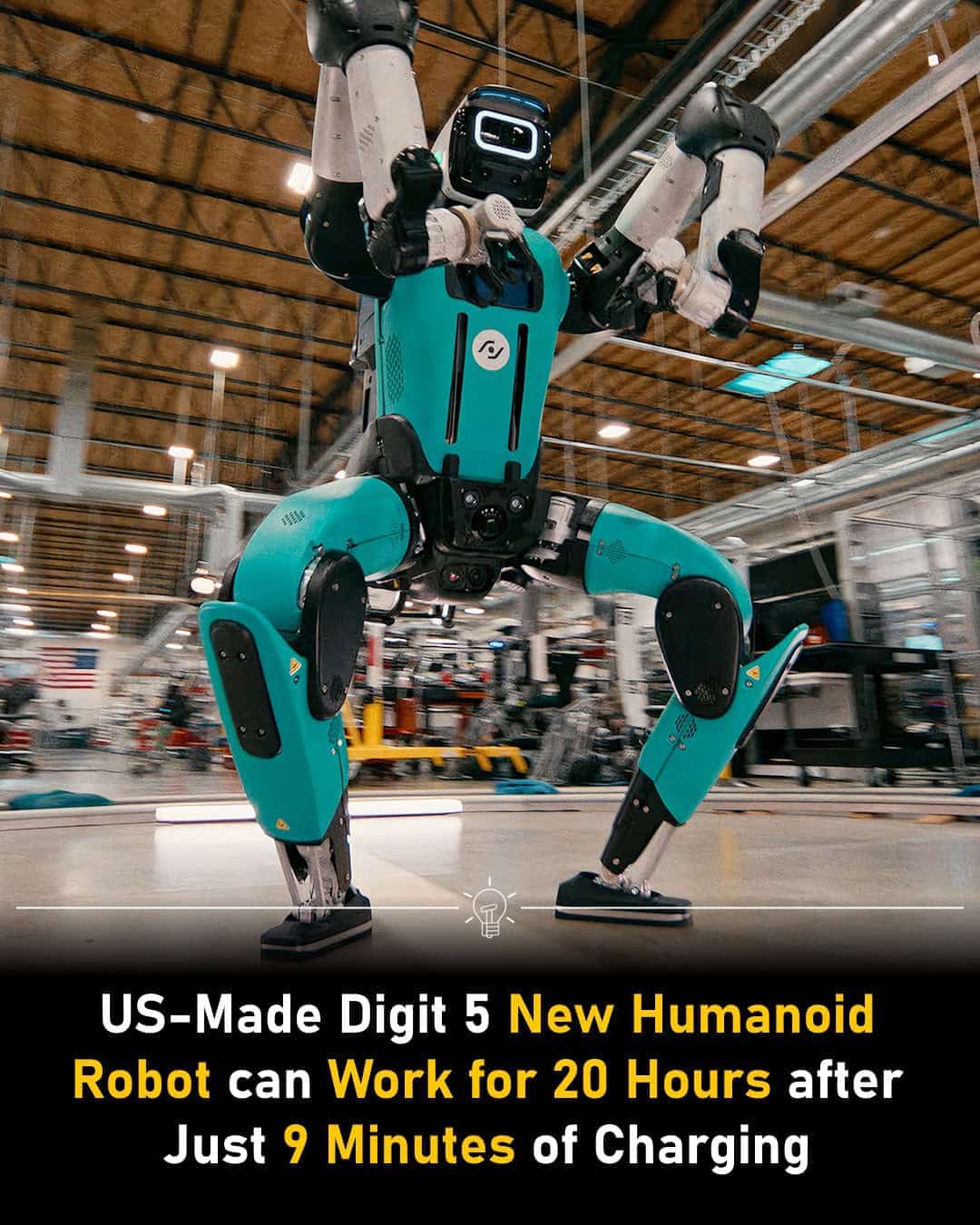
Agility Robotics has unveiled Digit 5, the fifth generation of its humanoid robot designed for warehouse, logistics and industrial work. According to the Agility press release, the new model focuses on longer operating time, heavier lifting, faster charging and safer operation around people. Digit 5 builds on more than 65,000 hours of real-world operational experience collected from earlier Digit deployments.
One of the biggest changes is the robot’s battery system. Agility says Digit 5 can operate for about 90 minutes before charging, while a full recharge takes approximately 9 minutes. This gives the robot a 10:1 run-to-charge ratio, compared with the previous generation, and the company says the system can support more than 20 hours of productive work within a 24-hour day.
The charging system is intended to reduce the amount of time Digit spends away from the production floor. Instead of waiting for long charging cycles, the robot can return to a charging station during natural pauses in warehouse operations. Agility says this approach could allow Digit to support workflows across multiple shifts, although actual operating time will depend on the workload and operating conditions.
Digit 5 has also been redesigned for heavier industrial tasks. Agility reports a maximum payload of 50 pounds (22.7 kilograms), representing a 40% increase over the previous generation. The new leg design uses the company’s proprietary cycloidal actuators and is intended to handle repetitive lifting while maintaining a human-scale form factor.
The robot stands about 5 feet 11 inches (1.81 meters) tall, weighs around 284 pounds (129 kilograms) and can reach up to 7.2 feet (2.2 meters). Its human-sized design is intended to let it move through existing aisles, doorways and workstations without requiring major changes to facilities built around human workers.
In addition, Digit 5 can use different grippers or tools for different workflows, including tote handling and machine tending. Agility says the modular approach is designed to make the robot easier to retask as the requirements of a warehouse or manufacturing facility change.
Agility says the robot is being designed for cooperative safety, allowing it to operate near people without the physical barriers traditionally used around industrial robots. Its safety architecture includes human-detection capabilities and an independent safety controller. However, Agility also states that Digit 5 remains in development, and its specifications and some safety features are subject to change. Early access is expected in the first half of 2027, with general availability planned for the end of 2027.
Following are the features and specifications of the Agility 5th Generation Digit 5 robot.
| Feature | Digit 5 |
| Generation | 5th-generation humanoid |
| Payload | Up to 50 lb (22.7 kg) |
| Runtime | About 90 minutes |
| Charging | About 9 minutes |
| Run-to-charge ratio | 10:1 |
| Daily work target | More than 20 hours/24 hours |
| Height | 5.9 ft (1.81 m) |
| Maximum reach | 7.2 ft (2.2 m) |
| Weight | 284 lb (129 kg) |
| End effectors | Swappable |
| Target early access | H1 2027 |
| General availability target | End of 2027 |
Related Robotic Updates:
- Digit Robot’s Charging-Port Design Raises Design Questions
- Robots Could Replace Humans in Every Physical Task by 2030 – CEO Says
- China Builds First Factory Where Robots Build More Robots
- Eric Trump-Backed Startup Builds AI Humanoid War Robots
- U.S. Blocks New Chinese Humanoid Robots Over Security Risks
- AI Robots Build China’s Great Wall Model Using 80,000 Blocks
- Robotic Snakes that Crawl Power Lines to Detect Faults
- Japan has Introduced a Giant Humanoid Robot for Railway Tasks
-
 Digit Robot’s Charging-Port Design Raises Design Questions
-
 China Builds First Factory Where Robots Build More Robots
-
 Robots Could Replace Humans in Every Physical Task by 2030 – CEO Says
-
 New U.S. Marines AI Weapon can also Track and Target People
-
 Samsung Develops 50-MW Offshore Floating Data Center for AI
-
 AI Firefighting Drones Target Wildfires Before they Spread