Agility’s Digit Robot Automatically Charge and Unplug Itself Before Work, But Its Charging-Port Design Needs a Rethink!
Agility Robotics’ Digit humanoid robot has demonstrated a startup routine that allows it to prepare for work without direct human assistance. In the viral video, the robot is stored inside a custom-fitted transport case while connected to a charging cable.
It disconnects the cable using its own robotic hand, sits up, stands independently, and activates its illuminated face to signal that it is ready. The sequence highlights how humanoid robots are being developed to manage more than their assigned warehouse tasks.
They may also handle routine activities such as preparing to start a shift. Agility Robotics has separately developed autonomous charging capabilities, helping reduce the need for workers to intervene whenever a robot needs to recharge.
The robot is designed for logistics, warehousing, and material-handling operations. Its human-like shape allows it to work in facilities built for people, including spaces with existing aisles, shelves, and workstations.
Digit can support repetitive activities that involve moving materials and handling containers. Agility says its robots have accumulated more than 65,000 hours of real-world operational experience, reflecting commercial deployments rather than laboratory demonstrations alone.
The company has worked with industrial customers, including GXO and Toyota Motor Manufacturing Canada. These deployments show that humanoid robots are moving beyond research projects and into practical industrial environments. However, their effectiveness still depends on the task, facility layout, safety requirements, operating costs, and reliability.
Awkward Charging Port Location
The charging-port location has also attracted attention for a less technical reason: the physical arrangement of the charging connection. The robot must reach the cable and remove it before rising from its storage position.
The main talking point is the awkward charging-port arrangement demonstrated in a viral post by RT’s on X (former twitter). The cable connects near the lower part of the robot’s torso, leaving its arms and hands to work around its body and the surrounding compartment during disconnection.
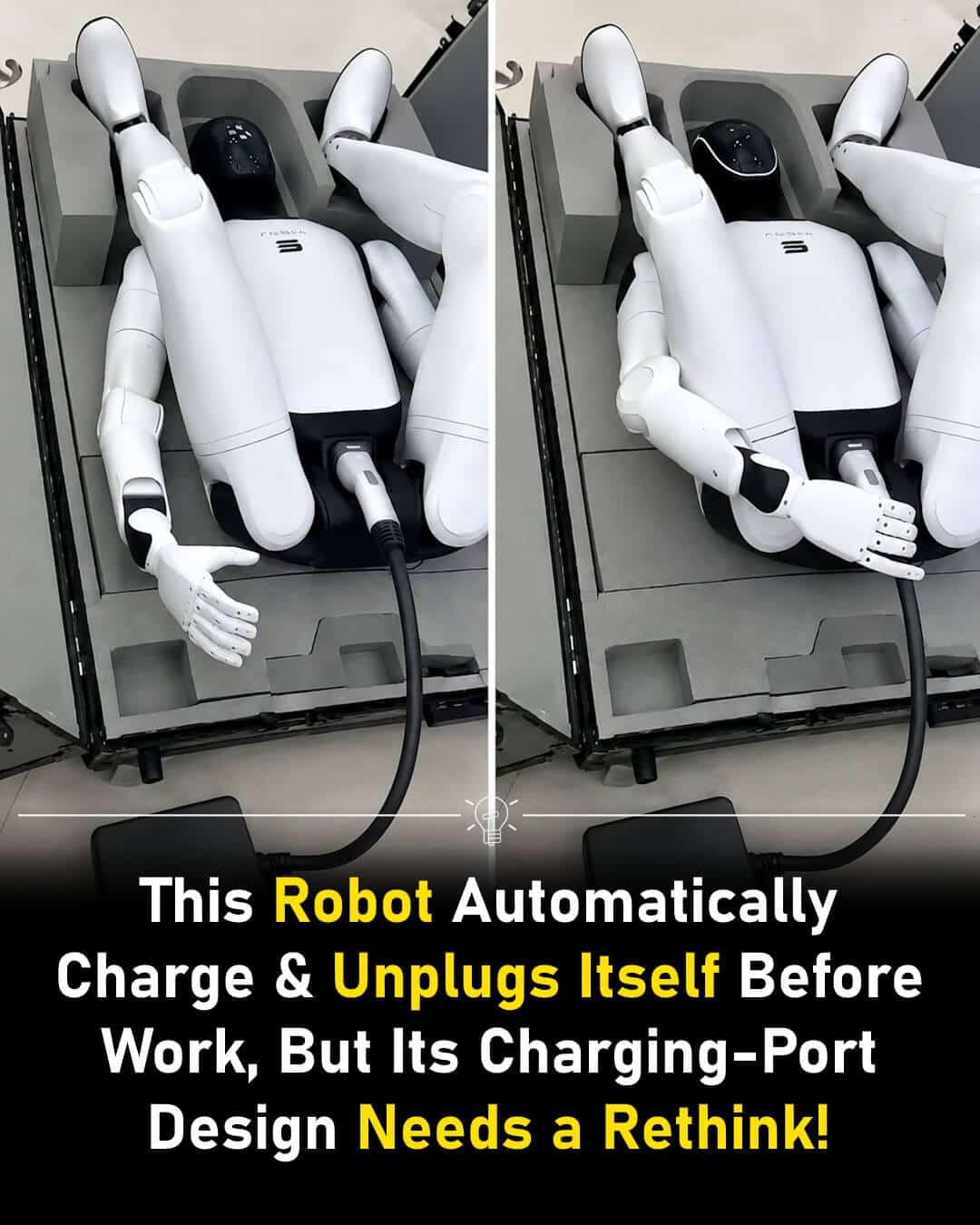
This is an interesting engineering challenge because humanoid robots have to manage not only walking and object handling but also their own supporting equipment.
Nevertheless, it raises a reasonable design question: could the charging connection be positioned to make access easier, reduce unnecessary arm movements, and simplify cable removal?
That movement has prompted humorous comments about whether the charging-port arrangement could be made more convenient. The released footage makes the sequence look awkward, but it does not establish that the design is defective or that the process regularly causes problems.
From an engineering perspective, the important questions are whether the connector is easy to access, whether the robot can disconnect it reliably, and whether the arrangement protects the cable and charging hardware from damage.
Next-Gen Agility’s Digit 5 Robot
Despite the older versions (shown in the above fig), Agility unveiled Digit 5, its next-generation humanoid robot on September 15, 2026, . The company lists a payload capacity of up to 50 pounds (22.7 kg), a height of approximately 1.81 meters, and a new battery system that runs for about 90 minutes before a nine-minute recharge.
According to Agility’s official statement, this enables a 10:1 run-to-charge ratio and more than 20 hours of productive work in a 24-hour period. The company also reported more than $300 million in multiyear orders.
Related Robotic Updates:
- Robots Could Replace Humans in Every Physical Task by 2030 – CEO Says
- China Builds First Factory Where Robots Build More Robots
- Eric Trump-Backed Startup Builds AI Humanoid War Robots
- U.S. Blocks New Chinese Humanoid Robots Over Security Risks
- AI Robots Build China’s Great Wall Model Using 80,000 Blocks
- Robotic Snakes that Crawl Power Lines to Detect Faults
- Japan has Introduced a Giant Humanoid Robot for Railway Tasks