BYD New Electric Truck in Europe to Challenge Tesla Semi with 1,006 HP and Massive 651 kWh Blade Battery
BYD’s new ETT44 electric heavy-duty truck, designed for the European market, is positioned as a direct rival to the Tesla Semi. The 4×2 truck made its public debut at IAA Transportation 2026 in Hannover, Germany, where BYD presented it as the flagship of its new European commercial-vehicle range.
The ETT 44 is built around a 651-kWh BYD Blade Battery using LFP chemistry. BYD claims up to 600 km (373 miles) of range for the long-range version, while another 434-kWh configuration is reported with a claimed range of about 400 km. The 600-km figure is a manufacturer claim, so actual range will vary with payload, speed, weather, terrain and operating conditions.
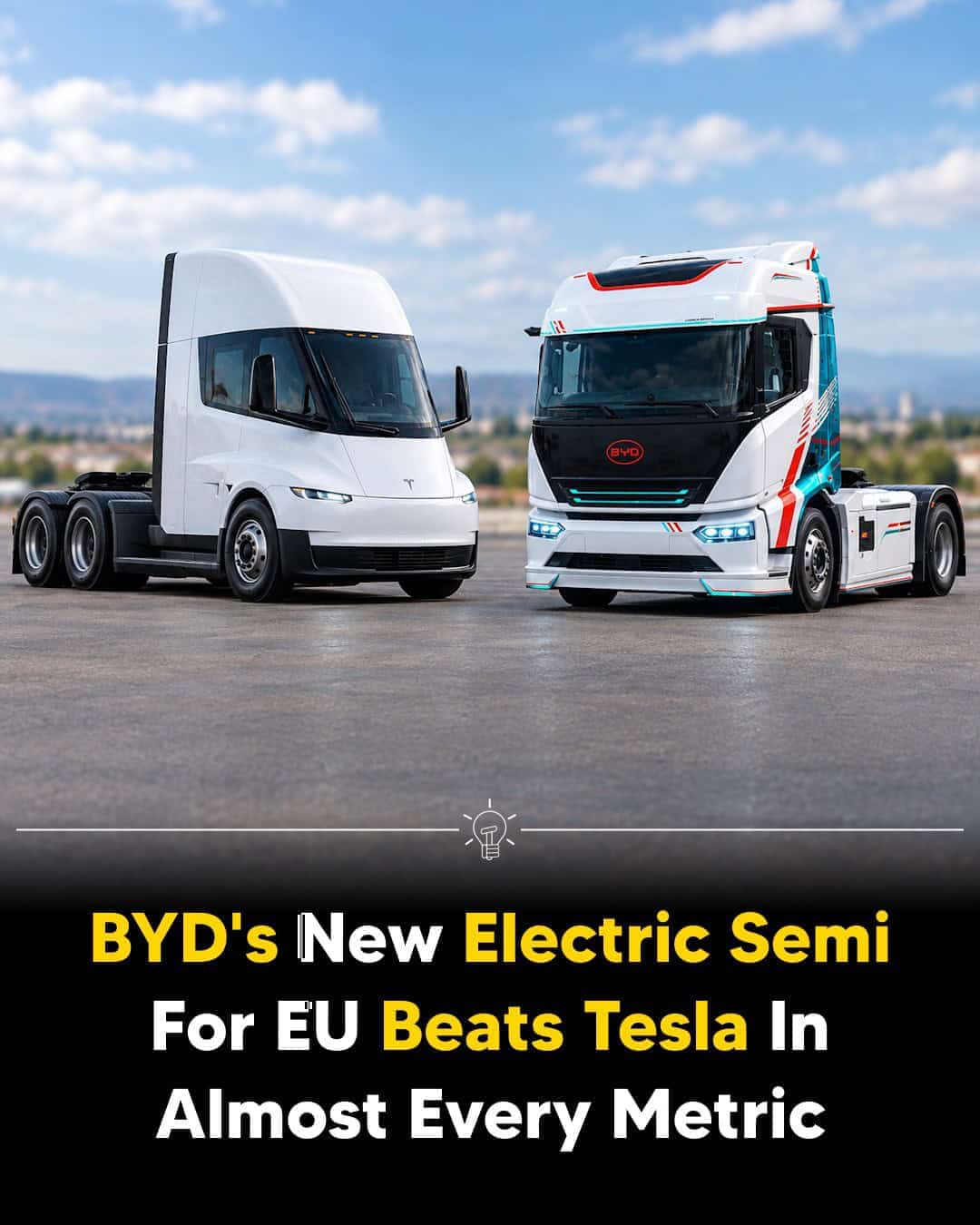
Power is another major feature of the new truck. BYD officially describes the ETT 44 as delivering more than 1,000 hp, with detailed reports putting peak output at around 750 kW (about 1,020 PS or 1,006 hp). This makes it a high-output electric tractor designed for demanding heavy-duty applications.
The truck is designed for combinations weighing up to 44 tonnes, which is above the 40-tonne gross combination weight listed for Tesla’s European Semi. That difference matters for freight operators because the usable payload depends not only on the legal combination limit but also on the tractor’s own weight and the trailer configuration.
Charging is arguably the ETT 44’s most notable specification. BYD says its FLASH Charging system can deliver up to 1.5 MW, allowing the 651-kWh battery to charge from 20% to 80% in about 20 minutes. BYD says that charging session can add up to 400 km (249 miles) of claimed range.
The truck also supports conventional CCS2 charging at up to 420 kW, according to detailed specifications reported after its European debut. The 1.5-MW figure therefore depends on access to compatible megawatt charging infrastructure rather than being the truck’s only charging method.
The timing is significant because Tesla has just published the European specifications for its Semi. Tesla lists up to 550 km of range at a 40-tonne gross combination weight, energy consumption of about 1.0 kWh/km, and up to 800 kW charging. Tesla says its Megacharger can recover about 60% of the Semi’s range in 30 minutes.
On the published figures, the ETT 44 has 50 km more claimed range and a 4-tonne higher gross combination limit than the European Tesla Semi. BYD also advertises substantially higher peak charging power, at up to 1.5 MW versus Tesla’s 800 kW, although the two companies describe charging performance differently, so these figures should not be treated as a direct one-to-one test of charging speed.
| Specification | BYD ETT 44 | Tesla Semi – Europe |
| Vehicle type | Battery-electric 4×2 tractor | Battery-electric tractor |
| Battery | 651 kWh Blade Battery | ~ 548 kWh |
| Claimed range | Up to 600 km / 373 mi | Up to 550 km / 342 mi |
| Gross combination weight | Up to 44 tonnes | 40 tonnes |
| Peak power | ~750 kW / 1,006 hp | Up to 800 kW (1,073 hp) drive power |
| Maximum charging power | Up to 1.5 MW | Up to 800 kW |
| Fast charging claim | 20–80% in ~20 min | ~60% range in 30 min |
| Range added during fast charge | Up to 400 km | ~60% of range |
| Standard DC charging | Up to 420 kW CCS2 | MCS up to 800 kW |
| Kerb weight | About 10.95–11.14 tonnes | 9.1 tonnes |
| Battery chemistry | LFP | Not disclosed |
| European deliveries | Market launch announced; timing varies by market | From 2027 |
*Figures are manufacturer-published or reported specifications and are not a controlled head-to-head test. BYD’s 600-km range and Tesla’s 550-km range are both estimates under specified operating conditions.
The comparison also has an important limitation: Tesla has not disclosed the European Semi’s battery capacity, while BYD has publicly disclosed a 651-kWh pack for the long-range ETT 44. Tesla lists the European truck at 9,100 kg curb weight and 40 tonnes gross combination weight, while BYD’s ETT 44 is reported at roughly 10.95–11.14 tonnes depending on configuration. Therefore, battery size alone does not determine payload or operating efficiency.
BYD is also offering more than the truck itself. Its European commercial-vehicle strategy combines Blade batteries, megawatt charging, energy storage, energy management and financing into an integrated fleet solution. The company says its European commercial-vehicle portfolio now spans from 3.5-tonne vehicles to 44-tonne heavy-duty trucks.
The ETT 44 therefore adds another major competitor to Europe’s rapidly developing electric heavy-truck market. Its headline specifications are impressive on paper, but real-world freight performance will ultimately depend on payload, range under load, charging availability, electricity costs, battery durability, service coverage and how quickly 1.5-MW charging infrastructure becomes available across European freight routes.
Related EE News:
-
 Windrose Electric Trucks Enter Australia’s Long-Haul Freight
-
 UK Battery Injects Hundreds of MW Power into Grid in 1 Sec
-
 UK Finally Makes Plug-In Solar Panels Legal at Home
-
 China Tests Underwater Solar Power Plant at 33 Ft Below Sea
-
 German Startup Turns Shop Awnings into Mini Solar Power Plants
-
 China Tests World’s Most Powerful 1MW Flying Wind Turbine