California Becomes America’s Solar Powerhouse with 46+ GW Installed Capacity & a Massive 73.8 GW Pipeline of New Projects
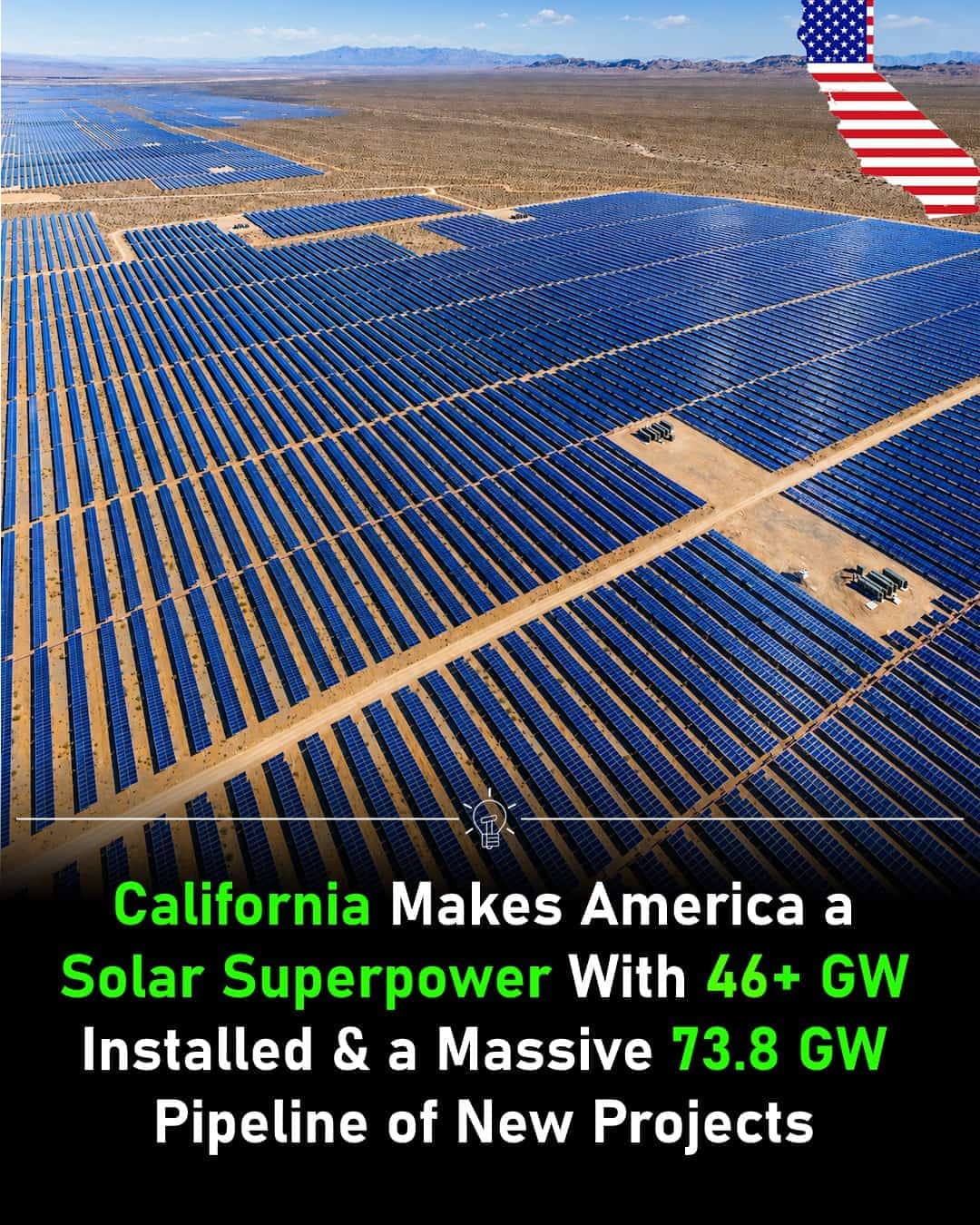
California has continued to expand its solar fleet at a rapid pace, with the state’s combined utility-scale and small-scale solar photovoltaic capacity reaching about 46.1 GW in the latest U.S. Energy Information Administration data for July 2026. The figure includes 24.15 GW of utility-scale solar PV and 21.08 GW of small-scale solar PV, plus about 0.92 GW of solar thermal capacity.
California remains one of the country’s largest solar markets, with utility-scale projects spread across the Central Valley and desert regions and millions of smaller systems installed on homes and businesses. The EIA’s July 2026 capacity data therefore puts California’s total solar PV capacity above the 46 GW level.
Solar generation is also becoming increasingly important to California’s daily electricity supply. CAISO’s 2026 monthly renewable reports track the state’s growing solar output and show how solar production has reached very high levels during daytime hours. During the first half of 2026, solar generation increasingly competed with natural gas generation in the CAISO market, particularly during daylight hours.
However, comparing generation by technology requires care because CAISO reports cover the ISO-controlled market rather than every electricity generator in the entire state. California’s solar expansion has also created periods of surplus daytime production, increasing the importance of flexible resources that can move electricity into the evening.
Battery storage has become the other major part of this transformation. The California Energy Commission’s storage survey says California’s battery storage resources surpassed 21,000 MW by mid-2026, with its dashboard updated on August 15. The statewide figure includes residential, commercial and utility-scale systems, as well as some utility-scale batteries outside California that serve customers on the CAISO grid.
The CEC says the state’s battery capacity has grown from less than 700 MW at the beginning of 2019 to more than 21 GW in 2026. These batteries can absorb electricity when solar production is high and discharge it later when solar output falls, making storage an increasingly important part of California’s electricity system.
Cleanview’s September 2026 project database lists 982 operating utility-scale solar farms with a combined 25.5 GW of capacity in California. Its largest listed facilities include Topaz Solar Farm at 586 MW, Bellefield Solar and Energy Storage Farm at 500 MW, Solar Star 1 at 318 MW, Desert Sunlight at 314 MW and several other projects around the 300-MW scale.
These utility-scale facilities operate alongside California’s much larger distributed solar fleet, which the EIA estimates at more than 21 GW. Together, the two segments explain why the state’s total solar capacity is substantially higher than its utility-scale figure alone.
Cleanview’s latest CAISO solar-project tracker lists 228 solar farms totaling 73,421 MW (73.4 GW), in development as of September 2026. Despite the CAISO report for combined projects in pipeline, Cleanview’s California-only database lists 271 planned solar farms totaling 58,086 MW (58.1 GW).
One example of the next generation of California solar projects is the Discovery Solar PV and Storage Project in Kern County. Its environmental documentation describes a proposed 1,400 MW solar facility with up to 1,000 MW of battery power and 8,000 MWh of storage, covering approximately 7,700 acres.
The project would connect to the Southern California Edison Windhub Substation through new and existing gen-tie facilities. Discovery illustrates the changing design of California’s largest solar developments: new projects are increasingly being planned as combined solar-plus-storage facilities rather than standalone solar plants.
California’s Installed Solar Capacity
California currently has about 45.2 GW of total solar PV capacity, including utility-scale and estimated small-scale solar, according to the latest EIA data for July 2026. This includes 24.15 GW of utility-scale solar PV and about 21.08 GW of small-scale solar, such as rooftop systems.
California’s own energy data also shows the rapid growth of solar. In 2025, solar PV generated 53.64 TWh, while solar thermal added another 1.89 TWh, giving solar roughly 55.5 TWh of in-state generation.
California’s Pipeline (Plan + Undersaturation) Solar Capacity
As of September 2026, Cleanview tracks 271 planned solar farms in California with a combined capacity of 58.1 GW. The list includes projects at different development stages, so this figure should be described as a development pipeline, rather than 58 GW of guaranteed future capacity.
The pipeline includes some very large projects. For example, Sanborn Hybrid 3 is listed at 1.42 GW, while Wingtip Solar 1, Boson, Muon and Angeleno Solar Farm are each above 1 GW. Some projects are already approaching commercial operation, meaning the pipeline will continue changing as projects are completed, delayed or cancelled.
How Much Solar + Battery Storage Provide to California’s Power
Solar and batteries now play a major role in California’s electricity system. During the first half of 2026, California used more solar electricity than natural gas for the first time; the California Energy Commission says solar use increased 22% from the first half of 2024 to the first half of 2026, while natural-gas use fell 51%.
Battery storage has grown alongside solar, reaching 21,112 MW of capacity by August 2026. Batteries do not generate electricity themselves; they store excess electricity (often solar during the daytime) and discharge it later when demand rises, particularly during the evening after solar production falls.
The following table shows the California’s current installed and future (planned) solar and battery storage capacity.
| California’s Installed and Future Planned Solar + Battery Storage | |
| Category | Current Ratings |
| Location | California, USA |
| Total Solar PV Capacity | ~46.1 GW |
| Utility-Scale Solar PV | 24.15 GW |
| Small-Scale Solar PV | 21.08 GW |
| Solar Thermal Capacity | ~0.92 GW |
| Utility-Scale Solar Farms | 982 projects |
| Operating Utility-Scale Capacity | ~25.5 GW |
| Battery Storage Capacity | 21,000+ MW |
| Battery Milestone | Surpassed 21 GW in mid-2026 |
| Battery Capacity in 2019 | <700 MW |
| CAISO Solar Pipeline | 228 projects / 73.4 GW |
| California-Only Planned Pipeline | 271 projects / 58.1 GW |
| Largest Listed Solar Farm | Topaz Solar Farm — 586 MW |
| Other Major Project | Bellefield Solar & Energy Storage — 500 MW |
| Solar Star 1 | 318 MW |
| Desert Sunlight | 314 MW |
| Distributed Solar Fleet | 21+ GW |
| Example Future Project | Discovery Solar PV & Storage |
| Discovery Solar Capacity | 1,400 MW |
| Discovery Battery Power | Up to 1,000 MW |
| Discovery Battery Storage | Up to 8,000 MWh |
| Discovery Project Area | Approximately 7,700 acres |
| Discovery Grid Connection | SCE Windhub Substation |
| Main Trend | Increasing development of solar + battery storage |
More Solar Farm and Green Energy Projects in US:
- Amazon Takes Over 1.2 GW Oregon Solar Farm After Bankruptcy
- California Solar Power Beats Natural Gas for First Time
- Texas Solar Set to Surpass Coal Power for the First Time
- US Wind & Solar Reach Record 760,000 GWh – 17% of Power Grid
-
 Amazon Takes Over 1.2 GW Oregon Solar Farm After Bankruptcy
-
 US Gets 1st Balcony Solar Panel that Plugs into Wall Outlets
-
 California Approves Solar Panels that Plug Into Wall Outlets
-
 GoSun Electric Tractor Uses Solar Roof Canopy to Recharge
-
 US Startup Builds Floating AI Data Center Powered by Waves
-
 US Floating AI Data Center to Generate 40 MW & 30M L Water