The Giant UK Battery Can Inject Hundreds of MW into the National Grid in Less Than One Second
The Minety Battery Energy Storage System in Wiltshire has become one of the UK’s landmark grid-scale battery projects. The facility stores up to 320 megawatt-hours (MWh) of electricity and can rapidly supply power when the grid needs it most. Spread across an area roughly the size of 35 football pitches, it plays a key role in supporting Britain’s growing renewable energy network.
One of Minety’s greatest strengths is its response speed. The battery can inject hundreds of megawatts of electricity into the grid in less than one second during sudden demand spikes or unexpected supply shortages. This ultra-fast response is much quicker than conventional gas-fired peaker plants.
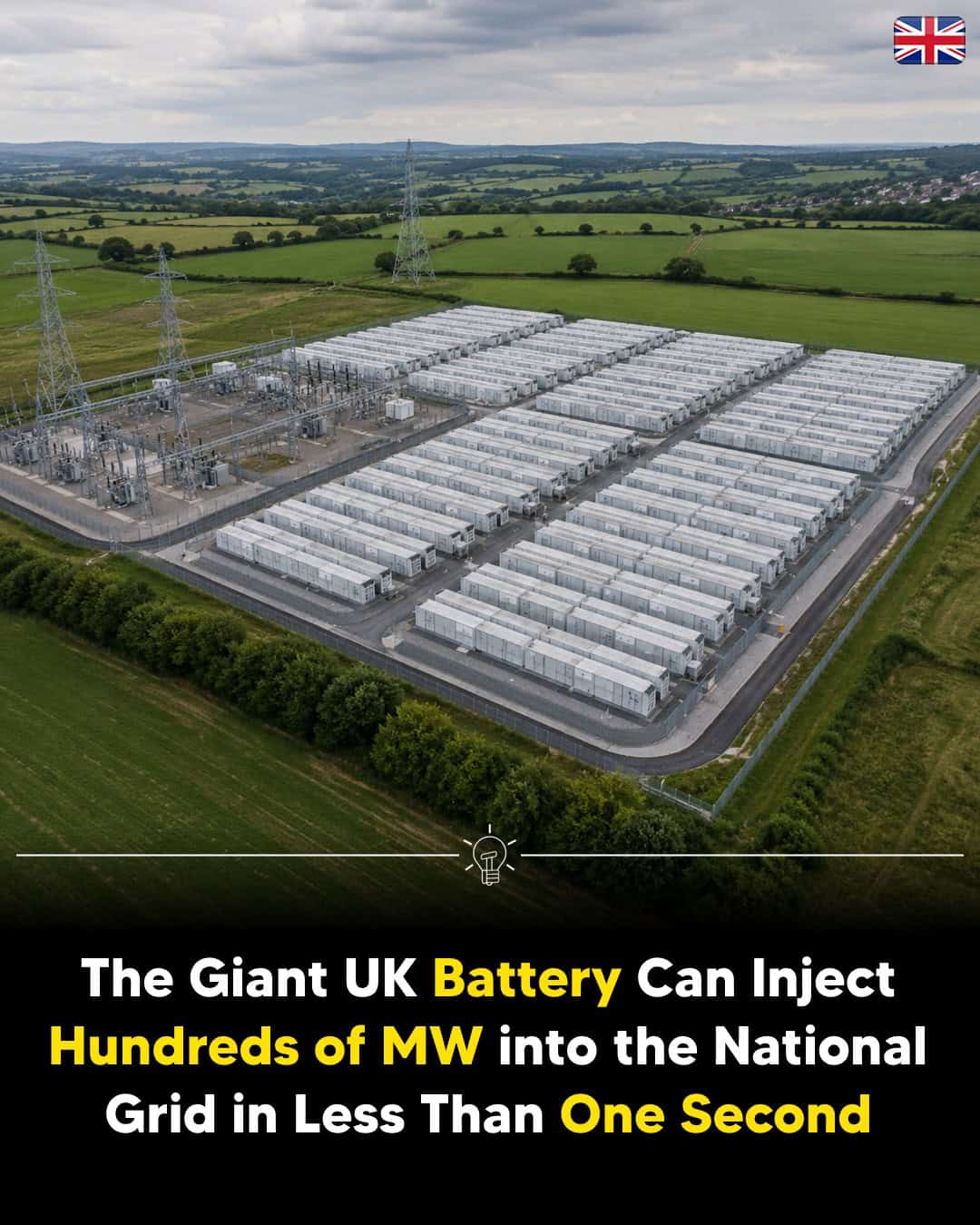
The system helps keep the UK’s electricity frequency close to the required 50 Hz, improving grid stability and reliability. It also absorbs excess electricity from wind and solar farms when generation is high and releases it when renewable output falls. This reduces renewable energy curtailment and lowers dependence on fossil fuel generation.
Battery storage is expanding rapidly across the UK as renewable energy continues to grow. The UK government and the National Energy System Operator (NESO) expect grid-scale storage to increase significantly over the coming years. Official figures show Britain’s grid-scale battery fleet reached about 7.3 GW by June 2026, with much more capacity planned this decade.
The UK is also accelerating grid connections for battery projects. Earlier reforms brought forward connection dates for around 10 GW of battery storage, allowing many projects to connect years earlier than originally planned. This is expected to strengthen grid flexibility and improve renewable energy integration.
Large battery systems are becoming a critical part of modern electricity infrastructure. They provide fast frequency response, reserve power, and energy balancing without producing direct carbon emissions during operation. As wind and solar generation increase, batteries are replacing many roles once handled by fossil fuel power plants.
The success of projects like Minety highlights the changing role of battery storage in the UK’s energy transition. Instead of serving only as backup systems, grid-scale batteries are becoming essential assets for maintaining reliable electricity supplies. Continued investment is expected to support a cleaner, more resilient, and renewable-powered electricity grid.
Source:
National Grid ESO – United Kingdom
Related Posts:
- Finland’s Giant Sand Battery Stores 100 MWh of Renewable Energy
- Edison’s Once-Failed and Forgotten Battery Makes a Comeback
- US Firms Plan Nuclear Battery Nickel-63 with 50-Year Lifespan to Counter China
- Qurmit – 95% Recyclable Fireproof Battery with 20 Years of Lifespan
- A Nuclear Nano-Diamond Battery, that Lasts For 28,000 Years
-
 Samsung Develops 50-MW Offshore Floating Data Center for AI
-
 UK Finally Makes Plug-In Solar Panels Legal at Home
-
 China Tests Underwater Solar Power Plant at 33 Ft Below Sea
-
 German Startup Turns Shop Awnings into Mini Solar Power Plants
-
 China Tests World’s Most Powerful 1MW Flying Wind Turbine
-
 UAE Uses Seawater & Solar Energy to Grow Crops in the Desert