Chinese Scientists Control a Robot Powered by Lab-Grown Human Brain Cells
Chinese scientists have developed an experimental robot controlled by a tiny cluster of lab-grown human brain cells. The system, known as MetaBOC, combines living nerve tissue with an electronic chip to control a robot and perform simple tasks.
Researchers from Tianjin University and the Southern University of Science and Technology are involved in this brain-on-a-chip technology. The development highlights a growing research field that combines biological systems with machines. It does not involve a complete human brain or a conventional artificial intelligence system alone.
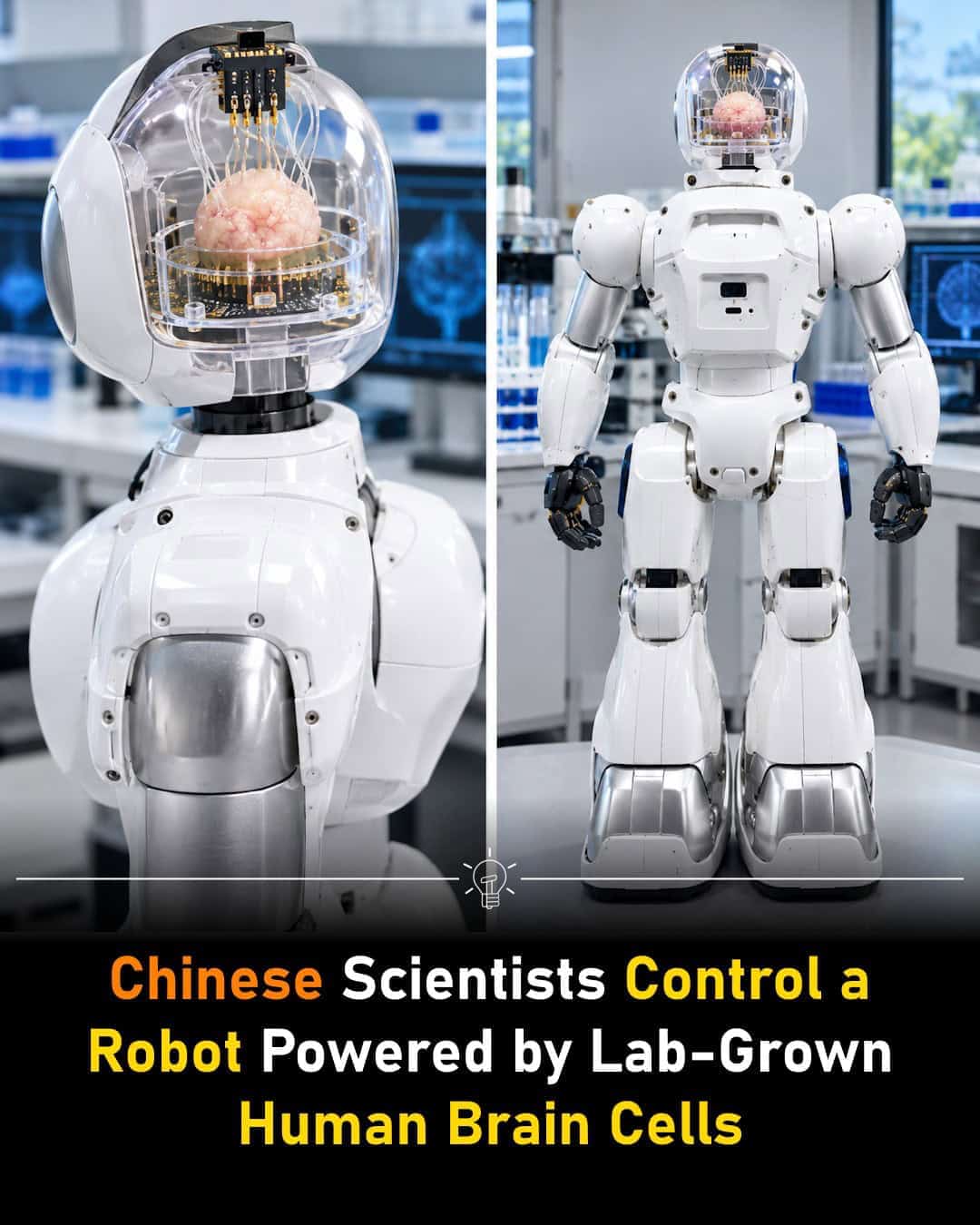
The technology uses a brain organoid, a small, three-dimensional cluster of neural cells grown from human stem cells. These cells can form connections and respond to electrical signals. Researchers place the organoid on a specialized neural interface chip, which records electrical activity and delivers controlled stimulation.
The chip acts as a bridge between the living tissue and the robot’s electronic control system. This allows the biological network to send and receive signals linked to the robot’s movements.
The MetaBOC system is designed to create a feedback loop between the organoid and the machine. Signals from the robot’s environment are converted into electrical inputs for the neural tissue. The organoid’s activity is then translated into commands that influence the robot’s actions. Through repeated stimulation and feedback, the neural network can adapt its responses to different situations.
This approach differs from conventional robots, which generally depend on programmed instructions or software-based machine learning models to process information and control movement.
The researchers reported that the system could support several basic robotic functions, including obstacle avoidance, target tracking and object grasping. These demonstrations suggest that cultured neural tissue can participate in controlling external devices when connected to suitable electronics.
However, the robot is not independently thinking or understanding its surroundings like a human. Its behavior depends on a carefully designed laboratory setup, electrical stimulation, signal processing and robotic hardware.
One of the important features of MetaBOC is its use of three-dimensional brain organoids rather than simpler two-dimensional cell cultures. The research team also investigated low-intensity focused ultrasound to support organoid development.
According to Tianjin University, the work was reported in the scientific journal Brain. Researchers presented the system as an open-source platform, potentially allowing other scientists to study and build on the technology. The project could help expand research into biological computing and hybrid intelligence.
The potential applications extend beyond robotics. Brain-on-a-chip systems could help scientists investigate how neural networks respond to stimulation, study neurological conditions and explore new methods of computing. Biological neural tissue may offer advantages for certain forms of adaptive learning and information processing.
Researchers are also interested in whether these systems could eventually perform selected computing tasks with lower energy demands than some conventional approaches. However, broad efficiency advantages have not been established for MetaBOC in practical, large-scale applications.
Despite the progress, the technology remains experimental and faces major challenges. Brain organoids are far smaller and less organized than a complete human brain. They lack the full architecture, sensory systems and complex connections needed for human-like cognition.
Keeping living tissue healthy also requires controlled laboratory conditions, including appropriate nutrients and environmental support. MetaBOC should therefore be understood as a biological computing research platform, not a conscious robot or a machine with human-level intelligence.
Related Robotic Updates:
- Digit 5 New Robot Offers 20-Hour Work After 9-Minute Charge
- Digit Robot’s Charging-Port Design Raises Design Questions
- Robots Could Replace Humans in Every Physical Task by 2030 – CEO Says
- China Builds First Factory Where Robots Build More Robots
- Eric Trump-Backed Startup Builds AI Humanoid War Robots
- U.S. Blocks New Chinese Humanoid Robots Over Security Risks
- AI Robots Build China’s Great Wall Model Using 80,000 Blocks
- Robotic Snakes that Crawl Power Lines to Detect Faults
- Japan has Introduced a Giant Humanoid Robot for Railway Tasks
-
 Digit 5 New Robot Offers 20-Hour Work After 9-Minute Charge
-
 Digit Robot’s Charging-Port Design Raises Design Questions
-
 China Builds First Factory Where Robots Build More Robots
-
 Robots Could Replace Humans in Every Physical Task by 2030 – CEO Says
-
 New U.S. Marines AI Weapon can also Track and Target People
-
 Samsung Develops 50-MW Offshore Floating Data Center for AI