Volkswagen’s Reveals New Mission-Efficiency EV with Nearly 800 (1,278 km) Miles of Range on One Charge
Volkswagen has unveiled its Mission Efficiency, a near-production electric concept designed to demonstrate how far EV efficiency can be pushed without relying on an enormous battery. According to the VW press release, it as the world’s most efficient near-production electric car. It combines production-related MEB+ technology with an extremely aerodynamic body and lightweight construction.
The biggest headline is its officially documented 1,278.36-kilometer (794-mile) journey from Wolfsburg, Germany, to Vienna, Austria. The route passed through Poznań in Poland and Olomouc in the Czech Republic. Volkswagen says the vehicle needed only one charging stop during the entire journey. It arrived in Vienna with a calculated 164 km of remaining range.
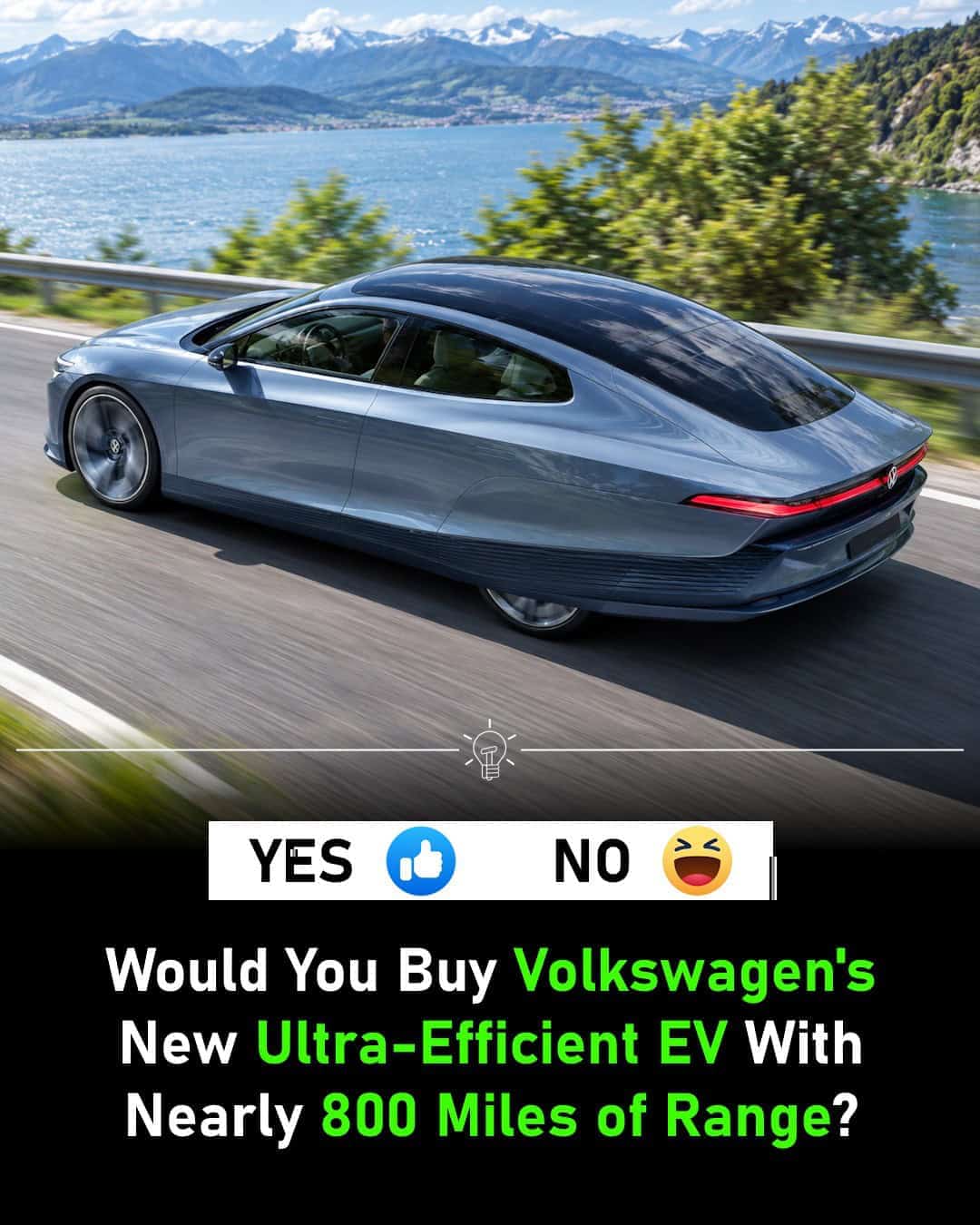
The Mission Efficiency uses a relatively small 54.9-kWh net lithium-ion NMC battery. During the record drive, it averaged 6.89 kWh/100 km when charging losses were excluded. Including charging losses, consumption was 7.51 kWh/100 km. The journey was completed at an average speed of 67.72 km/h, while the highest recorded speed was 138 km/h.
Volkswagen also conducted a separate idealized efficiency test. At a constant 68 km/h, with no uphill sections and auxiliary loads such as air conditioning switched off, the prototype consumed only 6.48 kWh/100 km. This figure is useful for demonstrating the vehicle’s efficiency potential, but it should not be confused with normal driving or an official WLTP range figure.
Aerodynamics are central to the design. The Mission Efficiency has a reported drag coefficient of just 0.158, which Volkswagen says is a record for a road-approved automobile. Its long, streamlined body, covered rear wheels, fully enclosed underbody, flush door handles and active cooling flaps are designed to reduce aerodynamic losses.
The car also uses specially designed wheel-area components to manage airflow around the wheels. Volkswagen says patented wheel deflectors, optimized wheel covers and low-rolling-resistance tires further reduce energy losses. The concept also incorporates lightweight materials, including carbon-fiber and aramid composite components, to reduce mass.
The powertrain is based heavily on Volkswagen’s existing production technology. The Mission Efficiency uses a 99-kW (135-PS) permanently excited synchronous motor driving the front wheels. It is based on the MEB+ platform and uses technology and components related to the new ID. Polo, showing that the project is not simply a theoretical prototype built around completely experimental hardware.
Volkswagen has also integrated a 370-watt photovoltaic system into the vehicle. The solar system is intended to provide additional electrical energy rather than replace the main battery. The concept is a 2+2-seater and provides up to 481 liters of luggage space, while its minimalist interior uses a “bring your own device” approach instead of a conventional large infotainment system.
Good to Know: The 1,278.36-km result is a Volkswagen-documented efficiency drive, not a standard WLTP range rating. Volkswagen also states that the vehicle is a concept and is not currently offered for sale.
Related EVs Updates:
- Toyota Confirms Hydrogen Hilux with 300kW Power for 2028
- Amazon Puts 1st 27 Mercedes Electric Trucks On German Roads
- BYD Launches Electric Truck to Rival Tesla Semi in Europe
- BYD’s New Electric Truck for EU Beats Tesla Semi in Almost Every Metric
- Windrose Electric Trucks Enter Australia’s Long-Haul Freight
-
 New Zealand Gets 85% of Electricity From Renewable Energy
-
 US Plans to Reuse Navy Nuclear Reactors for AI Data Centers
-
 US Space Force Plans Return of Nuclear Reactors to Space
-
 Toyota Confirms Hydrogen Hilux with 300kW Power for 2028
-
 Amazon Puts 1st 27 Mercedes Electric Trucks On German Roads
-
 BYD Orders 10 More Ships to Carry 130,000+ EVs Worldwide