Samsung Develops 50-MW Offshore Floating Data Center for AI
Samsung is Building a Floating 50MW Data Center to Cool AI with Seawater, Saving Land, Electricity and Freshwater
Samsung Heavy Industries is reportedly developing a 50-MW floating data center (FDC) designed to operate on water instead of occupying valuable land onshore. The concept is aimed at addressing growing demand for AI computing capacity while reducing some of the land, power and cooling constraints faced by conventional data centers.
The platform would use seawater-based cooling and could also have its own onboard power-generation system. According to a Samsung Heavy Industries press release, this approach could reduce dependence on shore-based electricity and freshwater cooling, although the exact power configuration may vary by project.
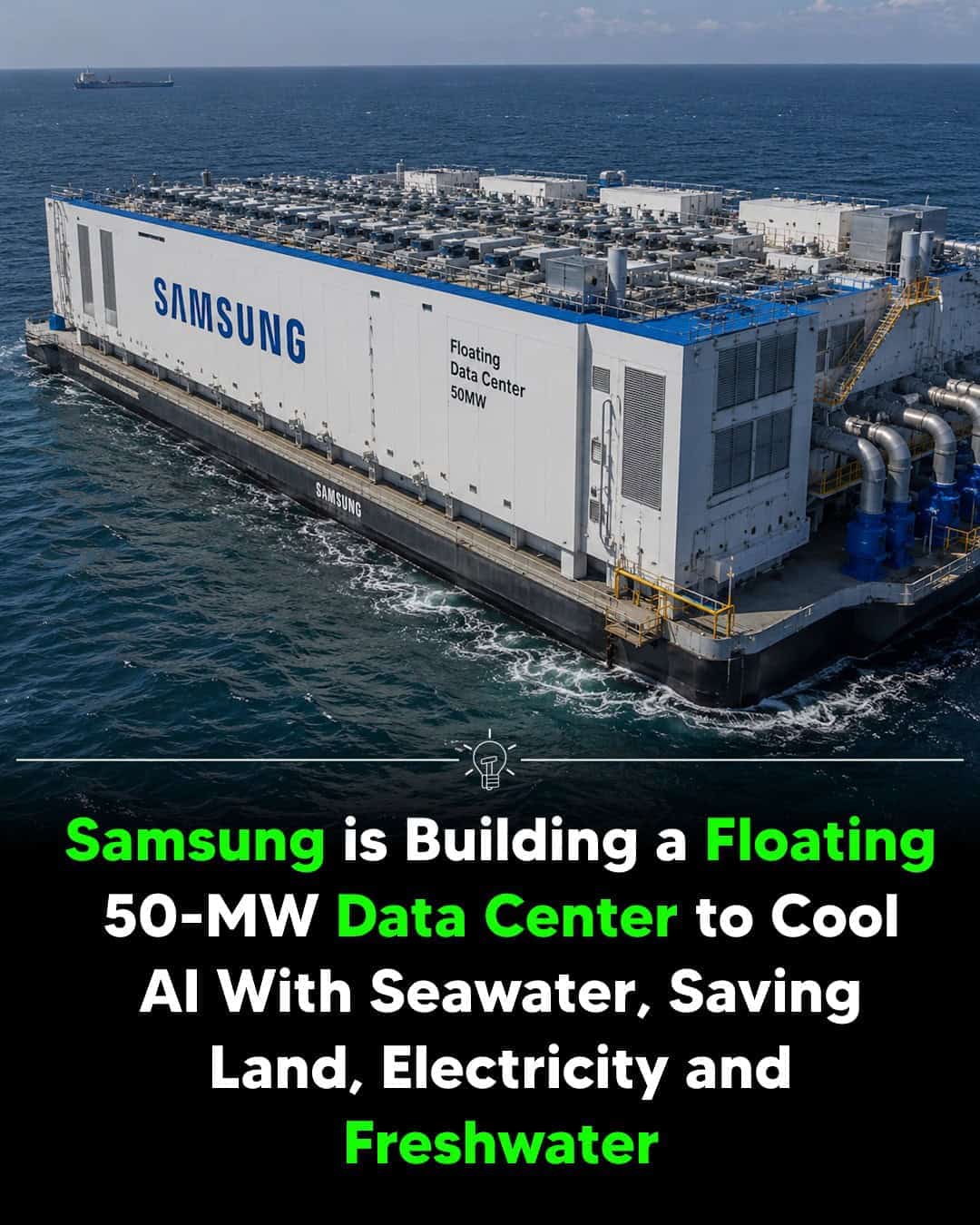
Samsung Heavy Industries has already received Approval in Principle (AiP) for its 50-MW FDC design from ABS and Lloyd’s Register. The company says its standardized shipbuilding approach could allow the data-center structure, equipment and systems to be integrated more efficiently than conventional land-based construction.
The project involves several international partners. Capital Clean Energy Carriers is working on project sourcing and investment, while Lloyd’s Register is involved in technical assurance, regulations and certification. Samsung has also partnered with Supermicro to test AI servers in river and offshore environments.
Putting powerful servers on water creates new engineering challenges. The equipment must withstand vibration, vessel movement, high-salinity air and changing humidity, which can affect server reliability and operating life.
Samsung is now pursuing multiple potential projects and is targeting commercialization by the second quarter of 2028. In the United States, Samsung has also signed an engineering contract for purpose-built floating facilities, with each planned unit providing 50 MW of critical IT capacity and projects being considered for Texas and other markets.
If the technology reaches commercial operation, floating data centers could become another option for deploying large AI computing facilities where land, electricity or water resources are constrained. Samsung’s project is still moving through engineering and commercialization stages, so its long-term cost, reliability and environmental performance will depend on how the first facilities perform in real-world conditions.
Related Posts:
- U.S. Develops Small Nuclear Reactors for AI Data Centers
- Virginia’s Power Use Surges 30M MWh as AI Data Centers Grow
- AI Data Centers Could Boost US Fossil Power by 123 Billion kWh
- AI Data Centers May Raise US Power Bills by $6.3 Billion
- U.S. Data Center Energy Use Could Reach 818 Billion kWh by 2050