US Floating AI Data Center to Generate 40 MW & 30M L Water
New U.S. Floating AI Data Center Will Generate 40 MW of Electricity and 30 Million Liters of Fresh Water Daily
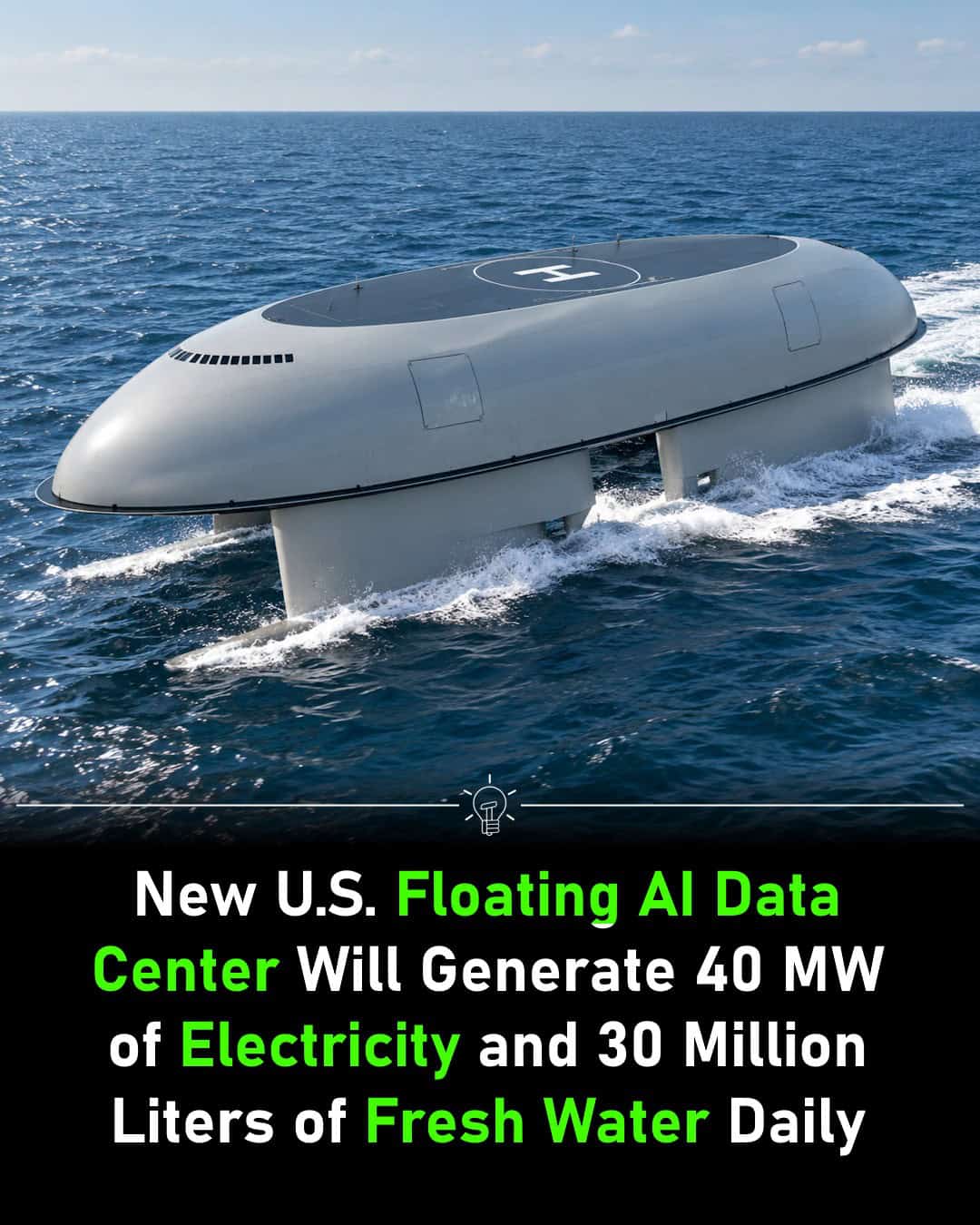
A U.S. company is proposing a floating AI data center that could generate electricity, produce freshwater and provide computing capacity from a single offshore vessel. Called the Blue Economy VITAL 100 MW Kraaken, the concept comes from Optimal Transit, a maritime technology partnership involving InMar Technologies and OptiFuel Systems.
The proposed vessel would combine a floating AI data center with an offshore power-generation system and desalination equipment. Unlike a conventional land-based data center, the platform is designed to operate offshore and could disconnect from its mooring when severe weather threatens.
Under the proposed configuration, the 100-MW platform would divide its available capacity between computing and utility services. Up to 60 MW would remain available for AI-grade computing, while as much as 40 MW of continuous electricity could be exported to shore. Optimal Transit estimates that 40 MW could supply electricity equivalent to roughly 32,000 homes.
The company says the platform would deliver power through a quick-disconnect connection to the shore. This would allow the vessel to provide electricity without requiring the construction of a conventional land-based power facility directly alongside the data center.
The Kraaken concept also includes a large desalination system. Optimal Transit says the vessel could produce approximately 30 million liters, or 7.9 million gallons, of freshwater every day. That output is estimated by the company to be enough for about 150,000 people.
The proposed system would use vacuum-flash desalination, with thermal energy and waste heat integrated into the process. Waste heat from onboard computing equipment could therefore be used rather than simply rejected into the surrounding environment. The freshwater would be another service delivered to shore through the vessel’s connection system.
Electricity generation is based on Optimal Transit’s patented Digital Ocean Thermal (DOT) technology. The concept draws on the same basic principle as Ocean Thermal Energy Conversion (OTEC), which uses the temperature difference between relatively warm surface seawater and much colder deep seawater to generate power.
Optimal Transit says its system also incorporates waste heat from the data center. The company claims the approach can provide continuous power without conventional fuel or a grid connection.
The Kraaken is based on a Small Waterplane Area Twin Hull (SWATH) design and is intended to operate either offshore or while moored near a coastal area. Optimal Transit says the vessel could disconnect and relocate when severe weather approaches, then reconnect after conditions improve.
The company has described speeds approaching 16 knots for the broader Kraaken platform. This could potentially make the system useful in locations affected by hurricanes, storms or other disasters, where land-based power and water infrastructure has been damaged. The proposed platform could then combine emergency electricity, freshwater production and computing capacity in one movable offshore facility.
Optimal Transit estimates the VITAL 100 MW Kraaken would cost about $587 million, excluding the AI computing hardware. The company compares this with an estimated $750 million to $1.33 billion for separate land-based facilities providing similar power, desalination and data-center capabilities. It also estimates that development could take roughly three years.
Related AI Infrastructure Updates:
- US Plans to Reuse Navy Nuclear Reactors for AI Data Centers
- Samsung Develops 50-MW Offshore Floating Data Center for AI
- Virginia’s Power Use Surges 30M MWh as AI Data Centers Grow
- AI Data Centers Could Boost US Fossil Power by 123 Billion kWh
- AI Data Centers May Raise US Power Bills by $6.3 Billion
- U.S. Data Center Energy Use Could Reach 818 Billion kWh by 2050