China’s AI “Flying Lifebuoy” Robot Autonomously Flies to Drowning Victims for Rapid Water Rescue
China has demonstrated an AI-powered flying lifebuoy designed to reach people in the water without requiring a pilot to fly the device manually. Developed by police in Hangzhou, Zhejiang Province, the system combines autonomous navigation with a flying rescue platform that can carry flotation support directly to a person in distress.
The device was demonstrated during a water-rescue drill at Xianghu Lake in Hangzhou on August 6, 2026. In the viral video, the orange rescue unit took off from the shore, flew toward a person in the water and landed beside the victim. It then shut down its propellers and remained floating on the surface while the person used it for buoyancy.
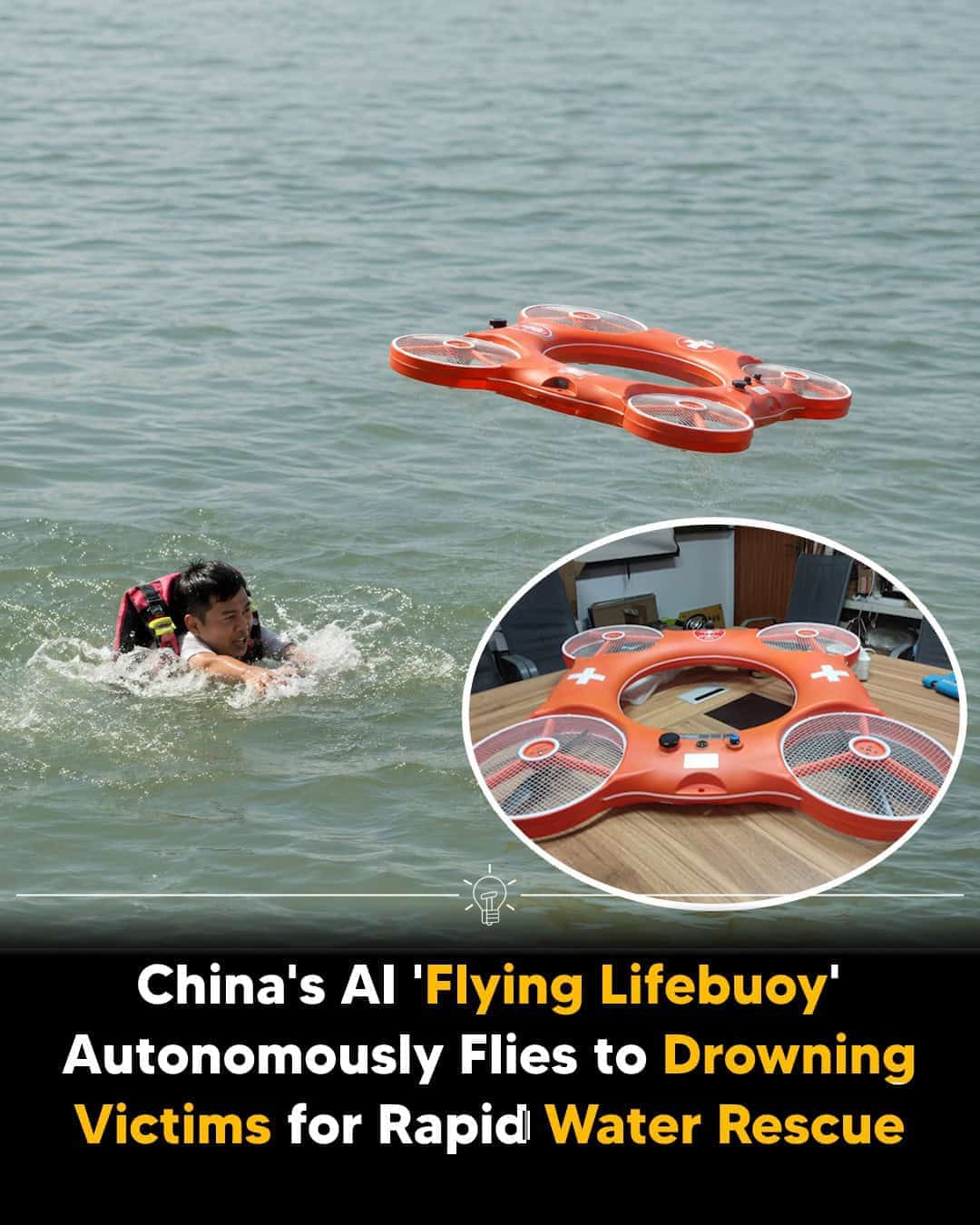
Unlike a conventional rescue drone that simply drops a flotation device, the flying lifebuoy itself becomes the flotation platform. After landing, its rotors stop and the unit remains stable while supporting the person until human rescuers arrive. Once the rescue operation is completed, the device can restart its motors, take off from the water and automatically return to its original location.
According to local reports, the unit weighs about 4.5 kilograms, can reportedly reach a maximum speed of around 31 mph (14 meters per second) and a range of 1.2 miles (2 km). In addition, it includes an infrared night-vision camera that allows operators to monitor conditions around the victim. Reports also say three units have been deployed around Hangzhou’s West Lake scenic area, including locations considered more prone to water accidents.
The system is intended to address a critical problem in water emergencies: the time between detecting an accident and getting flotation support to the victim. Hangzhou police are also testing a wider combination of autonomous rescue technologies, including drones that can locate people and drop inflatable lifebuoys, as well as an unmanned rescue boat that can approach and assist people in the water.
The flying lifebuoy is therefore designed as first-response support rather than a replacement for professional rescuers. Its main purpose is to provide flotation while rescue personnel travel to the scene, potentially giving a person additional time to remain above water.
CGTN reported in March 2026 that Hangzhou scenic-area police had equipped units with the flying lifebuoy for water-rescue operations, while later August reports documented its autonomous performance during a drill. The development reflects Hangzhou’s broader use of drones, autonomous vehicles and AI-assisted systems for emergency response, with the goal of shortening the time needed to deliver assistance during life-threatening incidents.
More Robotics Advancements and Updates:
- Robot Horse that Carries 660-Pound Humanoid Robot for Hours
- Chinese Scientists Build Robot Controlled by Human Brain Cells
- Digit 5 New Robot Offers 20-Hour Work After 9-Minute Charge
- Digit Robot’s Charging-Port Design Raises Design Questions
- China Builds First Factory Where Robots Build More Robots
-
 US Plans to Reuse Navy Nuclear Reactors for AI Data Centers
-
 Robot Horse that Carries 660-Pound Humanoid Robot for Hours
-
 Chinese Scientists Build Robot Controlled by Human Brain Cells
-
 Digit 5 New Robot Offers 20-Hour Work After 9-Minute Charge
-
 Digit Robot’s Charging-Port Design Raises Design Questions
-
 China Builds First Factory Where Robots Build More Robots