China Builds the Word’s First Underwater Solar Power Plant – Generating Electricity 10 Meters (33 ft) Below the Sea
China has demonstrated a perovskite solar power system operating 10 meters (33 feet) below the ocean surface. Researchers from Yunnan University tested the technology in the open sea and successfully used the electricity to charge lithium-ion batteries and power an LED panel. The research study by Yunnan University & School of Materials and Energy was published in Joule on September 11, 2026.
The project is being described as the first practical open-sea demonstration of underwater solar power at this depth. Previous underwater solar research had generally focused on much shallower depths of around 2 meters or less, according to the researchers.
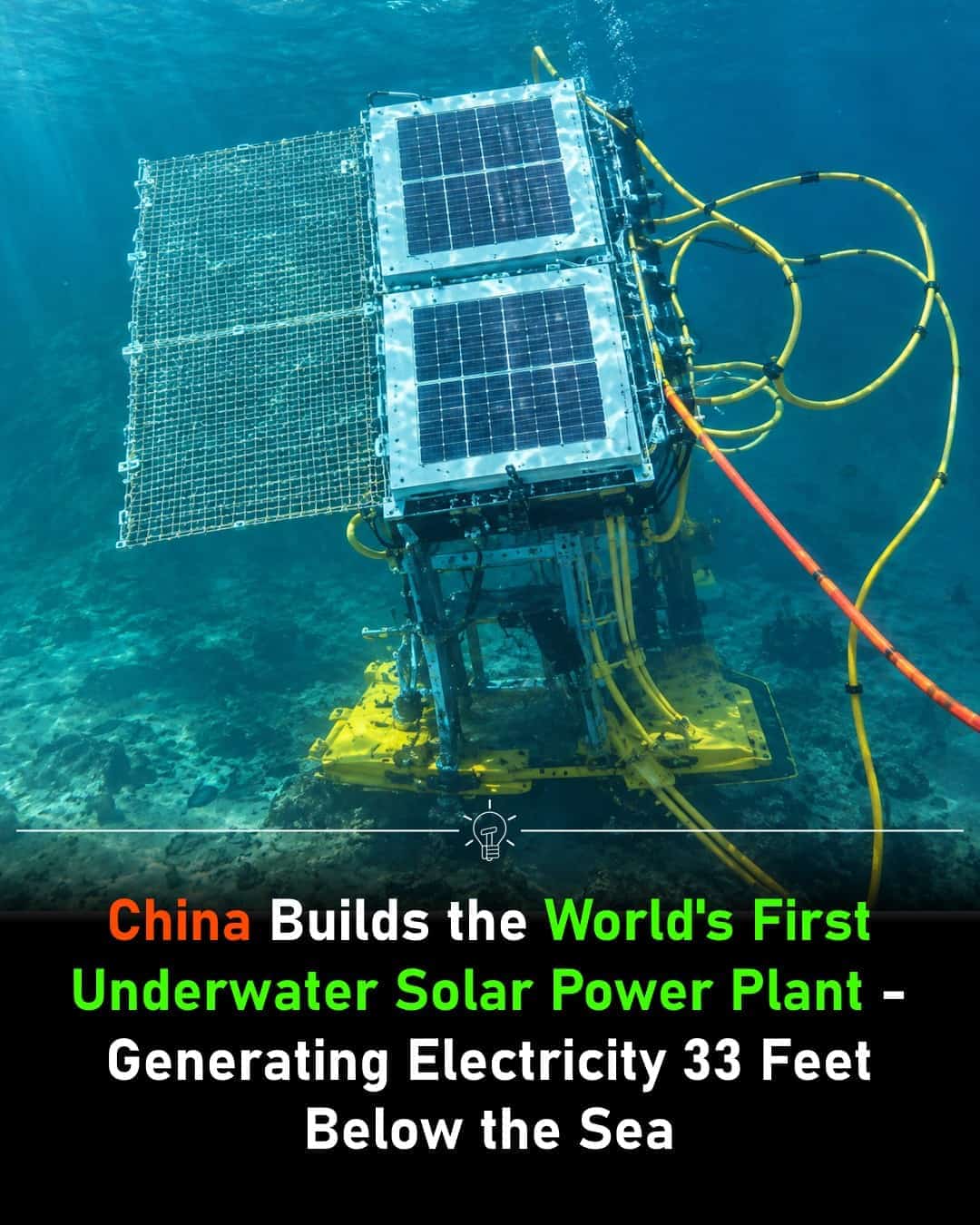
The researchers chose wide-bandgap perovskite solar cells instead of conventional silicon panels. Seawater absorbs much of the sunlight as it travels downward, especially red light, while blue-green wavelengths can penetrate farther. The perovskite cells were designed to make better use of this remaining underwater light.
Laboratory testing showed promising conversion performance. A small 0.0895-cm² cell reached 34.71% power-conversion efficiency, while a larger 28.79-cm² module reached 29.4% efficiency under simulated conditions corresponding to about 10 meters of water depth.
Operating a solar cell in seawater presents major durability challenges. The researchers developed a multilayer protective structure using materials including butyl rubber, protective glass and transparent epoxy resin to protect the cells against water penetration, pressure and corrosion.
The protected cells also underwent accelerated laboratory testing in simulated seawater. After 1,000 hours of immersion under simulated 10-meter underwater conditions, the cells retained 99.58% of their initial performance, according to the research results.
The team then moved from laboratory testing to a real marine environment. Researchers deployed the system near the Weizhou Islands in the South China Sea, integrating the perovskite solar cells with underwater equipment and testing them at depths of 2, 6 and 10 meters.
The output decreased as the system moved deeper underwater, but it still produced measurable electricity at 10 meters. During two hours of testing, the system generated 1,416 mWh at 2 meters, 752 mWh at 6 meters and 324 mWh at 10 meters, with the deepest test successfully charging a lithium-ion battery and powering an LED panel.
The researchers estimate that the cells could potentially operate for about 5.5 years before reaching 80% of their initial output, based on accelerated aging calculations at 25°C. This is a projected lifetime under modeled conditions, however, and should not be interpreted as five years of verified continuous operation in the ocean.
The technology is not intended to replace conventional solar farms or generate large amounts of electricity for cities. Instead, the researchers see potential for powering underwater sensors, cameras, communication equipment, marine robots and autonomous underwater systems where replacing batteries or running power cables can be difficult. The team plans to investigate operation at greater depths and develop standardized testing methods for underwater photovoltaics.
Related Posts:
- German Startup Turns Shop Awnings into Mini Solar Power Plants
- Germans Install Solar Panel Fences for Free Electricity
- MSU Develops Clear Solar Glass That Generates Electricity
- Colorful and Transparent Solar Panel to Replace Your Windows
- EU Solar Generates Record 25% of Electricity for First Time
- Texas Solar Set to Surpass Coal Power for the First Time
- EU Solar Generates Record 25% of Electricity for First Time
- China Builds World’s Largest 17.7 GW Solar Park on Tibetan Plateau
- Morocco’s Solar Project Aims to Export Power to Europe via Undersea Cable
- China Builds 300 MW Sahara Solar Plant for Algeria’s 15 GW Plan
- China’s Dual-Use Solar Farms & Photovoltaic Sheep Power Farms
- Germany’s 124 GW Solar Generation Now Exceeds Coal Power
-
 German Startup Turns Shop Awnings into Mini Solar Power Plants
-
 China Tests World’s Most Powerful 1MW Flying Wind Turbine
-
 UAE Uses Seawater & Solar Energy to Grow Crops in the Desert
-
 Morocco’s Solar Project Aims to Export Power to Europe via Undersea Cable
-
 Denmark Converts Gas Caverns Into Hydrogen Reserves for Winter
-
 Virginia’s Power Use Surges 30M MWh as AI Data Centers Grow