Ideal power equation of Transformer

(The ideal transformer as a circuit element)
If the secondary coil is attached to a load that allows current to flow, electrical power is transmitted from the primary circuit to the secondary circuit. Ideally, the transformer is perfectly efficient. All the incoming energy is transformed from the primary circuit to the magnetic field and into the secondary circuit. If this condition is met, (i.e, in Ideal transformer) the input electric power must equal the output power:

giving the ideal transformer equation: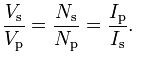
Transformers normally have high efficiency, so this formula is a reasonable approximation.
If the voltage is increased, then the current is decreased by the same factor. The impedance in one circuit is transformed by the square of the turns ratio. For example, if an impedance Zs is attached across the terminals of the secondary coil, it appears to the primary circuit to have an impedance of (Np/Ns)2Zs. This relationship is reciprocal, so that the impedance Zp of the primary circuit appears to the secondary to be (Ns/Np)2Zp.
You may Also Read:
- EMF Equation of the Transformer
- Transformer Phasing: The Dot Notation and Dot Convention
- Transformer Efficiency, All day Efficiency & Condition for Maximum Efficiency
-
 Operation of an 11kV to 400/230V Distribution Transformer
-
 What Do the 5P10 and 5P20 Mean in a Current Transformer?
-
 What is an Isolation Transformer? – Its Construction, Working and Applications
-
 Difference Between Ideal and Real or Practical Transformer
-
 Difference Between Single Phase and Three Phase Transformer
-
 Cooling Methods of a Transformer