Is It Better to Install GFCI Protection in the Electrical Panel or at the Outlet?
Ground Fault Circuit Interrupters (GFCIs) are designed to detect ground faults and protect against electric shock. Similar devices, such as Residual Current Devices (RCDs) and Residual Current Breakers with Overcurrent protection (RCBOs), serve the same purpose in regions like the EU, UK, Australia, and parts of Asia. These ground fault protection devices have undoubtedly saved thousands of lives worldwide.
In the United States (followed by National Electrical Code (NEC), GFCI protection is mandatory for specific applications to detect and protect against ground faults. Among the commonly used devices, there are two main types of GFCI protection i.e. GFCI circuit breakers and GFCI receptacles.
While it is not required to install both a GFCI breaker and a GFCI outlet simultaneously, the following are suitable options to help you decide whether to install a GFCI breaker in the main panel or a GFCI receptacle at the point of use for ground fault protection.
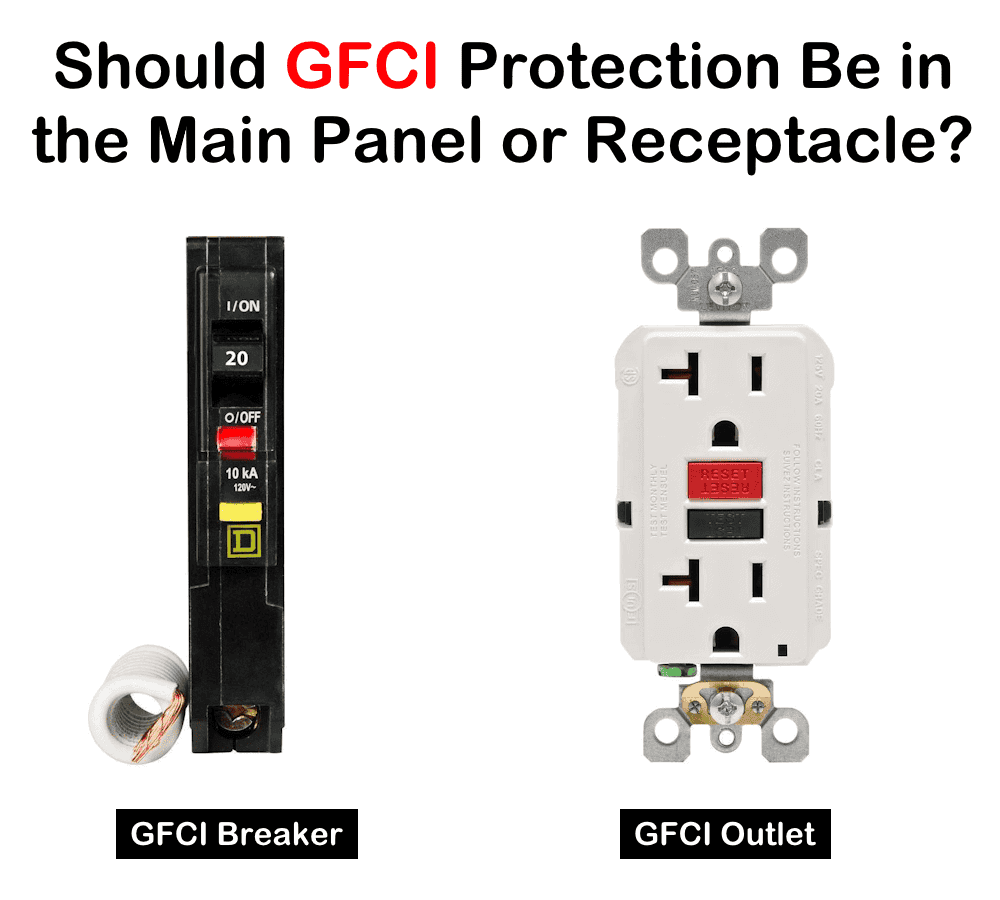
Good to Know: At present, only 15A and 20A GFCI receptacles rated for 120V are available, typically in NEMA 5-15 and 5-20 configurations. In other words, for 240V circuits, you must use GFCI breakers, as 240V GFCI receptacles are not available.
When to Use GFCI Breaker
If you want to protect the entire branch circuit and everything connected to it, a GFCI breaker is suitable to install in the main panel. This way, the whole load points connected to it i.e. lighting points, appliances and devices, outlets and receptacles connected to the branch circuit will be protected against ground faults.
Similarly, installing a GFCI breaker is a good option (especially in new branch circuits) when you want to combine GFCI protection against electric shock with Arc-Fault Circuit Interrupter (AFCI) protection for fire prevention.
In addition, a 2-pole (2P) GFCI breaker is required to protect 240V circuits, since no 240V GFCI receptacles are currently available. At present, only 15A and 20A GFCI receptacles rated for 120V are available.
Installing a GFCI breaker is the suitable option when:
- To protect entire branch circuits serving other load points
- Multiwire branch circuits are used, but must be carefully evaluated due to shared neutral issues.
- Circuit wiring is not easily accessible, or outlets are in wet/damp environments.
- Use a GFCI breaker if you need to protect an entire circuit, especially in areas like outdoor circuits, garages, or older homes with shared circuits.
- If the GFCI receptacle serves only outlets within the same room, Its OK. Otherwise, walk to the panel to install a GFCI breaker.
- The GFCI breaker protects the entire circuit and if it trips you know where to go to reset it without having to look for the reset button.
- Breakers require panel work, which may involve permits. It is a better approach to contact a licensed electrician to do so.
Where to Use a GFCI Breaker
GFCI breakers are installed in the electrical panel and protect the entire circuit. They are best used in the following situations especially in 240V circuits.
- Outdoor Circuits: Protect all outdoor outlets, lighting, or equipment (e.g., pools, hot tubs) where water exposure is likely.
- Garages and Basements: Areas with concrete floors or potential moisture, especially if multiple outlets are on the same circuit.
- Bathrooms: If a bathroom has multiple outlets on one circuit, a GFCI breaker can protect them all without replacing each outlet.
- Kitchens: For circuits powering multiple countertop outlets or appliances in wet areas.
- Laundry Rooms: To protect outlets near washing machines or sinks.
- Whole-House Retrofits: In older homes without GFCI protection, a breaker can protect an entire circuit without rewiring outlets.
- Long Circuits: For circuits with multiple outlets (e.g., a string of outlets in a workshop or crawl space).
- The NEC – 210.8(A)(1) through (A)(11) for dwelling and non-dwelling unites mandates GFCI protection for circuits in bathrooms, garages, kitchens, laundry areas, crawl spaces, unfinished basements, and outdoor areas, as well as for certain appliances like dishwashers or sump pumps. A GFCI breaker ensures compliance for the entire circuit in these areas.
- GFCI protection is required for various applications in compliance with the following NEC Articles: 210.8, 406.3, 424.44, 426.28, 427.22, 511.12, 517.17, 517.20, 525.23, 530.44, 547.28, 555.35, 620.6, 625.54, 680.5, 680.21, 680.22, 680.23, 680.27, 680.32, 680.43, 680.44, 680.51 through 680.59, 680.62, and 680.71.
When to Use GFCI Receptacle
On the other hand, in existing wiring systems (such as multiwire branch circuits with shared neutrals) or in sensitive environments like hospitals and server rooms, GFCI breakers may not be suitable due to the risk of unwanted tripping. In such cases, installing a GFCI receptacle at the end of the branch circuit is often the better solution.
Alternatively, portable GFCI devices can be used further down the line instead of a GFCI breaker. These are especially useful for outdoor protection (such as at construction sites, in damp or wet locations, and while traveling) helping to safeguard people against electric shock in hazardous conditions.
Moreover, if the main purpose is to protect 15A or 20A outlets operating at 120V, the best option is to use GFCI receptacles rather than GFCI breakers.
Wiring a GFCI outlet is the best option when you want:
- Installing GFCI protection at the point of use.
- Independent protection for one or two outlets only.
- Panel space is limited, or you want a more cost-effective retrofit solution.
- Protecting devices in locations with frequent nuisance tripping (like refrigerators), allowing quick reset access.
- Use a GFCI outlet for specific locations like bathrooms, kitchens, or single outdoor outlets where only one or a few outlets need protection.
- It is Cheaper to replace a receptacle than a breaker. Also, it is easier to find the problem and you don’t necessarily take out a whole branch circuit if they pop.
- Outlet are better because you know exactly what device caused the trip unless you are feeding other outlets.
- Outlets are simpler to install than breaker, but may require multiple units. Hence, it is recommended to contact a licensed electrician instead of DIY stuff.
Where to Use a GFCI Outlet
GFCI outlets are installed at the point of use and protect the ordinary outlet itself and any downstream outlets wired to it. They are best used in the following situations especially in 120V circuits:
- Bathrooms: Near sinks or vanities where water and electricity are in close proximity.
- Kitchens: For countertop outlets within 6 feet of a sink or in areas where appliances like blenders or toasters are used.
- Outdoor Outlets: For single outlets (e.g., on a patio or deck) or to protect a small group of downstream outdoor outlets.
- Laundry Areas: Near washing machines or utility sinks.
- Garages: For individual outlets used for power tools or EV chargers.
- Wet Bars or Sinks: Any area with a sink not covered by a GFCI breaker.
- Specific Appliances: Outlets serving dishwashers, garbage disposals, or other water-adjacent appliances (if not already protected by a breaker).
- NEC Requirements: GFCI outlets are required in the same locations as breakers in accordance with 210.8(A), (B), and 406.3(D)(2), and (3) e.g. (bathrooms, kitchens, garages, etc.) but are often used when only one or two outlets need protection, or when the circuit is already partially protected.
- Wiring Tip: A single GFCI outlet can be wired to protect downstream outlets on the same circuit using the “load” terminals, reducing the need for multiple GFCI outlets.
Resources:
- GFCI: Ground Fault Circuit Interrupter. Types, Working & Applications
- Why Do We Need a GFCI & How Does it Protect During Faults?
- How Does GFCI Respond to Ground Faults?
- How Does a Standard Breaker Respond to Electrical Fault?
- Why Doesn’t a Standard Breaker Protract Against Ground Faults?
- Difference Between Circuit Breaker and GFCI
- Difference Between GFCI and AFCI
- Difference between MCB, ELCB, RCBO and RCD Circuit Breakers
- What Happens if the Neutral is Lost in the Main or Subpanel?
- Why Must Neutral and Ground Wires Be Bonded in the Main Panel?
- Why are Neutral and Ground Wires Separated in a Subpanel?
- Will I Get an Electric Shock If I Touch the Ground Wire?
- Can the Neutral Wire Cause Electric Shock? Different Cases
- Will a Man Get an Electric Shock If He Hangs on a Live Wire?
- What is the Right Wire Size for 15A Breaker and Outlet?
- What is the Difference Between 15-Amp and 20-Amp Outlet?
- Can I Use a 240V Breaker on a 120V Circuit and Vice Versa?
- Can you use 15A Breaker on 20A Circuit and Vice Versa?
- Difference Between EGC and GEC in Electrical Grounding
- Difference Between 1-Pole and 2-Pole Breakers – NEC & IEC
- Can an AC Device Operate on DC Supply, and Vice Versa?
- What Happens if You Use a 120V Device on 240V & Vice Versa?
- Ground Terminal Up or Down: Which Way Should Outlets Face?
- Difference Between NEMA 14-50 Standard Vs EV Receptacle
Related GFCI Wiring Tutorials
- How to Wire 1-P & 2-P, 1-Phase & 3-P, 3-Phase GFCI Breakers
- How to Wire a 1-Pole GFCI Breaker
- How to Wire a 2-Pole GFCI Breaker
- How to Wire a 3-Phase, 3-Pole GFCI Breaker
- How to Wire an AFCI Breaker?
- How to Wire a Smart GFCI Breaker
- How to Wire Smart AFCI/GFCI Breaker
- How to Wire a GFCI Outlet – Wiring a GFCI Receptacle
- How to Wire Wi-Fi Smart GFCI Outlets
- How to Wire GFCI Combo Switch and Outlet
- How to Wire an AFCI Outlet?
- How to Wire an Outlet Receptacle?
- How to Wire a 1-Pole Breaker
- How to Wire a 2-Pole Breaker
- How to Wire a 3-Pole Breaker
- How to Wire a Smart Breaker
-
 Germany’s Electric Drone Hits 699 km/h, Eyes World Record
-
 How to Wire and Use Tesla Gen 3 Mobile Connector Charger
-
 How to Wire 48A Level 2 Dual Port EV Charging Station
-
 How to Wire Smart Electric Vehicle Charging Station – 32A/80A
-
 How to Wire ChargePoint Home Flex Charger for Every EV
-
 How to Wire an EV Wall Charger – Hardwired and Plug-in