How to Determine the Number of Incandescent Lamps in a Branch or Final Sub-Circuit?
If the current rating of a branch circuit or final sub-circuit has already been determined, and the proper cable and wire size has been installed according to that rating, you can calculate how many light points (lamps) can be connected to the circuit.
The following example and associated formula can be used to determine the number of lamps or bulbs that can be installed on a final sub-circuit or branch circuit:
Good to Know: Incandescent lamps and light bulbs are not the same as fluorescent lamps. They are treated differently in design calculations as shown below.
Calculating the Number of Incandescent Lamps in a Circuit
230V/240V Circuits
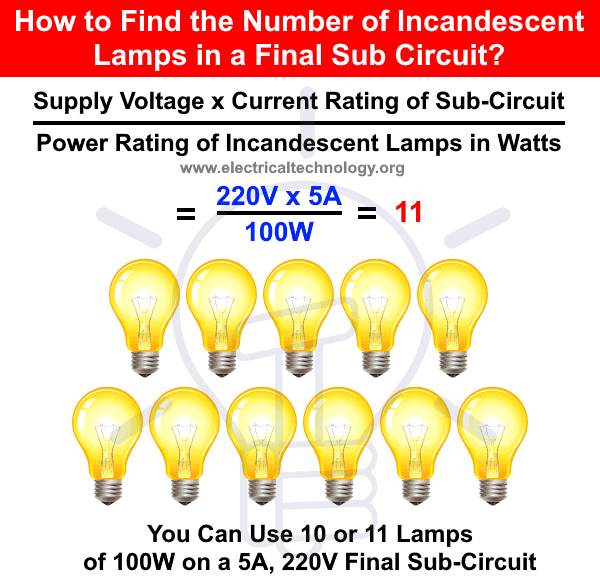
Suppose we need to install 100 W light bulbs in a home, office, or hall for general lighting. The current rating of the specific final sub-circuit is 5-amp, and the supply voltage is 230V (120/240V in the US). The maximum number of lamps can be calculated using the following formula:
Power Rating of the Circuit (V × I) / Load Power in Watts (P)
Number of Lamps = (Supply Voltage × Current Rating of Sub-Circuit) / (Power Rating of Incandescent Lamp in Watts)
= (230V × 5A) / 100W
= 11.5
This means you can install 11 incandescent lamps, each rated at 100W, on a 5A, 230V branch or final sub-circuit.
120V Circuits
Now, we need to find the number of incandescent lamps that can be connected to a 120V, 15-amp branch circuit.
(120V × 10A) / 150W
= 8
In this case, the maximum number of incandescent lamps that can be installed on the branch circuit is 8.
Good to Know: Keep in mind that, it is not recommended to use more than 10 incandescent lamps on a final sub circuit for normal lighting. The high power rating should be used to calculate the number of incandescent lamps in a final sun circuit in case of special bulbs with high power rating.
Note:
- Final sub-circuits and branch circuits are designed based on maximum demand, meaning they are rated to handle the maximum power consumption when all connected appliances are in use.
- The Power factor is considered unity because incandescent lamps have a purely resistive load.
Related Posts & Tutorials:
- How to Find the Number of Lights on a Single Circuit Breaker?
- How to Find the Number of Outlets on a Single Circuit Breaker?
- How to Determine the Number of Lighting Branch Circuits?
- How to Determine the Number of Branch Circuits?
- How to Size and Find the Numbers of Ceiling Fan in a Room?
- How to Find Voltage & Ampere Rating of Switch, Plug, Outlet & Receptacle?
- How to Find the Proper Size of Circuit Breaker? Breaker Calculator & Examples
- How to Find The Suitable Size of Cable & Wire ? – Solved Examples
- How to Size a Load Center, Panelboard and Distribution Board?
- How to Determine the Number of Circuit Breakers in a Panelboard?
- Which Bulb Glows Brighter When Connected in Series and Parallel & Why?
- What is the Objection to have Light Bulbs & Lamps Connected in Series?
- How to Control a Light Bulb using Single Way or One-way Switch?
- Lighting Design Calculation in a Building – Step by Step
- Home Wiring Installation Tutorials
-
 How to Wire and Use Tesla Gen 3 Mobile Connector Charger
-
 How to Wire 48A Level 2 Dual Port EV Charging Station
-
 How to Wire Smart Electric Vehicle Charging Station – 32A/80A
-
 How to Wire ChargePoint Home Flex Charger for Every EV
-
 How to Wire an EV Wall Charger – Hardwired and Plug-in
-
 How to Wire AC Level 2 EV Smart Breaker Charger – 40A/32A