California Builds Massive 21 GW Battery Storage for Its Solar Grid
California Builds the World’s Biggest 21 GW Solar Battery Storage Fleet to Power its Electric Grid
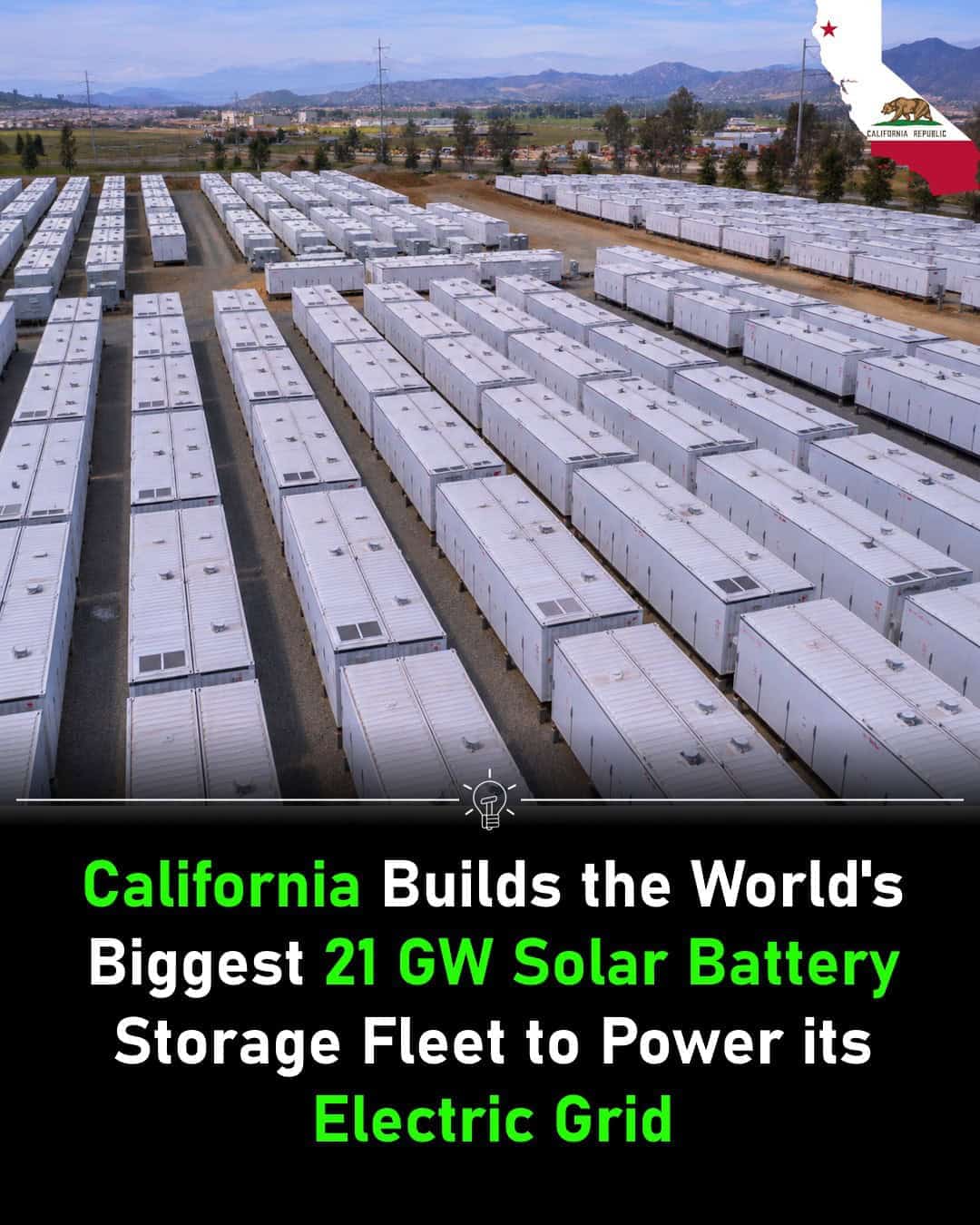
California has built one of the world’s largest battery-storage fleets, with total battery capacity reaching 21,112 MW by mid-2026. The California Energy Commission confirmed the milestone on August 7, 2026. The state’s battery capacity has grown from less than 700 MW in 2019 to more than 21 GW today. The CEC says the current fleet is roughly equivalent to one-third of California’s peak electricity demand during the September 2022 heat wave.
Nearly 16 GW of the total comes from about 310 utility-scale battery systems located in California . Another approximately 2 GW comes from utility-scale batteries in neighboring Arizona and Nevada that serve customers on the CAISO grid. More than 300,000 smaller battery systems at homes, businesses, farms and other sites contribute another roughly 3 GW. Because the CEC includes those out-of-state CAISO resources in its statewide total, the 21,112-MW figure is best described as the battery resources supporting California’s electricity grid.
The rapid battery expansion is closely connected to California’s growing solar fleet. Solar production is strongest during the middle of the day, while electricity demand can remain high after sunset. Batteries can charge when solar generation is abundant and then discharge electricity later.
This helps shift some daytime solar power into the evening and reduces the need for fast-ramping fossil-fuel generation during those hours. The CEC says solar use surpassed natural gas use during the first half of 2026, with solar usage increasing 22% and natural-gas usage falling 51% between January–June 2024 and the same period in 2026.
Battery capacity has also expanded sharply in just the past two years. According to the CEC, battery storage on the grid increased by 80% between the first half of 2024 and the first half of 2026 . The storage fleet is now large enough to provide a substantial amount of power during periods when solar generation declines. However, MW measures the instantaneous power output of batteries, not how long they can maintain that output. The total energy capability depends on each system’s MWh capacity and duration.
California’s Energy Commission reports that the CAISO system met or exceeded demand with clean-energy resources for at least part of the day on 208 days through August 2026, compared with 279 days during all of 2025.
The CEC also reports 1,525 hours when clean resources met or exceeded CAISO demand through August 2026. CAISO manages roughly 80% of California’s electricity system, so these figures describe the ISO-controlled portion of the grid rather than every electricity system in the state.
California is planning for substantially more storage as electricity demand grows. The state estimates that it will need more than 52,000 MW of battery and long-duration energy storage by 2045 to support CA clean-energy targets. The CEC says the current 21,112-MW fleet represents about 41% of that 2045 target . The expansion means California’s electricity system is increasingly being designed around a combination of solar generation and storage, with batteries providing a way to move part of the daytime renewable supply into periods of higher evening demand.
More Solar Farm and Green Energy Projects in US:
- Texas Plans 1.2 GW Spectra Solar Project at a Cool Site
- California Hits 46 GW Solar Capacity With 73 GW More Planned
- Amazon Takes Over 1.2 GW Oregon Solar Farm After Bankruptcy
- California Solar Power Beats Natural Gas for First Time
- Texas Solar Set to Surpass Coal Power for the First Time
- US Wind & Solar Reach Record 760,000 GWh – 17% of Power Grid