Difference Between Contactor and Motor Starter
The magnetic starter is very similar to the magnetic contactor in both design and operation. Both devices operate by activating contacts when the coil is energized.
The main difference between a contactor and a starter is that a starter includes an overload heater element. This sensitive coil monitors the heat generated by excessive current and changes in ambient temperature, providing motor overload protection to prevent overheating.
- Related Post: Main Difference between Fuse and Circuit Breaker
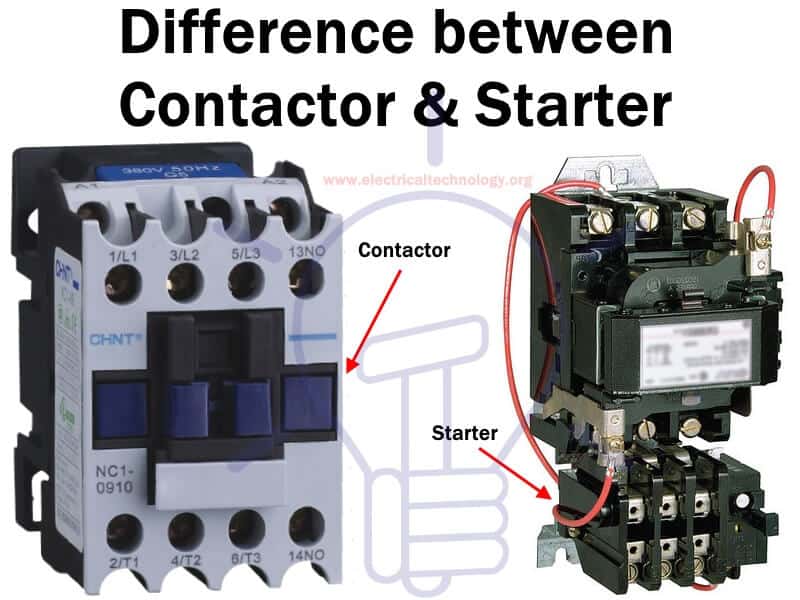
Key Differences between Motors and Contactors
A Motor Starter is essentially a contactor with an overload relay that disconnects power in case of motor overload.
Motor Starter = Contactor + Overload Relay
The term “Motor Starter” refers to an enclosed assembly that includes a contactor, control components, an autotransformer (if applicable), fuses, and an overload relay.
A Contactor is an electrically or electronically controlled switch, similar to a relay. It switches a circuit ON and OFF but does not provide overload protection. It is commonly used for controlling heating circuits, electric motors, and industrial automation.
A Contactor is a modified version of a relay and a part of a motor starter. It is rated by voltage or designed load current per contact (pole) and applies voltage to the contactor coil to make or interrupt the power circuit.
In short:
- If you have a motor starter, it includes both a contactor and overload protection in a single unit.
- If you have only a contactor, it does not provide overload protection.

Contactor vs. Motor Starter
- A motor starter is a combination of a contactor and an overload relay in a single unit.
- The contactor controls the flow of electrical current to the motor, making and breaking the circuit.
- The overload relay protects the motor from excessive current, preventing overheating and damage.
- A contactor is a separate component of a motor starter, used in applications requiring frequent ON/OFF switching, such as motors, lighting, and heating systems.
According to NEMA, the main function of a contactor is to establish and interrupt an electrical power circuit repeatedly. It receives commands from the motor starter control system to energize or de-energize the motor circuit.
A motor starter, on the other hand, receives signals from the contactor and other control systems to operate the motor.
- Related Post: Difference Between MCB, MCCB, ELCB, RCD & RCBO
How a Contactor Differs from a Circuit Breaker?
While a contactor functions similarly to a circuit breaker or switch, its working principle is different.
For example:
- If a switch or circuit breaker is in the ON position and a control system sends an open signal, it will not open the circuit unless manually operated or unless it burns out due to excessive current.
- In contrast, a contactor will automatically open its closed contacts when an issue occurs with the power supply. This prevents damage to the motor and ensures safe operation.
Motor Starters & Contactors in Motor Control
A motor starter can consist of:
- A circuit breaker or contactor
- A system of motor starters
- An autotransformer (to reduce motor starting voltage)
- A solid-state device like a Variable Frequency Drive (VFD), which controls the motor’s waveform for a smooth start
A starter is rated in amperes or motor horsepower (HP) and protects the motor circuit from overload surges and overheating.
A contactor is a specialized version of a relay and part of a motor starter. It is rated by voltage or designed load current per pole and applies voltage to the coil to control the circuit.
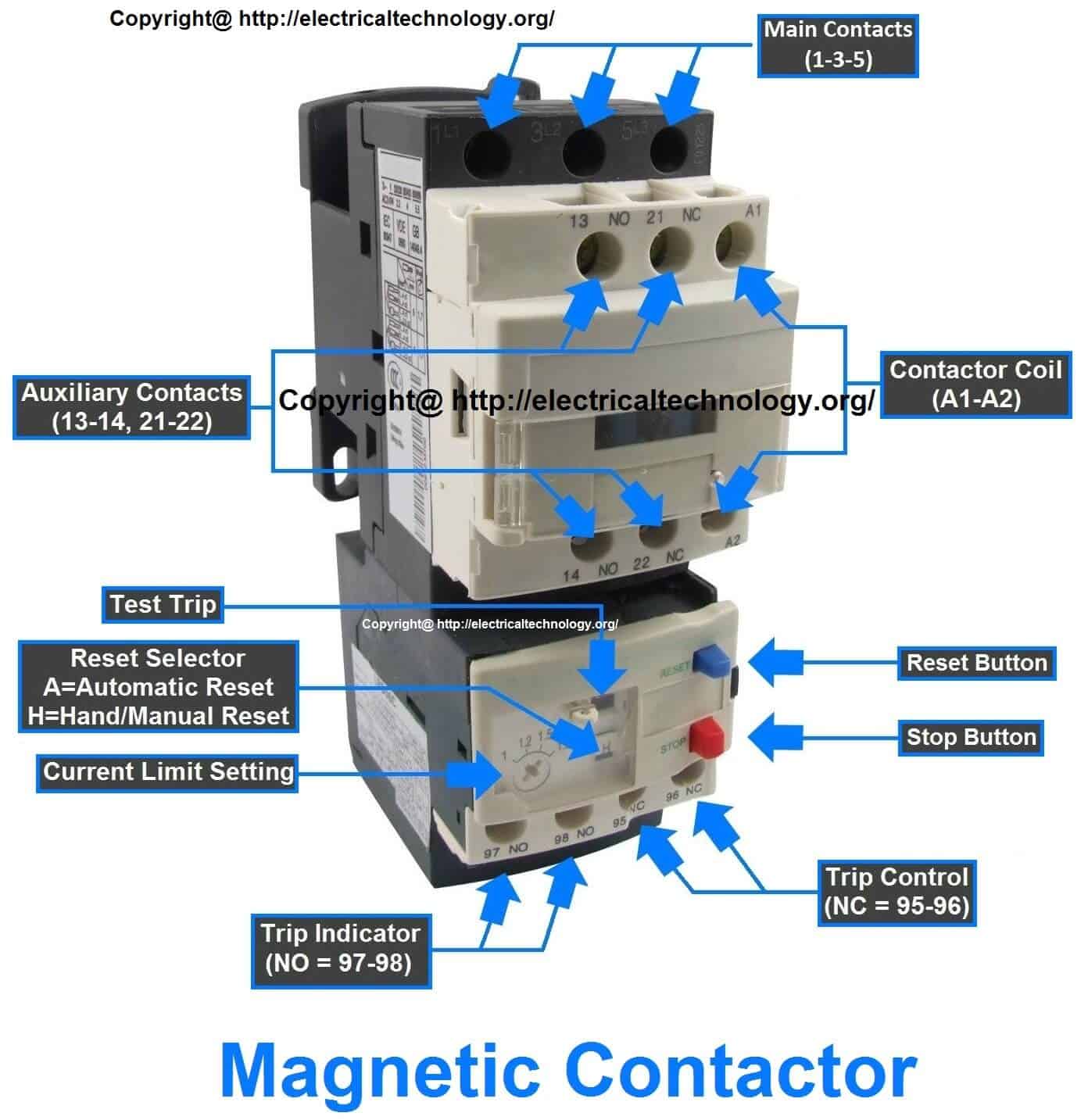
Good to know:
- The term “Motor Starter” refers to an enclosed assembly that includes a contactor, control components, autotransformer (if any), fuses, and an overload relay.
- Motor Starter = Contactor + Overload Relay
- If you have a starter, you get contactor + overload protection in one unit.
- If you have only a contactor, you do not have overload protection.
Related Posts:
- What is Motor Starter? Types of Motor Starters and Motor Starting Methods
- What is Soft Starter? Its Working, Diagram and Applications
- Direct Online Starter – DOL Starter Wiring Diagram for Motors
- What is a Contactor ? Types, Working and Applications
- Difference between Circuit Breaker and Isolator / Disconnector
- Difference Between Relay and Circuit Breaker
-
 Germany’s Electric Drone Hits 699 km/h, Eyes World Record
-
 How to Wire a Countdown Timer Switch – 15 Mins to 12Hrs
-
 How to Wire a Digital & Smart Fan Speed Controller Switch
-
 How to Wire Humidity Sensor and Fan Control Switch
-
 Wiring Combo Humidity Sensor & Fan Control with Light Switch
-
 How to Wire a Smart Motion Sensing Dimmer Switch