How to Install a NEMA 18-60, Three-Phase, 60A – 208Y/120V Non-Grounding Receptacle with Breaker and GFCI Protection
A NEMA 18-60 receptacle is a heavy-duty, industrial-grade straight-blade non-grounding receptacle designed for a 60A, 120/208V, 3-Phase Wye (Y or Star) power supply system. It is a heavy-duty, industrial-grade straight-blade receptacle designed for high-current commercial and industrial applications where both line-to-line and line-to-neutral loads are present. For instance, industrial machinery, process equipment, large HVAC units, and commercial power distribution equipment etc.
The NEMA 18-60 is a 4P, 4W non-grounding receptacle rated for 60A at 120/208V – 3-ΦY. It is wired using three hot (phase) conductors and one neutral conductor i.e. it does not need equipment grounding conductor. The three terminals (X, Y, Z) connects to the lines or “hot” wires i.e. (L1, L2, L3) and the (W) terminal connects to the neutral.
The 18-60R is available in industrial-grade, straight-blade, flush-mount and surface-mount configurations from manufacturers such as Hubbell, Leviton, and Eaton, and is commonly used where heavy-duty 3-phase loads are operated at mixed voltage.
Terminals
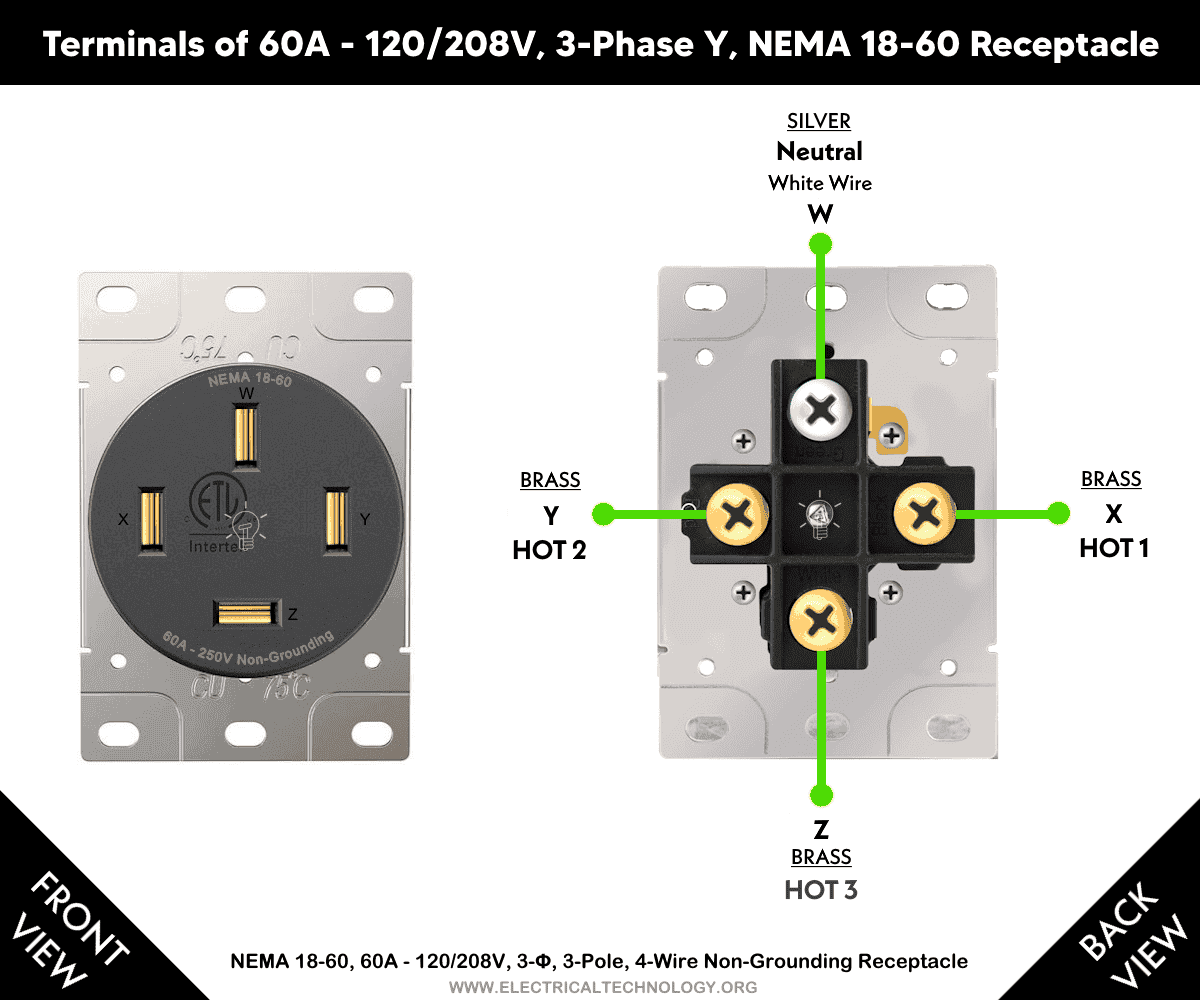
There are four terminals in a 18-60 receptacle as follows:
- W Terminal – Vertical Slot (I) – Silver Screw: Connects to the Neutral
- X Terminal – Vertical Slot (I) – Brass Screw: Connects to HOT 1 (Line 1)
- Y Terminal – Vertical Slot (I) – Brass Screw: Connects to HOT 2 (Line 2)
- Z Horizontal Slot (➖) – Brass Screw: Connects to HOT 3 (Line 3)
Click image or open in a new tab to enlarge
Electrical Ratings & Specifications
- NEMA: NEMA 18-60R – Straight-Blade Receptacle
- Poles: 4-Poles, 4 Wires – Non-Grounding – with Neutral
- Voltage: 120/208V – Three-Phase Y – AC Supply – 60 Hz
- Current: 60A
- Breaker / GFCI: 60A
- Wattage: ≈ 20 – 12.5kW
- Wire Size: #4-#6 AWG Copper
- Grade & Material: Commercial Grade – Nylon with Galvanized Steel Plate & Brass Contacts
- Mounting: Flush Mounting
- Termination: Back Terminal Screws
- Outdoor Box: 2-gang outdoor box – NEMA 3R rainproof enclosure
- Wiring: Hardwired / Dedicated Circuit
Related Post: How to Wire a 3-Phase, 60A – 250V NEMA 15-60 Receptacle
Wiring NEMA 18-60 with a 3-Pole Breaker
The following wiring tutorials illustrates how to wire a NEMA 18-60 receptacle rated at 60A – 120/208V, 3-Φ Y with a 60A 3-pole standard or GFCI breaker.
Step 1: De-energize the panel or load center at the main disconnect. Verify absence of voltage using an approved tester. Snap the 60A, 3-pole breaker onto the panel’s A-B-C phase busbars as shown in the fig. Before doing so, confirm the breaker is rated for 120/208V – 3-phase Y operation.
The 3-pole breaker connects to the phase conductors as follows:
- L1 (Phase A) to the breaker pole 1
- L2 (Phase B) to the breaker pole 2
- L3 (Phase C) to the breaker pole 3
Torque terminals per breaker manufacturer specifications.
Step 2. Terminate the neutral conductor on the panel neutral bar. Ensure the neutral bar is bonded only at the service disconnect (main panel) and isolated in a subpanel.
Do NOT connect an EGC to the receptacle, as it is a non-grounding type. Meanwhile, grounding of raceways and enclosures must still comply with NEC Article 250.
Step 3: Run the 3-phase branch circuit conductors to the receptacle junction box in EMT as follows:
- Pull (3) #4AWG (or #6) copper (THHN/THWN-2) for hot wires
- Pull (1) #10 AWG ground wire
Step 4: Strip conductors to manufacturer-specified length and connect the three-phase branch circuit conductor to the NEMA 18-60 receptacle as follows:
- L1 (Hot 1) to the X terminal
- L2 (Hot 2) to the Y terminal
- L3 (Hot 3) to the Z terminal
- Neutral to W terminal
Torque all terminals precisely about 25 in.-lb (3 N·m) or as specified by the manufacturer. For outdoor applications, Install the receptacle securely into the 2-gang NEMA 3R outlet box.
Step 5: Install the cover plate and label the circuit at the panel as “NEMA 18-60 – 120/208 V, 3-Phase, 60 A – Non-Grounding”. Verify enclosure bonding per NEC 250.
Now energize the breaker and measure voltages:
- L-L: ~208 V
- L-N: ~120 V
Click image or open in a new tab to enlarge

Wiring NEMA 18-60 with a 3-P GFCI
A 3-pole GFCI breaker works exactly like a normal 3-pole breaker except for the white built-in pigtail. In this case, connect the three-pole GFCI as follow:
- L1 → GFCI breaker terminal 1
- L2 → GFCI breaker terminal 2
- L3 → GFCI breaker terminal 3
As NEMA 16-60 has no ground, hence do NOT connect the equipment grounding conductor (EGC) to the load. Connect the GFCI white pigtail wire to the neutral busbar in the main panel as shown in the following wiring diagram.
Click image or open in a new tab to enlarge
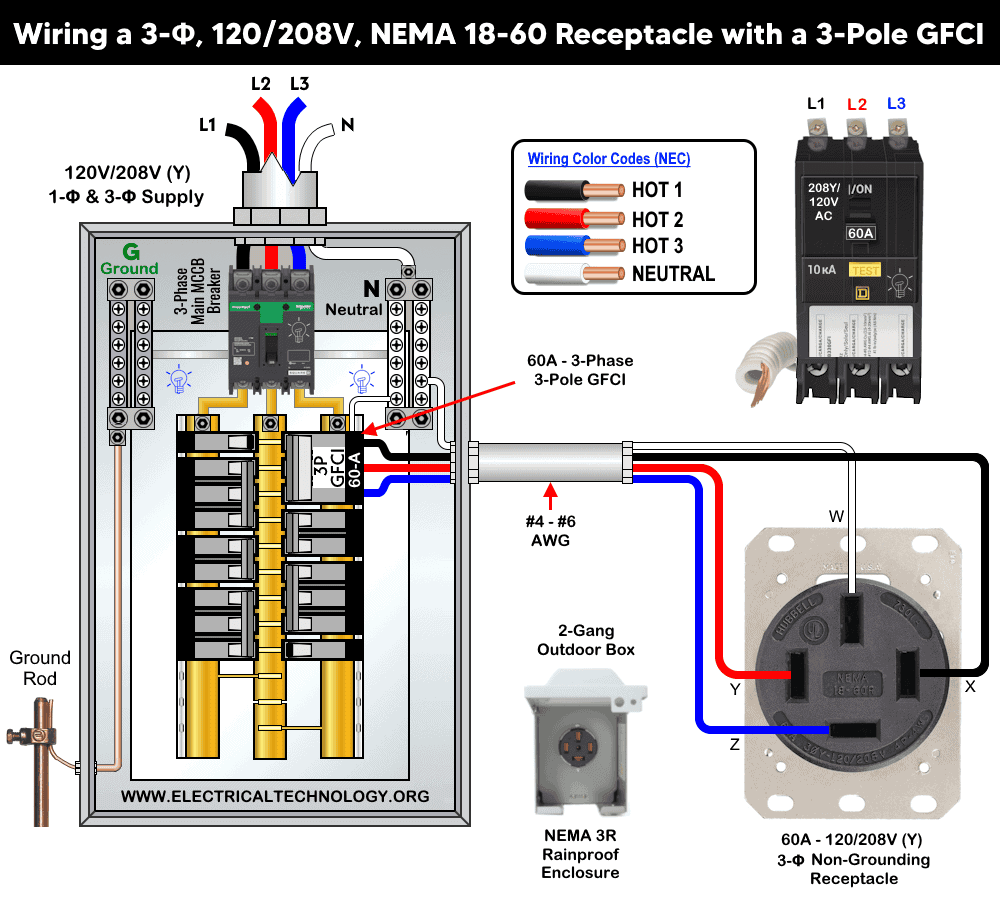
Good to Know: Even though the receptacle doesn’t require EGC, the GFCI breaker must have its built-in pigtail connected to the neutral bar to monitor current imbalance between Lines and Neutral.
FAQs:
How Many Amps Can a NEMA 18-60 Handle Safely?
A NEMA 18-60 industrial grade receptacle is rated for 60 amperes maximum. This rating applies to each phase conductor when supplied from a properly protected 60A, 3-pole overcurrent device.
How Many Watts Can a NEMA 18-60 Receptacle Hold?
For a 120/208 V, 3-phase Wye system, the maximum apparent power is calculated as:
P = √3 × VL-L × I
Substituting values:
P = 1.732 × 208 V × 60A
≈ 21,600 W (21.6 kW)
This is equivalent to:
3 × (120 V × 60 A) = 21.6 kW
Actual usable power may be lower depending on load characteristics, power factor, and manufacturer requirements (such as Hubble NEMA 18-60 is rated for 12.5kW).
Which Breaker Size Is Suitable for a NEMA 18-60 Receptacle?
The correct overcurrent protection is 60A, 3-pole circuit breaker or GFCI, rated for 120/208V, 3-phase. The breaker must be listed and compatible with the panelboard and intended application.
What Is the Correct Wire Size and Cable Type to Use with a NEMA 18-60?
The suitable wire size for copper conductors (per NEC Table 310.16, 75 °C terminals):
- Phase conductors (L1, L2, L3): #6 AWG Cu
- Neutral conductor: #6 AWG Cu (neutral must be full-sized due to possible unbalanced current in a Wye system)
For 75 °C temperature rating, the correct wire size for 60A circuit for each ungrounded conductor is #4AWG based on NEC Table 310.16.
Aluminum alternative:
- #4 AWG Al (where permitted and properly terminated)
Common wiring methods:
- Individual THHN/THWN-2 conductors in metallic conduit, or
- Approved multi-conductor cable assemblies rated for 60A, 120/208V, 3-phase.
Instructions, Precautions & Codes
- NEMA 18-60 is a three-phase outlet used in industrial and commercial setting.
- 18-60R are hardwired on a dedicated circuit.
- Use a 2-gang – NEMA 3R rainproof enclosure for NEMA 18-60, especially for outdoor applications.
- According to NEC Table – 310.16, the correct wire size for a 60A circuit and receptacle is #4 AWG copper. Likewise, the appropriate breaker size is a 60A, 208Y/120V, three-pole breaker (or 60A 3-P, GFCI breaker).
- NEMA 18-60 (as an industrial grade) can supply max 60A for both continuous and non-continuous loads.
- Use #4/3 cable (3 Hots + 1 neutral) for wiring a 3-phase NEMA 18-60 receptacle with a 3-pole breaker or GFCI rated for 120/208V.
Warning
- Always turn off the power supply by switching OFF the circuit breaker in the main electrical panel before performing any electrical work.
- If you are unsure or inexperienced, it is strongly recommended to contact a licensed electrician to perform the work in accordance with local electrical codes and safety regulations.
- The author assumes no responsibility or liability for any losses, injuries, or damages resulting from the use, misuse, or improper application of the information provided. Please be safe because playing with electricity is extremely dangerous.
Resources:
Related Wiring Tutorials
Related Wiring Tutorials
NEMA Family Outlets/Receptacle Wiring
NEMA 5 -Series
- How to Wire a 15A – 120V Outlet – NEMA 5-15 Receptacle
- How to Wire a 20A – 120V Outlet – NEMA 5-20 Receptacle
- How to Wire a 30A – 120V NEMA 5-30 Receptacle
- How to Wire a 50A – 120V – NEMA 5-50 Receptacle
NEMA 6-Series
- How to Wire a 15A – 240V Outlet – NEMA 6-15 Receptacle
- How to Wire a 20A – 240V Outlet – NEMA 6-20 Receptacle
- How to Wire a 30A – 240V – NEMA 6-30 Receptacle
- How to Wire a 50A – 240V – NEMA 6-50 Receptacle
NEMA 10-Series
- How to Wire a 20A, NEMA 10-20 Non-Grounding Receptacle
- How to Wire a 30A, NEMA 10-30 Non-Grounding Receptacle
- How to Wire a 50A, NEMA 10-50 Non-Grounding Receptacle
NEMA 14-Series
- How to Wire a 20A – 125/250V NEMA 14-20 Receptacle
- How to Wire a 30A – 125/250V NEMA 14-30 Receptacle
- How to Wire a 50A – 125/250V NEMA 14-50 Receptacle
- How to Wire a 60A – 125/250V – NEMA 14-60 Receptacle
NEMA General Outlets/Receptacle
- How to Wire a 15A/125V, NEMA 1-15 Non-Grounding Outlet
- How to Wire a 20A/250V, NEMA 2-20 Non-Grounding Receptacle
- How to Wire a 30A – 125V, NEMA TT-30 Receptacle for RVs
- How to Wire a 3-Phase, 60A – 250V NEMA 15-60 Receptacle
- How to Wire a 3-Phase, 60A – 120/208V NEMA 18-60 Receptacle (You are Here)
Smart Devices Wiring Series
- How to Wire 120/240V Smart Load Center with Smart Breakers
- How to Wire a Smart Breaker in a Smart 120/240V Panel
- How to Wire a Smart GFCI Breaker in a 120/240V Smart Panel
- How to Wire Smart AFCI/GFCI Breaker in a Smart Load Center
- How to Wire a Smart Switch in a 120/240V Load Center
- How to Wire a 15A Wi-Fi Smart Outlet in a Smart Panel
- How to Wire 15A and 20A Wi-Fi Smart GFCI Outlets
General Wiring Installations:
- How to Wire an Outlet Receptacle? Socket Outlet Wiring Diagrams
- How to Size a Breaker and Wires in AWG with EGC for Load?
- How to a Wire 3-Way Combination Switch and Grounded Outlet?
- How to Wire Combo Switch and Outlet? – Switch/Outlet Combo Wiring Diagrams
- How to Wire 120V & 240V Main Panel? Breaker Box Installation
- How to Wire a Subpanel? Main Lug Installation for 120V/240V
- How to Wire 277V & 480V, 1-Phase & 3-Phase, Commercial Main Service Panel?
- How to Wire 240V Water Heater Thermostat – Non-Continuous?
- How to Wire 3-Phase Simultaneous Water Heater Thermostat?
- How to Wire Twin Timer for 120V/240V Circuits – ON/OFF Delay
- How to Wire ST01 Timer with Relay & Contactor for 120V/240V Motors?
- How to Wire Multifunction ON/OFF Delay Timer for 120V/240V Motors?
Switches Wiring
- How to Wire Single Pole, Single Throw (SPST) as 2-Way Switch?
- How to Wire Single Pole, Double Throw (SPDT) as 3-Way Switch?
- How to Wire Double Pole, Single Throw Switch? Wiring DPST
- How to Wire Double Pole, Double Throw Switch? Wiring DPDT
- How to Wire Double Switch? 2-Gang, 1-Way Switch – IEC & NEC
- How to Wire 4-Way Switch (NEC) or Intermediate Switch as 3-Way (IEC)?
GFCI/AFCI Breaker/Outlet Wiring
- How to Wire a 1-Pole Breaker
- How to Wire a 2-Pole Breaker
- How to Wire a 3-Pole Breaker
- How to Wire a Tandem Breaker
- How to Wire GFCI Circuit Breakers
- How to Wire a 1-Pole GFCI
- How to Wire a 2-Pole GFCI
- How to Wire a 3-Phase, 3-Pole GFCI
- How to wire a GFCI Outlet?
- How to Wire an AFCI Breaker
- How to Wire an AFCI Outlet?
Related Posts:
- What is the Right Wire Size for 60A Breaker and Outlet?
- What is the Difference Between 15-Amp and 20-Amp Outlet?
- Difference Between Socket, Outlet and Receptacle
- Difference Between NEMA 14-50 Standard Vs EV Receptacle
- How to Find the Number of Outlets on a Single Circuit Breaker?
- How to Find Voltage & Ampere Rating of Switch, Plug, Outlet & Receptacle
- Can you use 15A Breaker on 20A Circuit and Vice Versa?
- Can You use a 15A Outlet on a 20A Circuit and Vice Versa?
- Ground Terminal Up or Down: Which Way Should Outlets Face?
- What Do the Green Dot or Orange Triangle Outlets Mean?
- What Do the Different Colors of Electrical Outlets Indicate?
- Why are Outlets and Receptacles in Hospitals Upside Down?
- How to Size a Load Center, Panelboards and Distribution Board?
- How to Determine the Number of Circuit Breakers in a Panelboard?
- How to Find the Proper Size of Circuit Breaker? Breaker Size Calculator & Examples
- How to Find The Suitable Size of Cable & Wire for Electrical Wiring Installation?
- Why is the Neutral Prong or Slot Wider on a Plug or Outlet?
- What Will Happen If You Connect a Male-to-Male Plug Between Outlets
-
 Germany’s Electric Drone Hits 699 km/h, Eyes World Record
-
 How to Wire and Use Tesla Gen 3 Mobile Connector Charger
-
 How to Wire 48A Level 2 Dual Port EV Charging Station
-
 How to Wire Smart Electric Vehicle Charging Station – 32A/80A
-
 How to Wire ChargePoint Home Flex Charger for Every EV
-
 How to Wire an EV Wall Charger – Hardwired and Plug-in