Why Doesn’t the Welding Current Pass Through the Welder’s Body and Shock Him?
We often hear the statement: “It is the current that kills, not the voltage.” However welding machines operate at very high amperage during the welding process, and the welder is in direct contact with the metal table and the workpiece being welded. Why, then, does the welder not get electric shock?
Well, It is true that electric current (measured in amperes) is what causes electrocution, not voltage alone. However, current will only flow through the human body if there is sufficient voltage to overcome the body’s resistance (or insulation) and establish a conductive path. In other words, voltage is the driving force that pushes current through a closed circuit.
This process involves several electrical parameters of electricity working together e.g. voltage, current, resistance, and a complete conductive path (electric circuit). Without an adequate potential difference and a closed circuit through the body, dangerous current cannot flow.
Click image or open in a new tab to enlarge
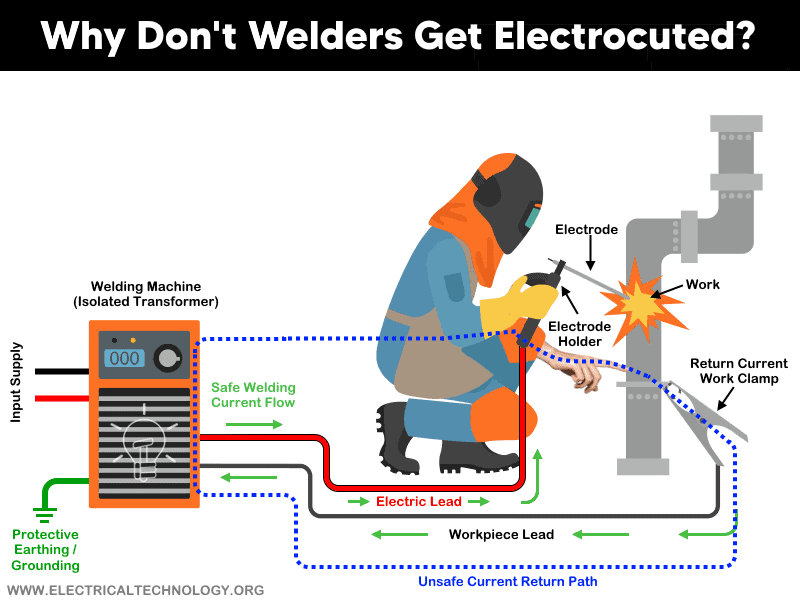
If you have ever been curious about how welding systems operate safely (despite delivering very high current), following are the reasons why a welder does not get electrocuted while holding the electrode holder or even when touching the grounded workpiece and welding table during operation.
Low Voltage – High Current
Most arc welding machines such as Shielded Metal Arc Welding (SMAW / Stick welding), Gas Metal Arc Welding (GMAW / MIG) and Gas Tungsten Arc Welding (GTAW / TIG) operates at low voltage and high current i.e.;
- Open Circuit Voltage (OCV): ~50-90V
- Arc Voltage (while welding): ~18-35V
- Very High Current: 50-400+ Amps
Now, the 20-30V (arc voltage) is generally too low to push dangerous current through dry human skin.
The average skin resistance of a human body in dry condition is ≈ 100,000Ω while it gets lower up to 1,000Ω in wet condition.
Now, suppose the welder is touching the metal piece being welded Human skin resistance (dry) ≈ 100,000 ohms.
Using Ohm’s Law in Dry Condition:
I = V/R
If 30V is applied across 100,000 Ω:
I = 100,000 Ω/30V
I = 0.3 mA
This insufficient current is unable to shock a person because the voltage is too low to move the current through the human body. Instead, it will flow to the least resistive path i.e. from the electrode to the work peace (metal) and ground ground clamp.
In addition, this current does not flow through the human body, which has relatively high resistance. Rather, it follows the path of least resistance, that is, from the electrode to the ground clamp through the welding circuit.
Being said that, the following voltage levels are considered safe in any electrical installation in what concerns direct and indirect contacts.
- 50V AC in dry condition
- 25V AC in wet / humid areas
- 120V DC
Anything higher than the above values is enough to shock a person in direct contact across the chest, wet skin, full circuit completion. In normal welding, that condition does not occur.
Warning: In wet condition (humidity, excessive sweat, raining), the human body resistance decrease up to 1,000 ohms, in this case, even low voltage is able to draw 30mA of current. This amount of current is near the threshold of danger and sufficient to shock you.
Incomplete Circuit
During the welding process, the welder is not completing the circuit through the heart.
In other words, welding current flows:
Electrode → Arc → Workpiece → Ground Clamp → Machine
During the job, the welder wears high resistance gloves and holds insulated electrode holder. Similarly, he does NOT normally touch electrode and workpiece simultaneously. The circuit does not pass through your chest.
The situation get worse when the welder:
- grabs the bare electrode
- Stands in water
- Touches grounded metal with wet skin
Isolated Welding Circuit
Modern welding machines use isolation transformers (in conventional welders) and inverter-based isolated power stages (in modern machines).
this means, the welding output is electrically isolated from the mains supply and you are not directly connected to 230V/240V supply. So even if you touch the electrode, you’re not touching the grid directly.
Warning:
- Older transformer stick welders are more shock-prone than modern inverter welders with reduced OCV.
- HF (High Frequency), also known as dielectric welding for plastic equipment operates at high voltage (800-2kV) and can be dangerous, with voltages from some oscillators capable of being lethal.
Protective Equipment
During welding, welders wear protective equipment such as: dry leather gloves, insulated boots and flame-resistant clothing.
These significantly increase overall human body resistance. On the other hand, wet conditions reduce resistance, which is why welding in rain is extremely dangerous.
FAQs:
Why 200-400A Welding Current Doesn’t Kill — But 30mA Can
This seems paradoxical until you distinguish between available current from a source and actual current flowing through the body.
The human heart can go into ventricular fibrillation at ≈30 mA AC (50–60 Hz) across the chest for >1 second.
That is only 0.0003 Amps. (In dry condition where voltage is 30V and human body resistance is 100,000 ohms)
on the other hand, a Shielded Metal Arc Welding machine may supply 300 Amps, but that current flows in a low-resistance metal path, not through the body.
Why 300A Doesn’t Flow Through Your Body?
As mentioned above, the average human body resistance is almost 100,000 ohms and during the arc voltage (up to 30V), only 0.3 mA current can flow through your body which is nearly negligible, hard to feel (or Unpleasant) and not lethal.
The worst case is when you do the same practice during wet condition. In this case, the resistance reduced up to 500Ω) and with 30V, current can goes up to 60mA. That’s dangerous, which is why wet conditions are hazardous.
In addition, the welding current prefers:
- Electrode → Arc plasma (~0.1–0.5 Ω) → Workpiece → Ground clamp
That path has drastically lower impedance than your body. Electricity always chooses the lowest impedance path.
Why the Arc Itself Doesn’t Shock You
The arc is A plasma path and extremely low resistance once established. Current prefers the arc path (least resistance) as electricity always follows the lowest impedance path. The plasma arc is far lower resistance than your body.
When Can a Welding Machine Electrocute?
Electrocution risk increases when:
- Working in confined spaces
- Wet environment
- Damaged electrode holder insulation
- Faulty ground clamp
- High OCV machine (older transformer welders ~90V)
OSHA considers >50V hazardous. Some stick welders have 70–80V OCV, which can shock you, especially with sweaty hands.
Which Welding is Safer, AC or DC?
DC welding is generally safer than AC in terms of muscle reaction:
- AC causes stronger muscle tetany at 50/60 Hz
- DC causes one-time contraction
- AC is more dangerous at the same RMS current
- DC shock threshold for fibrillation is higher than AC
This is why many modern inverter welders use DC output such as, Gas Metal Arc Welding and Gas Tungsten Arc Welding.
Do Welders Always Safe from Electric Shock?
Welders DO get shocked.
If not, It’s just because:
- Voltage is relatively low
- PPE increases resistance
- Circuit is isolated
- Current path is controlled
If safety procedures are ignored, electrocution is absolutely possible.
Related Posts:
- Is It Possible to Get Electrocuted by an Electric Vehicle?
- Can the Neutral Wire Cause Electric Shock? Different Cases
- Will I Get an Electric Shock If I Touch the Ground Wire?
- Will a Man Get an Electric Shock If He Hangs on a Live Wire?
- Why Don’t Birds and Squirrels Get Electrocuted on Power Lines?
- Why Can’t a 12V Car Battery Electrocute You?
- Which One Kills – Current or Voltage and Why? Amps vs Volts
- Which One is More Dangerous And Why? AC or DC ?
- Which One is More Dangerous? 120V or 230V and Why?
- What Would Happen If You Plugged A Charger into Another?
- What Happens If You Connect a Male-to-Male Plug Between Outlets
- What Would Happen If You Plugged A Charger into Another?
- What Happens if a Power Line Falls into the Ocean Water?
- What Happens When You Touch an Electrical Busbar?
- What Happens When Aircraft and Plane are Struck by Lightning?
- What Happens if We Connect a Polar Capacitor the Wrong Way?
- What Happens if a Battery is Connected to the AC Supply?
- What Happens to the Battery with Reverse Polarity Wiring Connection
- What Happens When an AC Line Touches a DC Line?
-
 UK Battery Injects Hundreds of MW Power into Grid in 1 Sec
-
 Samsung Develops 50-MW Offshore Floating Data Center for AI
-
 UK Finally Makes Plug-In Solar Panels Legal at Home
-
 China Tests Underwater Solar Power Plant at 33 Ft Below Sea
-
 German Startup Turns Shop Awnings into Mini Solar Power Plants
-
 China Tests World’s Most Powerful 1MW Flying Wind Turbine