Can You Install Circuit Breakers from Different Manufacturers in the Same Electrical Panel?
You may have noticed that circuit breakers from different manufacturers can physically fit into the breaker slots of an electric panel made by another brand. For example, the size of a 1-pole Homeline breaker (by Square D – Schneider) and a BR breaker (by Eaton) is typically 1 inch per pole.
Similarly, the size of a 1-pole QO breaker (by Square D) and a CH breaker (by Eaton) is ¾ inch per pole. Because of these similar dimensions, they may appear to fit into the same 1-pole breaker slot.
However, the real question is “Should you install a breaker from a different manufacturer in a panel just because it physically fits onto the busbars? Let’s find out below.
When it is Allowed
While it is not a good practice to install mixed breakers in a panel, but you can do it as it is allowed by Code when approved and UL listed as per NEC 110.3(B).
Some manufacturers produce classified breakers that are tested to work in other panels. These “Classified Breakers” are approved by UL to use in a panel manufactured by different brand.
For example, BRC classified breakers from Eaton (such as TYPE CL 1″ and TYPE CHQ 3/4″) are suitable to use in certain panels made by Square D (HOM/QO) – Schneider, Crouse-Hinds, Murray, Thomas & Betts, Siemens and General Electric (GE) etc.
Similarly, with Underwriters Laboratories (UL) approval, Siemens QD/QP (or Type MP-T) breaker can be installed in a Square D QO panel (having both Homeline and QO breakers) as shown in the below fig.
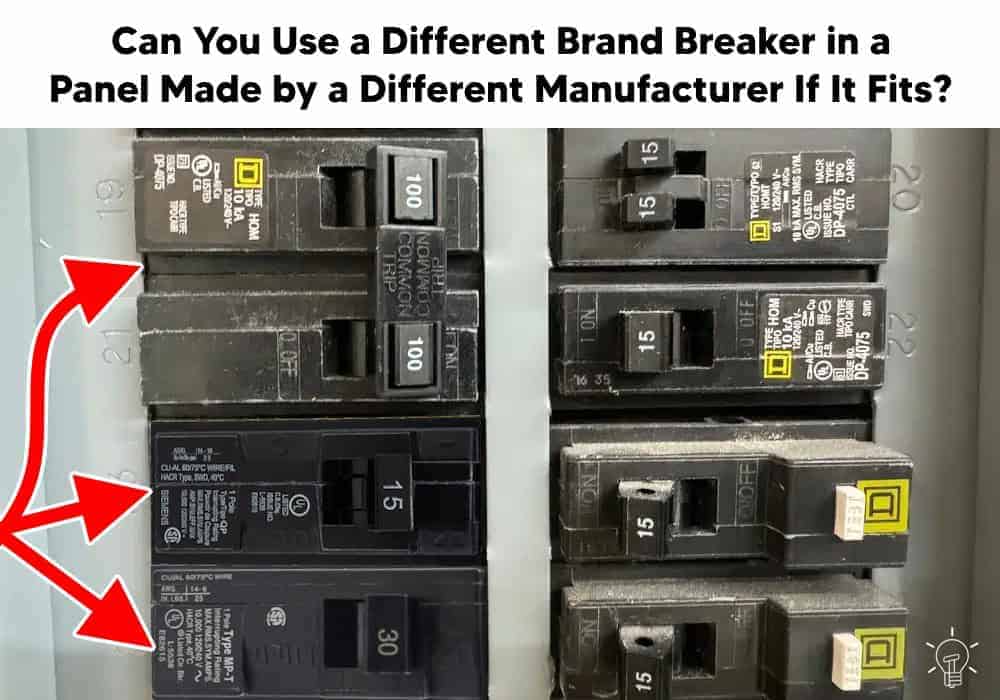
However, the breaker must specifically state compatibility on its label and the panel documentation must allow it.
In case of Square D panels and breakers, they print the following or similar statement with the panel documentation as shown below.
“Use of other than Square D® circuit breakers may adversely affect user safety and impair reliability. Schneider Electric disclaims all liability for damage, injury or non-performance caused by the use or failure of non-Square D circuit breakers.”

Good to Know:
- Specified Breaker: Can only be used in a panel by specified manufacture. The manufacturer of both breaker and panel is same.
- Classified Breaker: Can be used in a panel by different manufacturer (with UL listing). Manufacturer of both breaker and panel are different.
When it is Not Allowed
A specified breaker cannot be used as a replacement or installed in a panel manufactured by a different brand. Specified breakers are those approved by the manufacturer to be installed only in their own panels, not in panels made by other manufacturers.
For example, Leviton smart breakers can only be installed in Leviton smart load centers. Similarly, breakers from other brands (when not listed or approved for that panel) should not be installed in a panel manufactured by a different company.
The panelboard nameplate or the wiring diagram inside the panel door lists the exact breaker types permitted for that load center. Therefore, always use the breaker types and brands specified on the panel label when replacing or installing new breakers.
Breakers from different brands even with same rating may look similar but differ in bus stab contact design, spring tension, heat dissipation, trip characteristics and mechanical retention.
Because of these differences, an incompatible breaker may cause, poor busbar contact, excessive heating, arcing at the stab, breaker not tripping correctly and fire hazard.
NEC 110.3(B) states that equipment must be installed and used according to the manufacturer’s listing and labeling instructions.
In practice this means, each panelboard is tested and listed with specific circuit breakers. Similarly, the manufacturer publishes a list of approved breakers for that panel. In this case, using breakers not on that list violates the listing.
So even if a breaker clips onto the bus stab and appears to fit, it may not be approved for that panel. To avoid the possible troubles in the future, you should not install mix brands of breakers on the same panel.
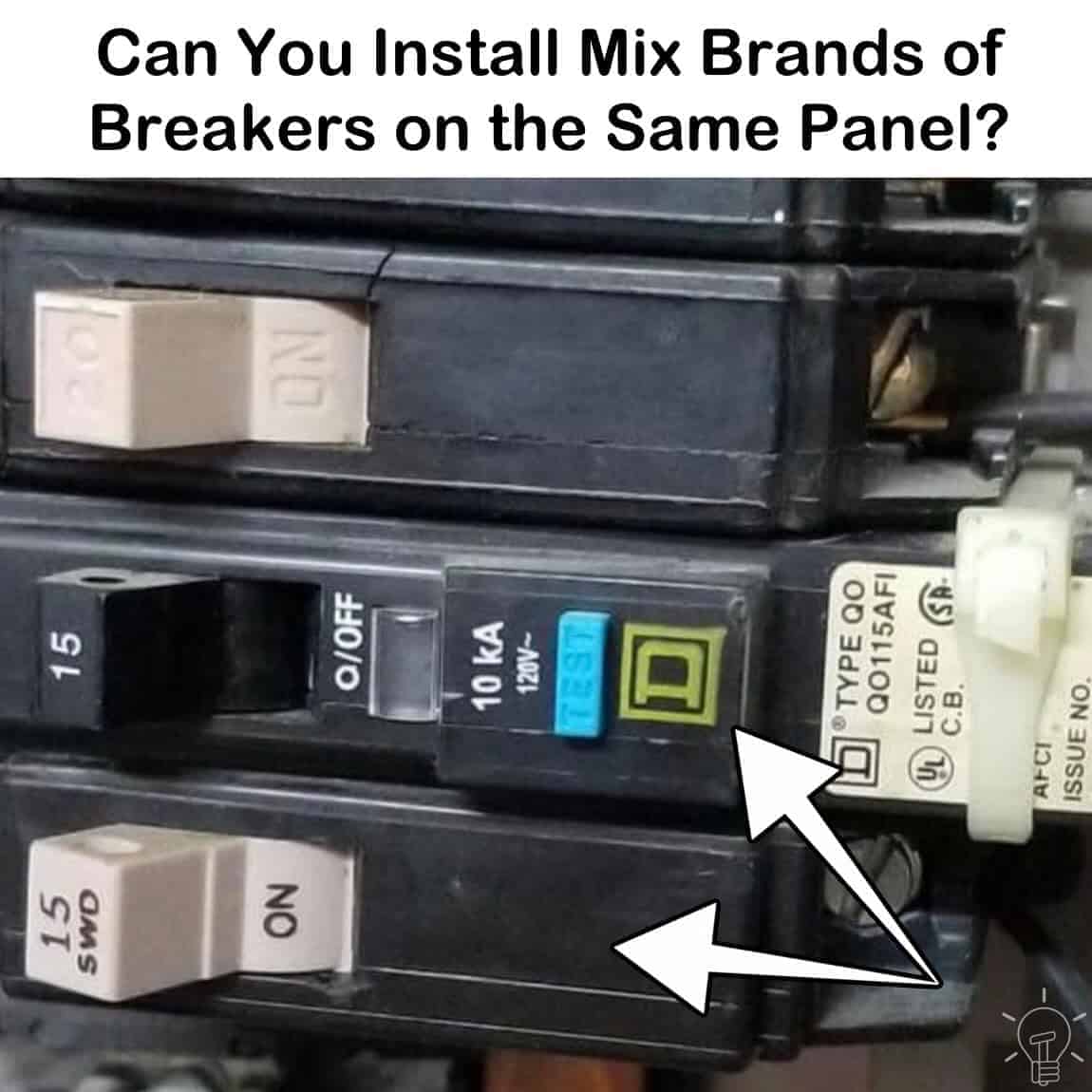
When an inspector finds mismatched circuit breakers (a mix of different brands such as Cutler-Hammer, Square D, Challenger, Leviton, General Electric, ITE, and Siemens) especially in older panels, they often include a note in the inspection report similar to the following.
“This panel contains circuit breakers that were not manufactured by the same company as the panel itself. Panel manufacturers typically void their warranty when breakers from other brands are installed. In addition, this practice may void the panel’s Underwriters Laboratories (UL) listing and could lead to equipment failure, property damage, or personal injury. We recommend evaluation by a licensed electrician and repair, modification or replacement as necessary.”
Good to Know:
- If a breaker does not fit snugly, don’t force to install it. Otherwise, it can cause arcing and damage to the bus bar.
- It is highly recommended to use the exact brand and type specified by the panel manufacturer to ensure safety and code compliance.
Precautions:
- Always disconnect the power supply by switching OFF the circuit breaker at the main service panel before performing any electrical work.
- Electrical equipment must be installed according to manufacturer instructions as required by the NFPA and NEC 110.3(B)).
- Never touch the terminal screws above the main breaker. These terminals are always energized and remain live even when the main breaker is switched OFF.
- If you are unsure about any part of the installation, consult a licensed electrician and ensure compliance with applicable local electrical codes.
Disclaimer: Electrical work is dangerous. The author assumes no responsibility for any loss, injury, or damage resulting from the use or misuse of this information, including improper circuit installation.
Resources:
Related Posts:
- National Electrical Code (NEC) Requirements for Panelboards
- Busbar, Bus Stab, Breaker Slot and Circuit Space in a Panel
- What is a Backfeed Main Breaker in an Electric Panel?
- What is the Max Number of Breakers Allowed in a Main Panel?
- What is Double Tapped Breaker and Double Lug in Main Panel
- What Happens if the Neutral is Lost in the Main or Subpanel?
- Why Must Neutral and Ground Wires Be Bonded in the Main Panel?
- Why are Neutral and Ground Wires Separated in a Subpanel?
- Should GFCI Protection Be in the Main Panel or Receptacle?
- Difference Between BR and CH Breakers and Load Centers
- Difference Between Homeline and QO Breakers and Panels
- Difference Between 1-Pole and 2-Pole Breakers – NEC & IEC
- Can the Neutral Wire Cause Electric Shock? Different Cases
- Will I Get an Electric Shock If I Touch the Ground Wire?
- Will a Man Get an Electric Shock If He Hangs on a Live Wire?
- What Happens When You Touch an Electrical Busbar?
- Can We Use AC Circuit Breaker for DC Circuit & Vice Versa?
- Can I Use a 240V Breaker on a 120V Circuit and Vice Versa?
- Can You Use 15A Breaker on 20A Circuit and Vice Versa?
- What is the White Powder on the Circuit Breaker Terminals?
- Why Doesn’t a Standard Breaker Protract Against Ground Faults?
Sizing & Rating
- How to Size a Load Center, Panelboards and Distribution Board?
- How to Determine the Right Size Capacity of a Subpanel?
- How to Size a Circuit Breaker? Breaker Size Calculator
- How to Determine the Number of Circuit Breakers in a Panel Board?
- How to Find the Right Wire Size for 100A Service 120V/240V Panel?
- What is the Correct Wire Size for 100A Breaker and Load?
- How to Find the Number of Lights on a Single Circuit Breaker?
- How to Size a Breaker and Wires in AWG with EGC for Load?
- How to Size a Breaker and Wires in AWG with EGC for Load?
- How to Size a Branch Circuit Conductors with Protection?
- How to Size Feeder Conductors with Overcurrent Protection
- How to Size Service-Entrance Conductors and Feeder Cables?
- How to Size Equipment Grounding Conductor (EGC)?
- How to Size Grounding Electrode Conductor (GEC)?
- How to Find the Proper Size of Wire & Cable In Metric & Imperial Systems
Wiring Tutorials
- How to Wire 120V & 240V Main Panel? Breaker Box Installation
- How to Wire a Subpanel? Main Lug Installation for 120V/240V
- How to Wire 120V & 208V – 1 & 3-Phase Main Panel? 3-Φ Load Center Wiring
- How to Wire a GFCI Circuit Breaker? 1, 2, 3 4 Poles GFCIs Wiring
- How to wire a GFCI Outlet? GFCI Wiring Circuit Diagrams
- How to Wire an AFCI Combo Switch – AFCI Switch Wiring Diagrams
- How to Wire a Single-Pole Circuit Breaker in a 120/240V Panel
- How to Wire a Two-Pole Circuit Breaker in a 120/240V Panel
-
 Germany’s Electric Drone Hits 699 km/h, Eyes World Record
-
 How to Wire and Use Tesla Gen 3 Mobile Connector Charger
-
 How to Wire 48A Level 2 Dual Port EV Charging Station
-
 How to Wire Smart Electric Vehicle Charging Station – 32A/80A
-
 How to Wire ChargePoint Home Flex Charger for Every EV
-
 How to Wire an EV Wall Charger – Hardwired and Plug-in