Difference Between BR and CH Breakers and Load Centers
CH vs BR Breakers and Panels: What’s the Difference and Where Are They Used?
When choosing an electrical panel or circuit breaker, Eaton (formerly known as Cutler-Hammer) stands out as one of the most trusted manufacturers in residential, commercial, and light-industrial electrical systems. Among Eaton’s most commonly used product lines are the BR and CH breaker and load center series.
CH and BR breakers are low-voltage circuit breakers designed to protect electrical circuits from overloads and short circuits. Each breaker type is specifically engineered to fit only its corresponding panel, ensuring proper mechanical compatibility, dependable electrical connections, and full compliance with UL and NEC requirements.
Likewise, CH and BR panels are two widely used Eaton load centers. While both perform the same essential function i.e. safely distributing electrical power, their build quality, interrupting ratings, and intended applications differ significantly. Although both systems are UL-listed and NEC-compliant, CH and BR breakers and panels are not interchangeable.
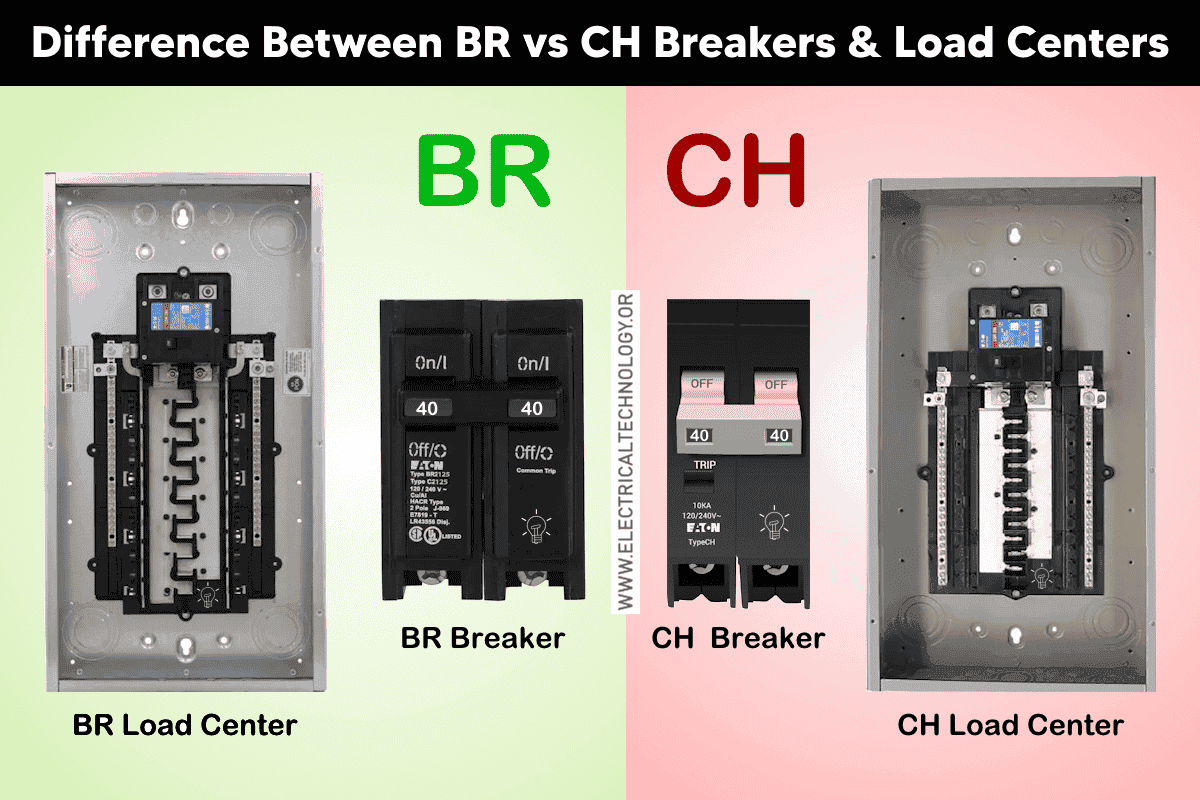
In the following guide, we will explain the difference between CH vs BR breakers, CH vs BR load centers, and identifies where each system is best suited for use.
What is a BR Breaker?
A BR breaker is Eaton’s standard residential circuit breaker line, widely used in homes across North America. BR breakers are cost-effective, reliable, and designed for general residential electrical loads.
BR breakers are 1-inch per pole, 120/240V rated, and fit only BR-type load centers. They are easily identified by their black handle, similar in appearance to many other residential breaker brands.
BR breakers are available in single-pole, double-pole, tandem (two circuits in one slot), and quad configurations. Eaton also offers GFCI, AFCI, and dual-function BR breakers, including Plug-On Neutral (PON) versions for faster installation and reduced panel wiring congestion.
Two-pole BR breakers use an external handle tie or internal common trip, depending on the model, to disconnect both ungrounded conductors during a fault.
BR breakers are primarily intended for residential homes, apartments, and light commercial applications where fault-current levels are moderate.
BR stands for Bryant, a company that originally manufactured these load centers and circuit breakers before the brand became part of Eaton. Today, BR load centers and breakers are produced under the Eaton name.
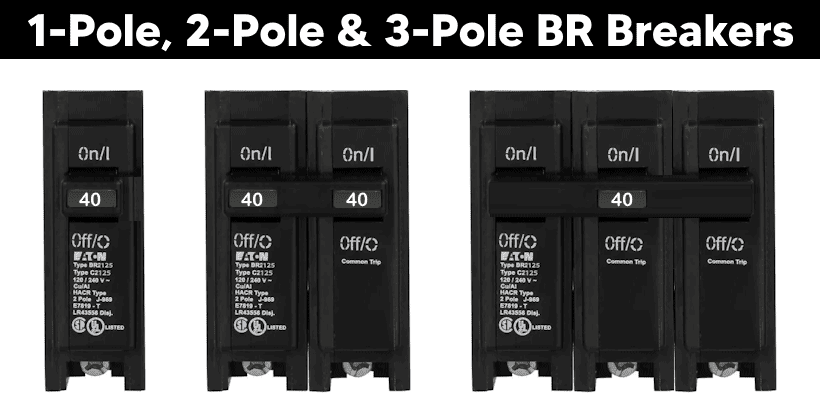
Key Features of BR Breakers
- Designed exclusively for BR panels
- Rated for 120/240V single-phase systems
- Available in 10 to 100A (current rating)
- Typical interrupting rating of 10 kA
- Black handle design
- Available in Duplex and Quadplex (CTL & Non CTL) for standard, tandem, GFCI/AFCI, and dual-function versions
- Budget-friendly and widely available
What is a CH Breaker?
A CH breaker is Eaton’s premium residential and commercial-grade circuit breaker, originally developed under the Cutler-Hammer brand. These breakers are known for their robust construction, copper bus compatibility, and high fault-current ratings.
CH breakers are ¾-inch per pole, 120/240V rated, and are designed exclusively for CH load centers. A defining feature of CH breakers is their tan-colored handle, which makes them easy to identify in the field.
CH breakers are available in single-pole, double-pole, and triple-pole configurations, along with advanced protection options such as GFCI, AFCI, and dual-function (AFCI + GFCI) breakers. Two-pole and three-pole CH breakers use a common internal trip mechanism, ensuring all phases disconnect simultaneously when a fault occurs on any one phase.
Because of their durability and higher interrupting ratings, CH breakers are commonly used in commercial buildings, premium residential installations, and high fault-current environments.
CH stands for Cutler-Hammer, another well-known electrical brand that was acquired by Eaton. The CH line continues to be recognized for its higher construction quality and premium performance. CHF vs. CH: CHF breakers are a subset of the CH line that include a “trip flag” to easily identify a tripped circuit, which standard CH breakers lack. CHF breakers are designed to be fully interchangeable with older standard CH breakers in Eaton/Cutler-Hammer panels.
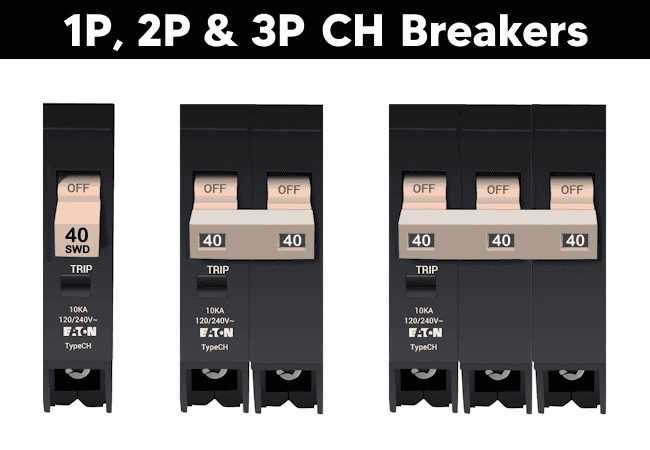
Key Features of CH Breakers
- Designed exclusively for CH panels
- Rated for 120/240V (single-phase and selected three-phase systems)
- Current rating is 10-100A
- Typical interrupting rating of 10–22 kA
- Tan handle for easy identification
- Thermal-magnetic trip mechanism
- Available in Twin (CHT) for standard, GFCI, AFCI, and dual-function types (in Universal CTL/non-CTL versions)
Key Differences between CH vs BR Breakers
| Feature | BR Breaker | CH Breaker |
| Application | Residential | Commercial / Premium Residential |
| Voltage Rating | 120/240V, 1-Phase | 120/240V, 1 & 3-Phase |
| Size | 1 inch per pole | ¾ inch per pole |
| Breaker & Handle Color | Black Body / Black Handle | Black Body / Tan Handle |
| Interrupting Rating (kAIC) | 10 – 65 | 10 |
| Durability | Standard | High |
| Price | Lower | Higher |
| Panel Compatibility | BR panels only | CH panels only |
What is a BR Load Center?
A BR panel is Eaton’s standard residential load center, designed for affordability and ease of installation. BR panels typically use aluminum bus bars and accept 1-inch BR breakers.
These panels are designed for single-phase 120/240V systems, with common main breaker ratings from 100A to 200A (even available in 600A) with max 60 spaces & 42 to 120 circuits. Many modern BR panels support Plug-On Neutral (PON) breakers, reducing wiring time and improving panel organization.
BR panels are widely used in homes, apartments, and small commercial spaces where fault-current levels are relatively low.
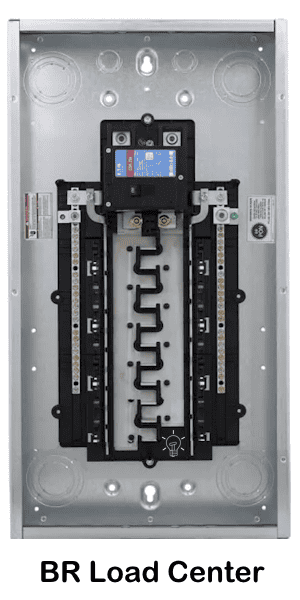
Characteristics of BR Panels
- Aluminum bus bars
- Standard residential short-circuit ratings
- Supports tandem and quad breakers
- Cost-effective design
- NEC and UL compliant
CH breakers do not fit BR panels, and BR breakers do not fit CH panels. Only CH and CHD models are interchangable. Forcing mismatched breakers is unsafe and violates manufacturer instructions and NEC requirements.
What is a CH Load Center?
A CH panel is Eaton’s premium load center, designed for higher performance and long-term reliability. CH panels use copper bus bars, which provide superior conductivity, reduced heat buildup, and greater resistance to corrosion compared to aluminum.
CH load centers support ¾-inch CH breakers, allowing more circuits in the same enclosure size. They are also available in Plug-On Neutral (PON) load centers for quicker, easier and cleaner installations. These panels are suitable for single-phase and selected three-phase systems, with main breaker ratings typically ranging from 100A to 400A, depending on configuration such as 120/240V single-phase or three-phase four-wire, 208Y/120V or 240V AC
CH panels are commonly installed in commercial buildings, workshops, industrial facilities, and high-end residential projects in both single-phase and three-phase power supply systems.
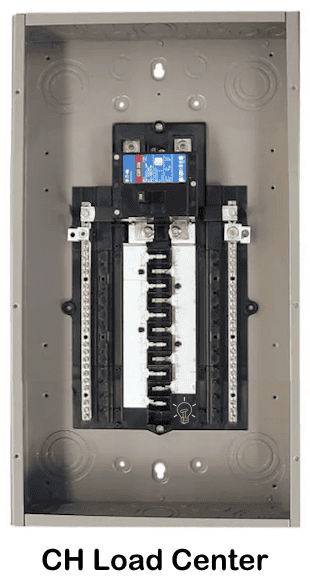
Characteristics of CH Panels
- Copper bus bars
- High short-circuit withstand ratings
- Compact breaker footprint
- Professional-grade construction
- Meets NEC and UL standards
Comparison of BR vs CH Panels
| Feature | BR Panel | CH Panel |
| Breaker Type | BR only | CH only |
| Bus Material | Aluminum | Copper |
| Breaker Size | 1 inch | ¾ inch |
| Fault Current Rating | Lower | Higher |
| Color | Gray | Tan |
| Build Quality | Standard | Premium |
| Supply System | 1-Phase | 1-Phase / or 3-Phase |
| Cost | Lower | Higher |
| Applications | Residential | Commercial / Premium Residential |
Where are CH and BR Systems Used?
BR System is Best For
- Residential homes
- Apartments
- Small offices
- Light electrical loads
- Budget-friendly installations
CH System is Best For
- Commercial buildings
- Industrial or workshop environments
- High fault-current locations
- Critical electrical loads
- Premium residential installations
Which One Should You Choose?
- Choose BR if you need a reliable, cost-effective solution for standard residential wiring and everyday household loads.
- Choose CH if you require higher durability, better fault-current handling, copper bus construction, and long-term reliability, especially in commercial or high-end residential applications.
Both systems are UL-listed and NEC-compliant when installed correctly, but CH clearly stands out where performance, longevity, and safety margins matter most.
FAQ
Can I use a CH breaker in a BR panel?
No. They are mechanically and electrically incompatible.
Is CH better than BR?
Yes, in terms of durability, fault-current rating, and build quality. BR is better for budget-focused residential projects.
Are CH panels worth the extra cost?
For commercial, industrial, or premium residential installations, yes!. They are premium panels by Eaton.
Can You Use Eaton BR or CH breakers in Square D Homeline or QO Panels? Caution: Although an Eaton BR breaker (1-inch) or CH breaker (3/4-inch) may appear to physically fit into a Square D Homeline or QO panel due to similar breaker widths, their use is neither approved nor recommended. Similer is the case for ABB, Leviton, Siemens Breakers i.e. they should not be used in different panels manufactured by different brands. Square D Homeline and QO panels are specifically tested and UL-listed only for use with their corresponding Homeline and QO breakers. Installing an Eaton BR or CH breaker in these panels can violate NEC and UL listing requirements, void manufacturer warranties, and create potential safety hazards, including overheating or arcing caused by improper bus bar connections.
Resources:
- Difference Between Homeline and QO Breakers and Panels
- National Electrical Code (NEC) Requirements for Panelboards
- Difference Between 1-Pole and 2-Pole Breakers – NEC & IEC
- Difference Between Circuit Breaker and GFCI
- Should GFCI Protection Be in the Main Panel or Receptacle?
- How Does a Standard Breaker Respond to Electrical Fault?
- Why Doesn’t a Standard Breaker Protract Against Ground Faults?
- How Do GFCI and Standard Breakers Respond to Ground Faults?
- Can you use 15A Breaker on 20A Circuit and Vice Versa?
- Can I Use a 1-Phase Breaker on a 3-Phase Supply & Vice Versa?
- Can I Use a 240V Breaker on a 120V Circuit and Vice Versa?
- Can You use a 15A Outlet on a 20A Circuit and Vice Versa?
Standard Breakers & GFCI Breakers Wiring Installations
- How to Wire a 1-Pole GFCI
- How to Wire a 2-Pole GFCI
- How to Wire a 3-Phase, 3-Pole GFCI
- How to Wire a 1-Pole Breaker
- How to Wire a 2-Pole Breaker
- How to Wire a 3-Pole Breaker
- How to Wire a Tandem Breaker
- How to Wire GFCI Circuit Breakers
- How to Wire an AFCI Breaker
General Outlets and GFCI/AFCI Receptacles Wiring
- How to Wire an Outlet Receptacle? Socket Outlet Wiring Diagrams
- How to wire a GFCI Outlet?
- How to Wire GFCI Combo Switch and Outlet
- How to Wire an AFCI Combo Switch
- How to Wire an AFCI Outlet?
- How to a Wire 3-Way Combination Switch and Grounded Outlet?
- How to Wire Combo Switch and Outlet? – Switch/Outlet Combo Wiring Diagrams
- How to Wire a 15A – 120V Outlet – NEMA 5-15 Receptacle
- How to Wire a 20A – 120V Outlet – NEMA 5-20 Receptacle
- How to Wire a 15A – 240V Outlet – NEMA 6-15 Receptacle
- How to Wire a 20A – 240V Outlet – NEMA 6-20 Receptacle
- How to Wire a 50A – 125/250V Outlet – NEMA 14-50 Receptacle
Sizing Breakers, Wires, and Panels
- How to Size a Circuit Breaker?
- How to Size a Breaker and Wires in AWG with EGC for Load?
- How to Find the Proper Size of Wire & Cable In Metric & Imperial Systems
- How to Size a Load Center, Panelboards and Distribution Board?
- How to Determine the Right Size Capacity of a Subpanel?
- How to Find the Right Wire Size for 100A Service 120V/240V Panel?
- How to Determine the Number of Circuit Breakers in a Panelboard?
- How to Find the Number of Outlets on a Single Circuit Breaker?
- How to Size Service-Entrance Conductors and Feeder Cables?
- How to Size Feeder Conductors with Overcurrent Protection
- How to Size a Branch Circuit Conductors with Protection?
- How to Size Equipment Grounding Conductor (EGC)?
- How to Size Grounding Electrode Conductor (GEC)?
- How to Size Motors FLC, HP, Voltage, Breaker Size and Wire Size
- What is the Correct Wire Size for 100A Breaker and Load?
- What is the Right Wire Size for 15A Breaker and Outlet?
- What is the Suitable Wire Size for 20A Breaker and Outlet?
Main Panels Wiring Tutorials
- How to Wire 120V/240V Main Panel? Breaker Box Installation
- How to Wire 208V/120V, 1-Phase & 3-Phase Main Panel?
- How to Wire 240V, 208V & 120V, 1 & 3-Phase, High Leg Delta Main Panel?
- How to Wire 277V/480V, 1-Phase & 3-Phase Main Service Panel?
- How to Wire a Subpanel? Main Lug Installation for 120V/240V
- Single Phase Electrical Wiring Installation in Home according to NEC & IEC
- Three Phase Electrical Wiring Installation in Home – NEC & IEC
- How To Wire a Single Phase kWh Meter – 120V/240V
- How to Wire a Three-Phase Meter? 120/208/240/277/347/480/600V