Why Does the Circuit Breaker Turn ON in the Opposite Direction Compared to General Wall Light Switches?
In residential 120/240V electrical panels following NEC/UL standards (common in North America), the main breaker, standard branch circuit breakers, and general wall-mounted toggle switches are typically ON when the handle is UP and OFF when it is DOWN.
However, in most countries following IEC standards (common in UK, Europe, Asia, Africa, etc.), main and general circuit breakers in 230V consumer units are designed according to IEC standard. In these systems, flipping the handle UP means ON, and DOWN means OFF for Main breakers. While the case is opposite for general switches and pushbutton light switches e.g. it operates in reverse orientation other than main circuit breakers and switches i.e. pressing UP indicates OFF and DOWN indicates ON.
It shows the operating mechanisms and conventions for circuit breakers and light switches differ between regions that follow IEC versus NEC standards.
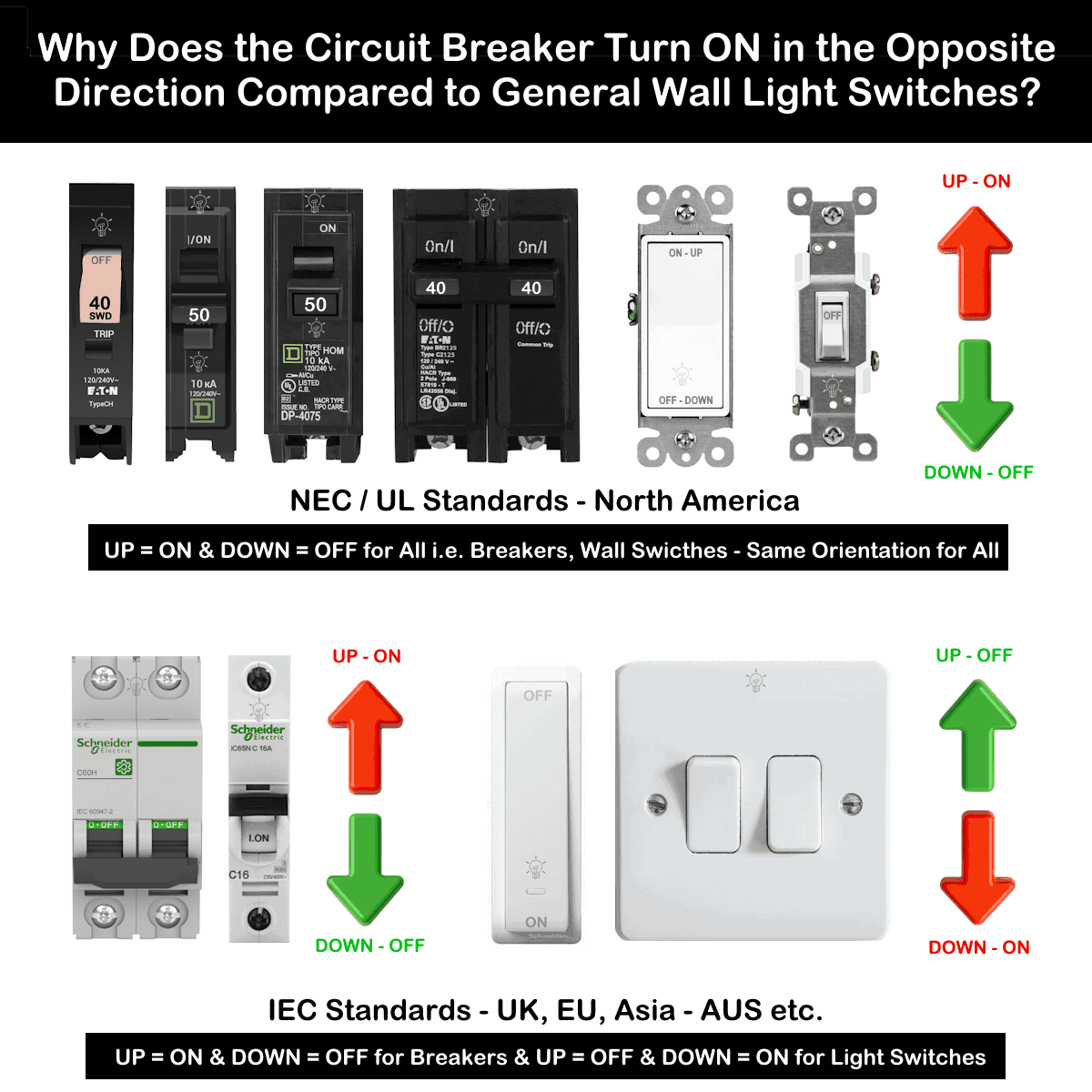
Now, the key question is why do main breakers in IEC systems turn ON when flipped upwards, while light switches turn ON when flipped downwards? Why not to use the same orientation like in the NEC standards when UP is used for ON and Down is used for OFF?
Opposite Switching Mechanism of Breakers vs Switches
IEC/UL Standards
AC miniature breakers (MCBs) are designed in accordance with safety standard IEC 60898-1 for for residential, and light commercial wiring systems where Up means ON and Down means OFF. The same design is followed by both IEC and UL standards for safety purposes.
In IEC following regions, light switches and pushbuttons on electrical devices turn ON when pressed downwards because this design is based on human ergonomics i.e. pushing down is naturally easier for us especially in dark locations. In NEC following areas, the case is opposite. This design is safer because, for example, if someone accidentally falls onto a switch, it will turn OFF, which could be dangerous in case of opposite orientation.
On the other hand, breakers or main switches turn ON when flipped upwards. In the case of circuit breakers, the ON/OFF operation is not performed as frequently as with light switches. Instead, it is carried out intentionally, with greater attention and for specific purposes.
Gravity & Safety
The main reason for turning the breaker ON in the upward direction is safety. For instance, when a short circuit or fault occurs and the breaker trips, gravity automatically pulls the handle downward and disconnect the main power supply.
If the breaker were designed to be ON when downward, a loose handle or any impact could accidentally switch it back ON, which would be highly dangerous.
Emergency OFF
From the perspective of human psychology and physical anatomy, it is much easier and faster to push or drop something downward. In an emergency, if you need to switch off the power quickly, you can flick the breaker down with one swift motion. This is why the ‘OFF’ position of a circuit breaker is always designed to be downward.
Clear Identification
This design ensures that the power supply is fully connected only in the upward position. The overall purpose of these different designs is both convenience and safety. It significantly reduces the chance of power being accidentally switched ON by mistake.
The design is also made different to clearly distinguish between a normal switch and a circuit breaker:
- Normal Switch: It only controls a light or fan
- Breaker: It protects the entire circuit (sub-circuit or final-circuit). Turning it ON in the upward direction clearly shows that the system is under load and actively working.
Hence, it is easy to identify whether the main breaker is ON or OFF just by looking at the position of its handle in the consumer unit. This is especially important for electricians or anyone working on the circuit during troubleshooting, maintenance, repair, or when working on other branch circuit breakers inside the consumer unit.
Good to Know:
- Electrical panels and load centers in the U.S. are generally installed in a vertical orientation (though not always), where the breakers are mounted in a horizontal position.
- On the other hand, single-phase 230V consumer units used in the UK, EU, Australia, Asia, and other IEC-based regions are typically installed in a horizontal orientation, with breakers mounted in a vertical position.
- In addition, 400V three-phase distribution boards in IEC-following countries are generally installed in a vertical orientation, where the breakers are mounted horizontally, similar to NEC panelboards and load centers.
Related Posts:
- National Electrical Code (NEC) Requirements for Panelboards
- IEC and BS 7671 Requirements for Consumer Unit and Distribution Board
- Can We Use AC Circuit Breaker for DC Circuit & Vice Versa?
- Can I Use a Different Brand Breaker in a Panel if it Fits?
- Difference Between Specified & Classified Circuit Breakers
- Difference Between BR and CH Breakers and Load Centers
- Difference Between Homeline and QO Breakers and Panels
- Difference Between 1-Pole and 2-Pole Breakers – NEC & IEC
- Busbar, Bus Stab, Breaker Slot and Circuit Space in a Panel
- What is a Backfeed Main Breaker in an Electric Panel?
- What is the Max Number of Breakers Allowed in a Main Panel?
- What is Double Tapped Breaker and Double Lug in Main Panel
- What Happens if the Neutral is Lost in the Main or Subpanel?
- Why Must Neutral and Ground Wires Be Bonded in the Main Panel?
- Why are Neutral and Ground Wires Separated in a Subpanel?
- Should GFCI Protection Be in the Main Panel or Receptacle?
- Can the Neutral Wire Cause Electric Shock? Different Cases
- Will I Get an Electric Shock If I Touch the Ground Wire?
- Will a Man Get an Electric Shock If He Hangs on a Live Wire?
- What Happens When You Touch an Electrical Busbar?
- Can I Use a 240V Breaker on a 120V Circuit and Vice Versa?
- Can You Use 15A Breaker on 20A Circuit and Vice Versa?
- What is the White Powder on the Circuit Breaker Terminals?
- Why Doesn’t a Standard Breaker Protract Against Ground Faults?
- Why is Earth Pin Thicker and Longer in a 3-Pin Plug?
- Why Do Prongs in Electrical Plugs Have Holes in Them?
- Why is the Neutral Prong or Slot Wider on a Plug or Outlet?
-
 Germany’s Electric Drone Hits 699 km/h, Eyes World Record
-
 How to Wire a Countdown Timer Switch – 15 Mins to 12Hrs
-
 Arkansas School Uses Rooftop Solar to Raise Teacher Pay
-
 How to Wire a Smart Switch Companion with a Smart Switch
-
 Why are Inductive & Capacitive Reactances Measured in Ohms?
-
 What Happens If You Install a Larger Capacitor in a Fan?