What Do the TEST and RESET Buttons Mean on GFCI Breakers and Outlets?
Why Do Some Breakers in My Panel Have a TEST/RESET Buttons?
Not all breakers look the same inside a load center. If you open your electrical panel cover, you will see different types of breakers.
Standard breakers, without TEST or RESET buttons, are used to protect branch-circuit conductors and connected loads from overcurrent and short circuits. For example, a 15A breaker will trip automatically when the current flowing through the circuit exceeds 15 amps. As a result, it disconnects the power and protects the entire circuit from overheating, damage, or fire hazards.
Other than ordinary breaker in the panel, you may see breakers with a TEST and RESET button. Those are GFCI, AFCI (or combo of AFCI/GFCI) breakers. Similar is the case with standard outlets and AFCI/GFCI receptacle.
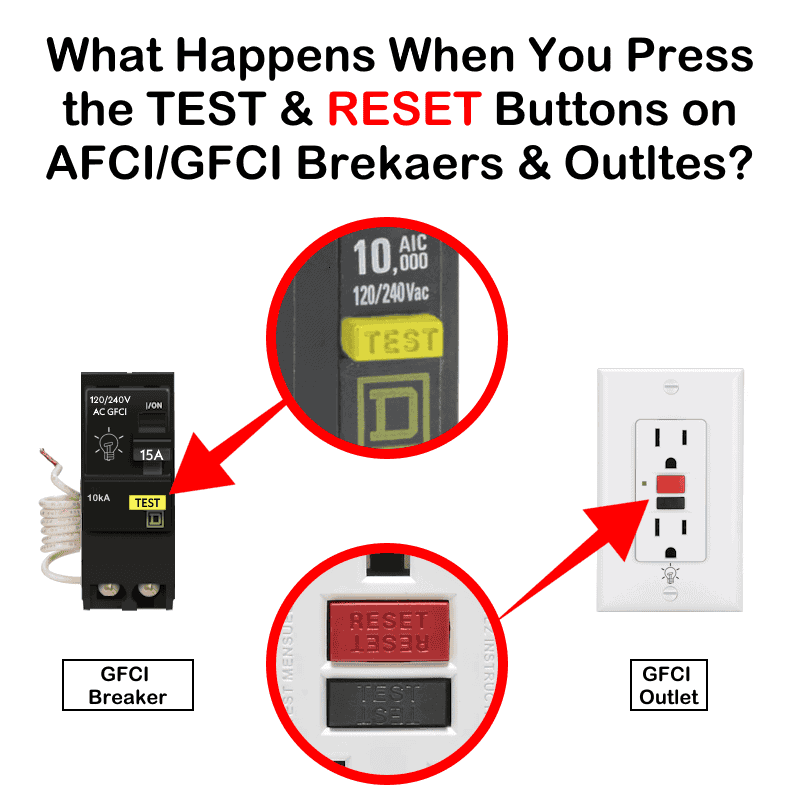
TEST/RESET Buttons on GFCI/AFCI Breakers and Outlets
You will find these buttons on the following protective devices used to protect different parts of your home.
- GFCI breakers
- AFCI breakers
- Combo of AFCI/GFCI (CAFCI) breakers
- AFCI/GFCI outlets and receptacles
- Some surge protection and safety devices
GFCI Breaker
A GFCI stands for Ground Fault Circuit Interrupter. It is a safety device used to protect a person from electric shock. It constantly monitors the flow of electricity through the branch circuit connected to it. If it detects even a tiny imbalance (as small as 5 milliamps of leakage current due to ground fault), it cuts power almost instantly. That reaction happens in milli second, so that, it can protect against electric shock.
They are installed to protect an entire circuit. One GFCI breaker can protect every outlet, light, and appliance on that circuit.
This is common in older homes. An electrician may have upgraded a circuit by installing a GFCI breaker instead of replacing every individual outlet.
Good to Know: National Electrical Code (NEC) Article – 210.8(A)(1) through (A)(11), 406.3(D)(2), and (3) requires GFCI protection (via GFCI breaker or outlet) in bathrooms, kitchens, garages, wet or dump areas, crawl spaces, and outdoor circuits at the panel level.
AFCI Breaker
An AFCI means Arc Fault Circuit Interrupter. It protects against electrical arcing, damaged wires and fire hazards. These breakers are used for connected load in bedrooms, living rooms and other residential branch circuits (required by NEC).
It detects arc faults whenever sparking occurs between one wire or between two adjacent wires. This is one of the main causes of electrical fire hazards in wooden homes, which is why AFCI protection is required in dwelling units.
Some modern breakers combine both GFCI protection and AFCI protection in a single unit which is known as Dual-Function Breakers. The newer version known as combination AFCI (CAFCI) is required in almost all 120V circuit in a residential unit (home).
AFCI / GFCI Outlet
In addition to AFCI and GFCI breakers, Test and Reset buttons are also found on GFCI outlets and receptacles. Some outlets are combination AFCI/GFCI devices. These buttons are not present on standard outlets or receptacles.
The main purpose of AFCI or GFCI outlet is same as AFCI/GFCI breaker i.e. it protects against ground faults and arc faults.
An AFCI or GFCI breaker is installed in the electrical panel when the entire circuit, or a multiwire branch circuit (MWBC), needs protection. It is also an option when you are out of space in the panel and want an independent protection for one or two outlets only. For more details, see Should GFCI Protection Be in the Main Panel or Receptacle?
On the other hand, a GFCI outlet is often used on a multiwire branch circuit for specific appliances, server rooms, or hospital equipment where protecting the entire circuit with a GFCI or AFCI breaker is not desirable.
This helps prevent nuisance tripping that could otherwise shut off the entire circuit and interrupt critical equipment or devices.
The Test and Reset buttons on the breaker works the same way as the one on an outlet. Press it to test and he breaker will trip. Similarly, press RESET to restore power. Let’s see how it works as follows.
- Related Post: GFCI Outlet – Line vs Load – What is the Difference?
What Happens When You Press the TEST Button?
The TEST button on a GFCI breaker and outlets is used to verify proper operation, detect failed or damaged devices and confirm shock protection is active.
Pressing TEST intentionally triggers the GFCI. It simulates a ground fault by intentionally creating a small imbalance in current flow. The device checks whether the protection system is working properly. It immediately cuts power to the outlet or circuit.
- On a GFCI breaker, the breaker handle may move to the TRIPPED position and the entire circuit it controls will go dead. Lights, outlets, and appliances on that circuit will all shut off.
- On a GFCI outlet, RESET button pops out and the small indicator light may go out. Any device plugged into that outlet will lose power.
This means the safety mechanism is working and nothing is broken. This is exactly what is supposed to happen.
You should press the TEST button once a month. This confirms the device is working properly. A GFCI that does not trip when tested is faulty and should be replaced.
What Happens When You Press the RESET Button?
RESET restores power after the GFCI has tripped.
Good to Know: Most Ground Fault Circuit Interrupter (GFCI) breakers have a RESET function, but it is usually combined with the breaker handle itself rather than a separate large “RESET” button like on a GFCI outlet.
Once you press RESET button, you should hear a click. In this case, the internal mechanism reconnects the circuit power flows again and the GFCI outlet or breaker returns to normal operation.
- On a GFCI breaker, pressing RESET restores the full circuit. Everything that was shut off will power back on.
- On a GFCI outlet, pressing RESET brings the outlet back to life. Any device plugged in will work again.
If the RESET button will not stay in, something is wrong. The GFCI may still be detecting a fault a real ground fault exists in the circuit. Check for a wet outlet, a faulty appliance, or a wiring problem. If there is no fault at all, it indicates the device is defective and need to be replaced with a new one.
In this condition, the problem should be inspected before restoring power. Do not force it and call a licensed electrician if the problem continues.
Good to Know: NEC Article 210.12 in accordance with 210.12(B) through (E), requires AFCI protection in all new constructions, dormitories, dwelling units, bedrooms, living rooms, and other similar residential areas.
Safety Precautions:
- Always disconnect the main power supply before doing any electrical work.
- GFCI/AFCI devices are one of the most important safety devices required by NEC in your home.
- The TEST button makes sure they are working. The RESET button brings them back after they do their job.
- Always test AFCI and GFCI devices regularly. It takes seconds, but could prevent a fatal shock.
- If RESET will not stay in, there may be a real ground fault or the device is faulty. Call an electrician.
- Never bypass or tape down the Test/Reset buttons.
- If an AFCI or GFCI trips on its own (without you pressing TEST) take it seriously. Something on that circuit caused it. Find the cause before you reset it. When in doubt, call a licensed electrician.
Disclaimer:
The author assumes no responsibility for any loss, injury, or damage resulting from the use or misuse of this information, including improper circuit installation. Electrical work can be hazardous and should only be performed with proper knowledge and safety precautions. Always exercise extreme caution when working with electricity.
Resources:
Comparison
- Difference Between GFCI and Circuit Breaker
- Difference Between GFCI and AFCI
- Difference Between 15-Amp and 20-Amp Outlet?
- Difference Between MCB, MCCB, ELCB, RCD & RCBO Breakers
- Difference Between NEMA 14-50 Standard Vs EV Receptacle
- Difference Between Socket, Outlet and Receptacle
- Difference Between 1-Pole and 2-Pole Breakers
- Difference Between EGC and GEC in Electrical Grounding
Related GFCI Wiring Tutorials
- How to Wire 1-P & 2-P, 1-Phase & 3-P, 3-Phase GFCI Breakers
- How to Wire a 1-Pole GFCI Breaker
- How to Wire a 2-Pole GFCI Breaker
- How to Wire a 3-Phase, 3-Pole GFCI Breaker
- How to Wire an AFCI Breaker?
- How to Wire a Smart GFCI Breaker
- How to Wire Smart AFCI/GFCI Breaker
- How to Wire a GFCI Outlet – Wiring a GFCI Receptacle
- How to Wire Wi-Fi Smart GFCI Outlets
- How to Wire GFCI Combo Switch and Outlet
- How to Wire an AFCI Outlet?
- How to Wire an Outlet Receptacle?
- How to Wire a 1-Pole Breaker
- How to Wire a 2-Pole Breaker
- How to Wire a 3-Pole Breaker
- How to Wire a Smart Breaker
Related Posts:
- Why Do We Need a GFCI & How Does it Protect During Faults?
- How Do GFCI and Standard Breakers Respond to Ground Faults?
- How to Find the Number of Outlets on a Single Circuit Breaker?
- How to Find Voltage & Ampere Rating of Switch, Plug, Outlet & Receptacle
- Can You use a 15A Outlet on a 20A Circuit and Vice Versa?
- What Happens if You Use a 120V Device on 240V & Vice Versa?
- Can I Use a 240V Breaker on a 120V Circuit and Vice Versa?
- Ground Terminal Up or Down: Which Way Should Outlets Face?
- What Do the Green Dot or Orange Triangle Outlets Mean?
- What Do the Different Colors of Electrical Outlets Indicate?
- Why are Outlets and Receptacles in Hospitals Upside Down?
- How to Size a Load Center, Panelboards and Distribution Board?
- How to Determine the Number of Circuit Breakers in a Panelboard?
- How to Find the Proper Size of Circuit Breaker? Breaker Size Calculator & Examples
- How to Find The Suitable Size of Cable & Wire for Electrical Wiring Installation?
- Why is the Neutral Prong or Slot Wider on a Plug or Outlet?
- What Will Happen If You Connect a Male-to-Male Plug Between Outlets
- Will a Man Get an Electric Shock If He Hangs on a Live Wire?
- Can the Neutral Wire Cause Electric Shock? Different Cases
- Will I Get an Electric Shock If I Touch the Ground Wire?
-
 Germany’s Electric Drone Hits 699 km/h, Eyes World Record
-
 How to Wire and Use Tesla Gen 3 Mobile Connector Charger
-
 How to Wire 48A Level 2 Dual Port EV Charging Station
-
 How to Wire Smart Electric Vehicle Charging Station – 32A/80A
-
 How to Wire ChargePoint Home Flex Charger for Every EV
-
 How to Wire an EV Wall Charger – Hardwired and Plug-in