What is the Average Life Span of a Circuit Breaker?
Every device and piece of equipment eventually reaches the end of its service life. The same applies to electrical equipment. The lifespan of an electrical device depends on multiple factors, including design quality, operating conditions, loading, maintenance practices, environmental conditions, and manufacturing standards.
For example, the average life expectancy of a power transformer is 20-30 years, according to IEEE/ANSI C57.96. However, actual lifespan can vary significantly. Some transformers may require replacement well before this period due to overloading, insulation deterioration, moisture ingress, poor maintenance, or fault conditions, while others remain in reliable operation long beyond their expected service life through proper maintenance and favorable operating conditions.
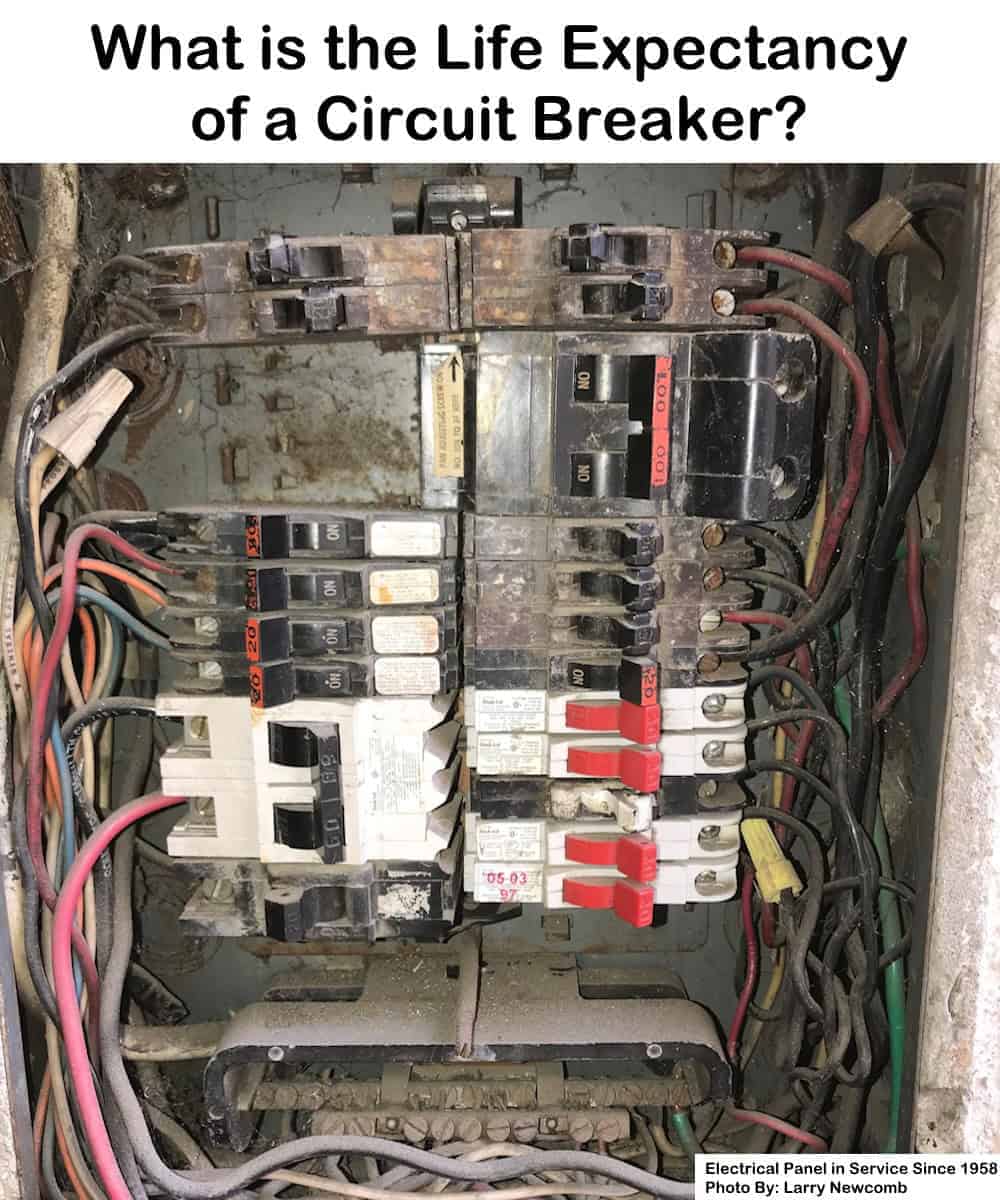
Life Expectancy of Circuit Breakers
The life expectancy of a circuit breaker depends on its type, quality, operating conditions, and the number of times it interrupts fault currents. Manufacturers usually specify breaker life in terms of mechanical life and electrical life rather than years.
| Type of Life | Description | Typical Rating |
| Mechanical Life | Number of times the breaker can be switched ON and OFF without load or under normal operating conditions. | 10,000-20,000 operations for residential MCBs; up to 100,000+ operations for industrial breakers |
| Electrical Life | Number of times the breaker can safely interrupt rated load current or fault current. | 2,000-10,000 operations depending on breaker type and rating |
According to the Consumer Product Safety Commission (CPSC), the average service life of a circuit breaker is approximately 35 years. The same general principle applies to other protective devices, such as Arc-Fault Circuit Interrupters (AFCIs) and Ground-Fault Circuit Interrupters (GFCIs).
The following table (by CPSC) shows the average life expectancy of standard circuit breakers and compares it with the expected lifespan of other common electrical devices and components.
| Electrical Equipment and Devices Average Life Expectancy | |
| Component | Service Life |
| Electrical Panel | 50+ years |
| Standard Circuit Breaker (MCB/MCCB) | 35 years |
| AFCI/CAFCI Circuit Breaker | 35 years |
| GFCI Circuit Breaker | 35 years |
| GFCI Receptacle | 20 years |
| Exterior Light Fixture | 35 years |
| Interior Light Fixture | 45 years |
| Wall Switch | 35 years |
| Receptacle Outlet | 50+ years |
| Wire Metal Conductor | 100+ years |
| Wire Insulation | 70 years |
| Whole-House Generator | 12 years |
| Whole-House Surge Protector (SPD) | 3 years |
Similarly, under normal operating conditions and with proper maintenance, the expected service life of an Air Circuit Breaker (ACB) is typically 20-40 years, a Vacuum Circuit Breaker (VCB) can last 20-30+ years, and an SF6 Circuit Breaker can remain in service for 30-40+ years.
Good to Know: The National Electrical Code (NEC) does not require circuit breakers to be replaced after a specific number of years. A breaker can remain in service as long as it is in good condition and functions properly. However, manufacturers and electrical inspectors often recommend testing or replacement if a breaker shows signs of aging, damage, or unreliable operation.
Factors that Affect the Breaker Life Span
The biggest threats to breaker longevity are heat, moisture, frequent fault events, and poor connections. Regular panel inspections, proper installation, and keeping electrical loads balanced go a long way toward maximizing breaker lifespan.
A circuit breaker may wear out sooner if it experiences:
- Frequent tripping due to overloads or short circuits
- High fault-current interruptions
- Excessive switching operations
- Overheating caused by loose connections
- Moisture, corrosion, dust, or chemical contamination
- High ambient temperatures
- Mechanical damage or vibration
One of the most important factors is to always use a properly sized circuit breaker for the specific residential or commercial application. Wrong breaker for the application using a residential-grade breaker in a commercial or high-cycle application, or mismatching the breaker’s interrupting rating to the available fault current, shortens life significantly.
Another factor affecting circuit breaker lifespan is the aging of the bimetallic strip, which responds to thermal overloads. Over time, it can lose calibration. In this case, the breaker may trip too early or (more dangerously) too late.
Likewise, the springs within the trip mechanism gradually lose tension with age. Reduced spring force can slow the breaker’s operation or impair its ability to trip reliably when required.
To help extend the service life of your circuit breakers, inspect them periodically and exercise them at least once a year by switching each breaker OFF and ON three times. This helps ensure that the internal operating and tripping mechanisms remain free-moving and function properly when needed.
Before performing this procedure, make sure that the loads connected to the breakers are turned off or unplugged whenever possible. This precaution is important because inductive loads, such as motors, compressors, refrigerators, freezers, air conditioners, and similar equipment, can be adversely affected by repeated power interruptions within a short period of time.
Disconnecting or turning off these devices before exercising the breakers helps prevent unnecessary stress on the equipment and reduces the possibility of nuisance trips or startup-related issues.
Regular inspection and maintenance can improve the reliability and safety of the electrical system while helping maximize the useful life of the breakers.
When to Change the Breaker?
The primary purpose of a circuit breaker is to protect a home or electrical installation from fire hazards and equipment damage caused by overcurrent conditions. Its job is to automatically trip and disconnect the power supply whenever excessive current flows through the branch-circuit conductors to the load.
If a circuit breaker becomes faulty, it may fail to trip during an overload or short-circuit condition. As a result, current exceeding the breaker’s rated capacity can continue to flow through the conductors. This excessive current can overheat the wires, damage or melt their insulation, and significantly increase the risk of an electrical fire.
In such cases, replacing the faulty circuit breaker is mandatory to maintain the safety and protection of the electrical system.
If you notice the following signs, replace the circuit breaker with new one immediately.
Signs a Circuit Breaker May Need Replacement
- Nuisance tripping without an apparent cause
- Failure to trip during an overload or fault
- Difficulty resetting the breaker
- Burn marks, discoloration, or melted insulation
- Cracking, corrosion, or physical damage
- Excessive heat at the breaker terminals
- A loose or spongy operating handle
As a safety precaution, it is generally advisable to have circuit breakers inspected and, if necessary, replaced when an electrical panel is more than 40 years old. While the panel enclosure itself may remain in service for 60 years or more without significant issues, the circuit breakers are often the components most susceptible to wear, aging, and failure.
When troubleshooting an older panel, recurring breaker malfunctions indicate that the breakers have reached the end of their service life. In this case, both the panel and breakers need replacement due to the main culprit of the breakers inside panel. To do so, consult a licensed electrician for a thorough inspection regarding repair or replacement.
Rule of Thumb: For most residential electrical systems, a quality MCB or molded-case circuit breaker can typically last 20-40 years under normal conditions. However, a breaker that has repeatedly interrupted large fault currents should be inspected and may need replacement even if it is much newer.
Even if a breaker still technically “works,” an aged one may not trip when it should, which is the more dangerous failure mode.
How Much Does It Cost to Replace a Breaker?
Standard circuit breakers are generally inexpensive. A typical breaker rated up to 30A from manufacturers such as Square D, Eaton, Siemens, or GE typically costs between $5 and $30, depending on its type, rating, and features. Likewise, specialized breakers such as AFCI (Arc-Fault Circuit Interrupter) and GFCI (Ground-Fault Circuit Interrupter) breakers may cost up to $50 or more.
The situation can become more expensive if the electrical panel uses breakers manufactured by companies that are no longer in business, such as Zinsco or Federal Pacific Electric (FPE). Since replacement breakers for these obsolete panels are less common and often produced by specialty manufacturers, the cost of a single replacement breaker can exceed $100.
Regardless of the cost, replacing a faulty circuit breaker is a worthwhile investment. Spending a relatively small amount on a replacement breaker is far less expensive than risking damaged equipment, electrical system failures, or the potentially devastating consequences of an electrical fire caused by a malfunctioning breaker.
Resources:
Related Posts:
- Can I Use a Different Brand Breaker in a Panel if it Fits?
- What is the Max Number of Breakers Allowed in a Main Panel?
- What is a Backfeed Main Breaker in an Electric Panel?
- What is Double Tapped Breaker and Double Lug in Main Panel
- What is Tandem Breakers and How to Install it?
- What is the White Powder on the Circuit Breaker Terminals?
- Can We Use AC Circuit Breaker for DC Circuit & Vice Versa?
- Why are the Breakers Switched Opposite to Light Switches?
- Busbar, Bus Stab, Breaker Slot and Circuit Space in a Panel
- Difference Between CTL and Non-CTL Breakers & Load Centers
- Difference Between Specified & Classified Circuit Breakers
- Difference Between BR and CH Breakers and Load Centers
- Difference Between Homeline and QO Breakers and Panels
- Difference Between 1-Pole and 2-Pole Breakers
- Difference Between Circuit Breaker and GFCI
- How Does a Standard Breaker Respond to Electrical Fault?
- Why Doesn’t a Standard Breaker Protract Against Ground Faults?
- How Do GFCI and Standard Breakers Respond to Ground Faults?
- Can I Use a 1-Phase Breaker on a 3-Phase Supply & Vice Versa?
- Can I Use a 240V Breaker on a 120V Circuit and Vice Versa?
- Can You Use 15A Breaker on 20A Circuit and Vice Versa?
- Should GFCI Protection Be in the Main Panel or Receptacle?
- National Electrical Code (NEC) Requirements for Panelboards
Sizing & Rating of Breakers
- How to Find the Proper Size of Circuit Breaker?
- How to Size a Breaker and Wires in AWG with EGC for Load?
- How to Determine the Number of Circuit Breakers in a Panel Board?
- How to Find the Number of Lights on a Single Circuit Breaker?
- How to Find the Number of Outlets on a Single Circuit Breaker?
- What is the Right Wire Size for 15A Breaker and Outlet?
- What is the Suitable Wire Size for 20A Breaker and Outlet?
- What is the Correct Wire Size for 100A Breaker and Load?
- How Many Amps Will Flow in a Short Circuit Powered by a 120V, 20A Breaker?
Breakers Wiring Tutorials
- How to Wire a 1-Pole Breaker
- How to Wire a 2-Pole Breaker
- How to Wire a 3-Pole Breaker
- How to Wire a 1-Pole GFCI
- How to Wire a 2-Pole GFCI
- How to Wire a 3-Phase, 3-Pole GFCI
- How to Wire a Tandem Breaker
- How to Wire GFCI Circuit Breakers
- How to Wire an AFCI Breaker
- How to Wire a Smart Breaker in a Smart 120/240V Panel
- How to Wire a Smart GFCI Breaker in a 120/240V Smart Panel
- How to Wire Smart AFCI/GFCI Breaker in a Smart Load Center
- How to Wire 120V & 240V Main Panel? Breaker Box Installation
- How to Wire a Subpanel? Main Lug Installation for 120V/240V
- How to Wire 120/240V Smart Load Center with Smart Breakers
-
 Germany’s Electric Drone Hits 699 km/h, Eyes World Record
-
 How to Wire and Use Tesla Gen 3 Mobile Connector Charger
-
 How to Wire 48A Level 2 Dual Port EV Charging Station
-
 How to Wire Smart Electric Vehicle Charging Station – 32A/80A
-
 How to Wire ChargePoint Home Flex Charger for Every EV
-
 How to Wire an EV Wall Charger – Hardwired and Plug-in