Tesla Ramps Up Optimus V3 Production to Three Shifts Daily as it Targets 10 Million Humanoid Robots
Tesla is reportedly moving its Optimus humanoid robot program into a more intensive production phase. Reports indicate that the Optimus V3 line at the company’s Fremont, California, facility is operating across three shifts, with output reaching several dozen robots per day. However, these production figures have not been officially confirmed by Tesla.
The reported ramp is focused on learning how to manufacture Optimus consistently rather than simply demonstrating individual robots. The production process is described as a combination of automated and semi-automated operations. A report by hellobro also indicates the current production yield at about 50%, although the exact meaning of that figure has not been independently established.
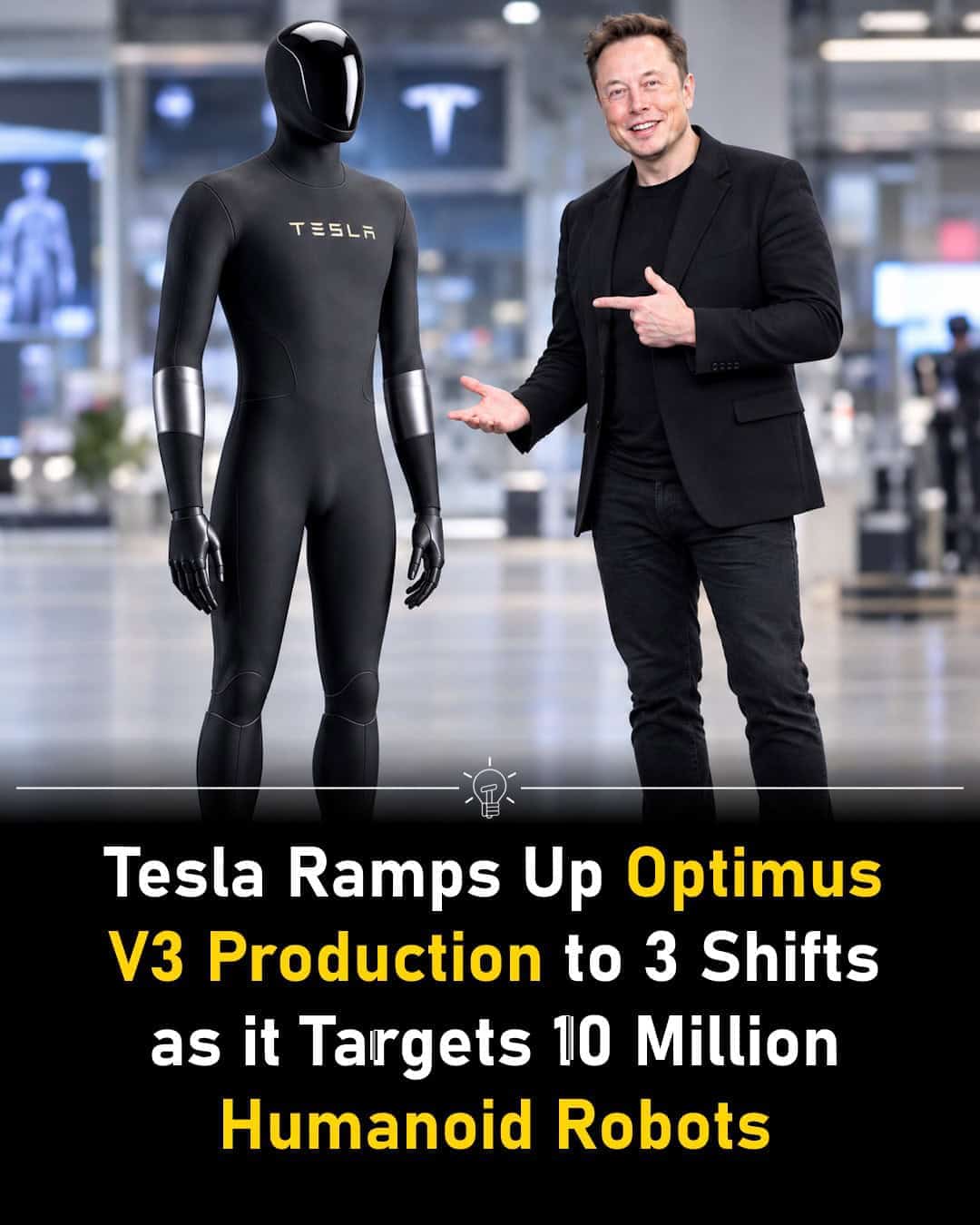
Tesla has been preparing its Fremont facility for Optimus production by converting space previously used for Model S and Model X manufacturing. Tesla said earlier in 2026 that its first-generation Optimus production line is designed for an eventual annual capacity of about 1 million robots. The company has also said the initial manufacturing ramp will follow a relatively slow S-curve as it solves new component and production challenges.
Recent supply-chain reports point to another important step. According to Tesla Briefings, Tesla reportedly placed an order for roughly 5,000 Optimus units with Chinese suppliers and has been auditing suppliers in China. Three companies (Tuopu Group, Ningbo Joyson Electronic and Zhejiang Sanhua Intelligent Controls) were reportedly moved toward certified mass-production status following the audits. Tesla itself has not publicly confirmed the reported order.
The reported supplier targets call for production capacity of around 1,000 robots per week by late September, followed by 2,000 to 2,500 units per week by the end of 2026. These figures should be treated as reported production or supply targets rather than confirmed Tesla shipments. Some reports also distinguish between component-supply capacity and completed-robot production, which makes direct comparisons difficult.
Optimus V3 is also receiving major hardware changes. Its redesigned hand is reported to have 22 degrees of freedom, compared with 11 degrees reported for the earlier generation. Tesla has described the hand as being designed for greater dexterity, with a tendon-driven mechanism intended to reproduce some of the movement of a human hand.
The production challenge is significant because humanoid robots require many specialized components to work together. Tesla has said that, unlike the automotive industry, there was no mature Optimus supply chain ready for large-scale production. The company has therefore been developing suppliers and bringing some manufacturing capabilities in-house.
Tesla is also building a much larger Optimus manufacturing facility at Gigafactory Texas. The company’s 2026 materials describe a second-generation production line designed for a long-term annual capacity of 10 million humanoid robots. That is a future manufacturing-capacity target, not an indication that Tesla is currently producing millions of robots.
The company has previously discussed a long-term Optimus price in the $20,000–$30,000 range, but Tesla has not announced a confirmed retail price for the V3. Tesla has also indicated that early production will primarily support its own operations and training rather than immediate large-scale external sales.
More Robotic Updates:
- Robot Horse that Carries 660-Pound Humanoid Robot for Hours
- Chinese Scientists Build Robot Controlled by Human Brain Cells
- Digit 5 New Robot Offers 20-Hour Work After 9-Minute Charge
- Digit Robot’s Charging-Port Design Raises Design Questions
- China Builds First Factory Where Robots Build More Robots
- AI Flying Lifebuoy Robot Flies to Rescue Drowning Victims
- Threehalves Builds 7-Foot “Centaur Robot” for Extreme Work