New Zealand Gets 85% of Electricity From Renewable Energy
New Zealand Gets 85% of Its Electricity from Renewables – Yet Kiwis Keep Adding More Rooftop Solar to Make it Even Cleaner
New Zealand is rapidly expanding solar power even though renewable energy already dominates its electricity system. According to the Ministry of Business, Innovation and Employment (MBIE), 88.5% of the country’s electricity generation came from renewable sources in 2025, up from the roughly 85% level seen in recent years. Hydropower remains the largest renewable source, while geothermal, wind and solar are adding further capacity.
Solar is now becoming a much more visible part of New Zealand’s electricity mix. MBIE reports that solar generation increased 66% in 2025, reaching a new record as several large solar farms came online. The Electricity Authority also reported that grid-connected solar capacity had increased by 247 MW since 2023, with solar contributing around 1–2% of total electricity supply from mid-October 2025.
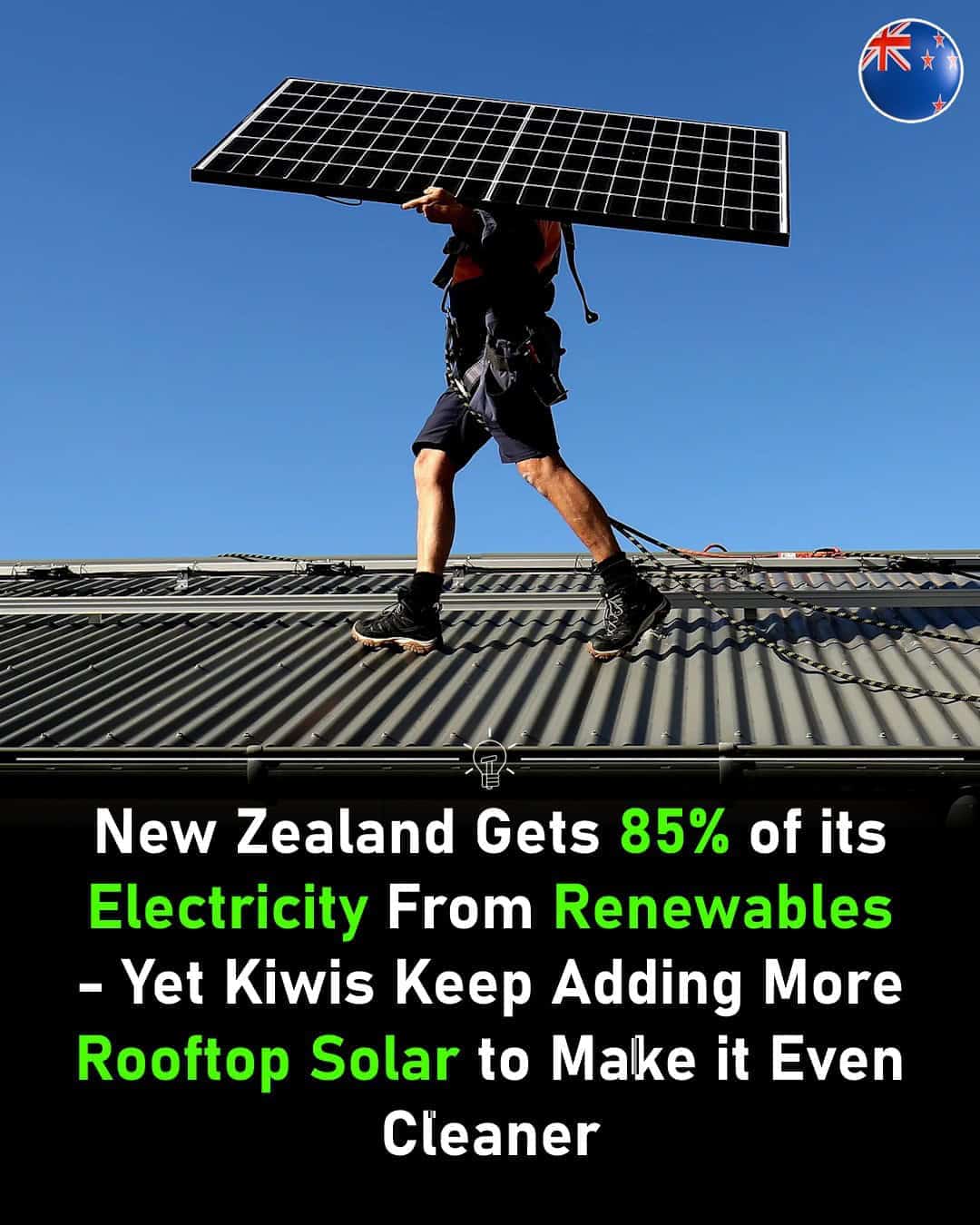
Rooftop solar is expanding alongside large utility-scale projects. The Electricity Authority said in April 2026 that around 75,000 households had solar systems, with more than 14,700 also having batteries. New rules are being introduced to allow many solar and battery systems to export more electricity to local networks while maintaining network safety and reliability.
The growth is also changing the size and role of residential solar systems. Falling technology costs, household electricity expenses and the ability to export surplus electricity are supporting interest in rooftop generation. Industry group SEANZ has also highlighted the growing role of distributed solar and batteries, although actual financial benefits vary depending on installation costs, electricity tariffs, export payments and household consumption.
Large solar farms are now moving beyond the early development stage. The Electricity Authority said in February 2026 that 783 MW of new grid-connected solar capacity was expected from projects coming to market in 2026 and 2027. If those projects are completed as planned, total grid-connected solar capacity would reach about 1,031 MW.
Several major projects are being developed in regions including Canterbury and other parts of the South Island. MBIE reported that the 43 GWh Clandeboye solar farm in Canterbury began construction in 2025, while other proposed projects include the 300 MW Twizel Solar Project and the 300 MW Grampians Solar Project in the Mackenzie Basin. Some of these projects remain subject to development and approval processes.
Solar is also becoming part of a broader strategy that combines different renewable technologies with energy storage. Hydropower can provide flexibility when solar and wind output changes, while grid-scale batteries can store excess electricity and release it when demand rises. With 1,705 MW of committed new generation capacity expected over the following three years, MBIE says 94% is renewable, including 930 MW of solar, showing how quickly solar is moving into New Zealand’s electricity pipeline.
Related Renewable Energy Updates:
- UK Battery Injects Hundreds of MW Power into Grid in 1 Sec
- California Solar Power Beats Natural Gas for First Time
- EU Solar Generates Record 25% of Electricity for First Time
- China Tests Underwater Solar Power Plant at 33 Ft Below Sea
- China Tests World’s Most Powerful 1MW Flying Wind Turbine
- Morocco’s Solar Project Aims to Export Power to Europe via Undersea Cable
- China Builds World’s Largest 17.7 GW Solar Park on Tibetan Plateau