How to Wire a Smart Wi-Fi Circuit Breaker? – Automatic Remote Control Protection
In the era of 4G, and 5G, smartphones are equipped with music players, cameras, email, internet connections, and the ability to make calls to friends and relatives.
But why discuss phone calls when we’re supposed to be talking about circuit breakers and protection? Well, if smartphones can handle all these important tasks, why can’t we use them to control our circuit breakers? Electricians and sparkies are just as tech-savvy as anyone else. So, we should welcome smart home automation as well.
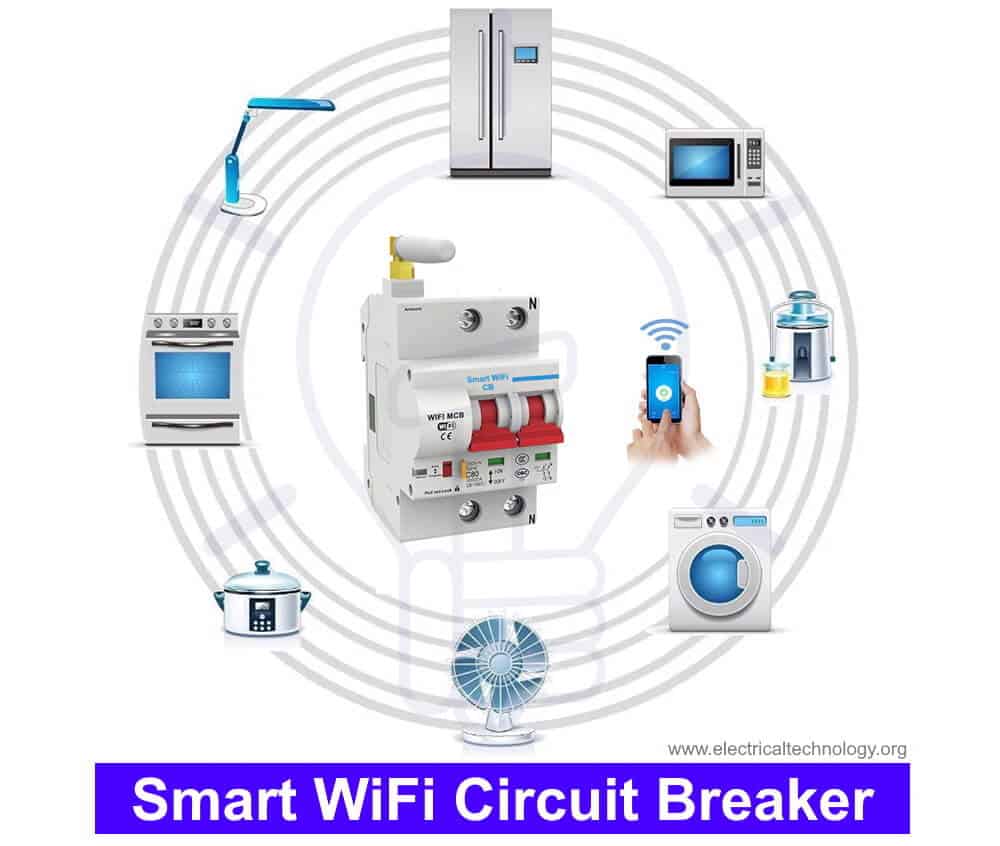
So you got the idea that we are talking about smart Wi-Fi remote control circuit breakers. Yes, they exist. The smart Wi-Fi circuit breaker can control the on/off position through ISC when connected to Wi-Fi and an active internet connection router.
We will be talking about the Single Pole (1P), Two Pole (2P), Three Pole (3P), and Four Pole (4P) Smart Wi-Fi Circuit breakers with ratings and specifications.
- Related Post: Electronic Circuit Breaker – Schematic and Working
Specification and Characteristic Rating of Smart Wi-Fi MCB
All the above-mentioned Wi-Fi circuit breakers have the following features:
- Smart Wi-Fi Automatic Circuit breakers can be used for short circuit and overvoltage protection.
- They can be controlled remotely from anywhere and anytime as they are connected to a smartphone through Wi-Fi.
- They are compatible with Google Assistant, Google Nest, Amazon Alexa, and IFTTT, allowing control through voice commands using these devices.
- They can be scheduled for on/off operation through the internet and mobile phones.
- They provide surge, short circuit, and overload protection.
- They also provide undervoltage and overvoltage protection.
Related Post: MCB (Miniature Circuit Breaker) – Construction, Working, Types and Applications
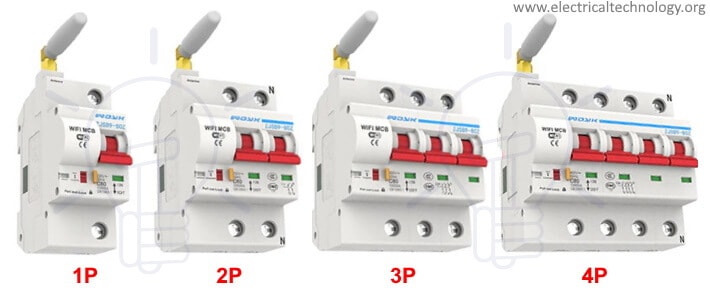
Following is the datasheet table with the rating and characteristics of the smart Wi-Fi circuit breaker.
| Characteristics | Rating |
| Standard | IEC 60898-1 , GB10903.1 |
| Pole Number | 1P, 2P, 3P, 4P |
| Rated Current | 10A, 16A ,20A, 25A, 32A, 40A, 63A, 80A, 100A, 125A |
| Frame Grade Rated Current | 125A |
| Rated Frequency | 50 / 60 Hz |
| Rated Voltage | Up t0 230V AC (1P, 2P) – 400V AC (3P, 4P) |
| Impact Withstand Voltage | 6kV |
| Short Circuit Breaking Capacity | 10kA |
| Tripping Characteristics | Class C |
| Protection Grade | IP20 (CE Certificate) |
| Antipollution Grade | 2 |
| Ambient Temperature | -25 °C to +65 °C |
| Installation Category | II, III |
| Installation Type | Din Rail |
| Wi-Fi Range | 2.4G Wi-Fi |
| Electrical Operation Life | More than 6000 Times |
| Mechanical Operation Life | More than 10000 Times |
Obviously, this smart circuit breaker can be used to transform ordinary household wiring into a smart system with automation. For example, with scheduled operation, you can turn off and on a fan, heater, washing machine, water pump motor, etc., at specific times, and they can switch on/off automatically according to the schedule. The time setting can be done through a smartphone instead of manual operation.
Construction of Wi-Fi Circuit Breaker
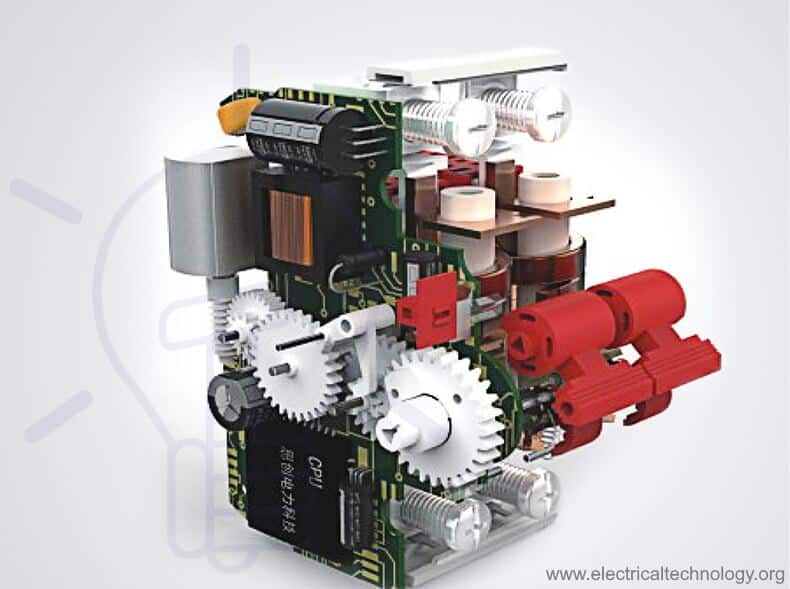
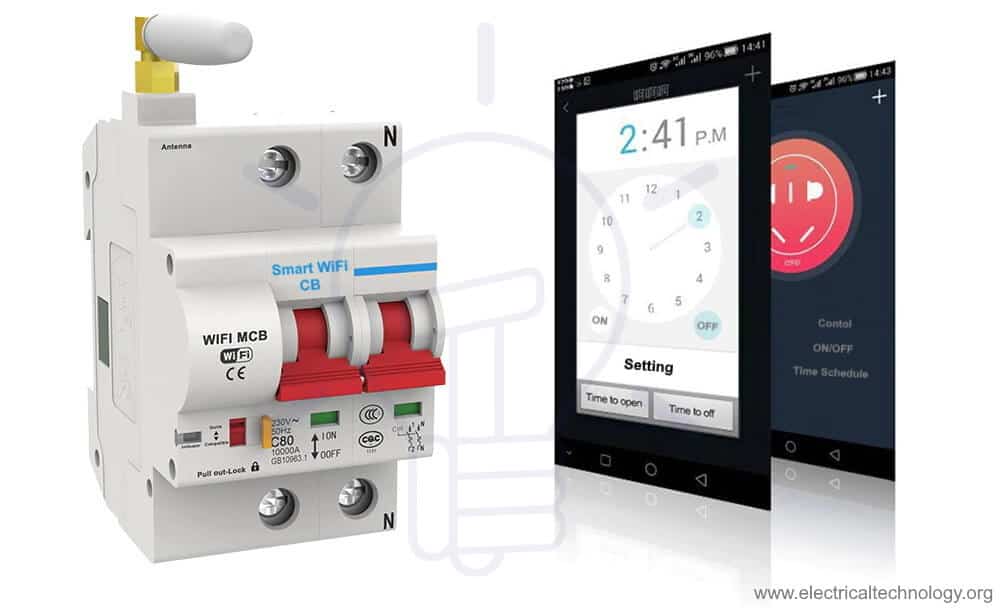
Wi-Fi circuit breakers are similar to normal and ordinary circuit breakers except they have an antenna for Wi-Fi signals and a special mechanical switch mechanism for automatic on/off operation as shown in the following figure.
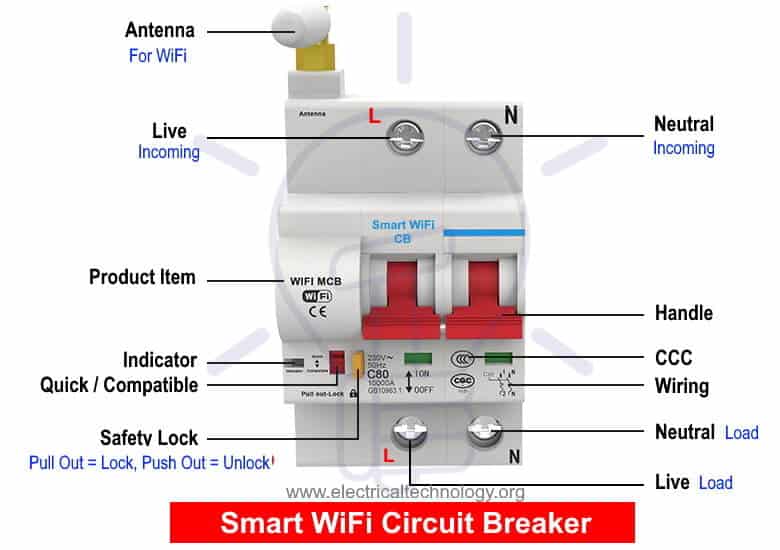
The following figure shows the nameplate rating data of a Smart Wi-Fi MCB.
How to Wire and Install a Smart Wi-Fi Circuit Breaker?
It is the same as an ordinary circuit breaker (which can be seen in our home distribution board) except for the antenna for remote control through Wi-Fi in the smart circuit breaker.
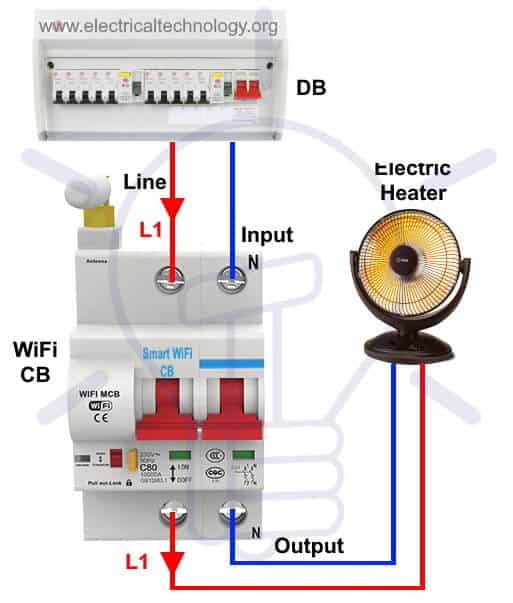
The upper portion is the input (Line and Neutral) while the lower is the output. In some cases, the incoming lines are connected to the lower portion in our home distribution boards. In that case, you may install the smart circuit breaker upside down in the existing distribution board for proper operation.
After installation, simply install the iOS or Android app by scanning the QR code on the product box. After installing the app, you can pair the device and set the automatic operation or scheduled time operation through the smartphone.
Note: If you are not sure how to install an MCB to the existing distribution board, contact a licensed electrician as playing with electricity is dangerous which leads to serious damage and injuries. For more details, refer to the user manual for step by step installation instruction.
- Related Post: What is an RCD (Residual Current Device)? RCB and RCCB
Smart MCB Video:

Applications of Smart Wi-Fi Circuit Breakers
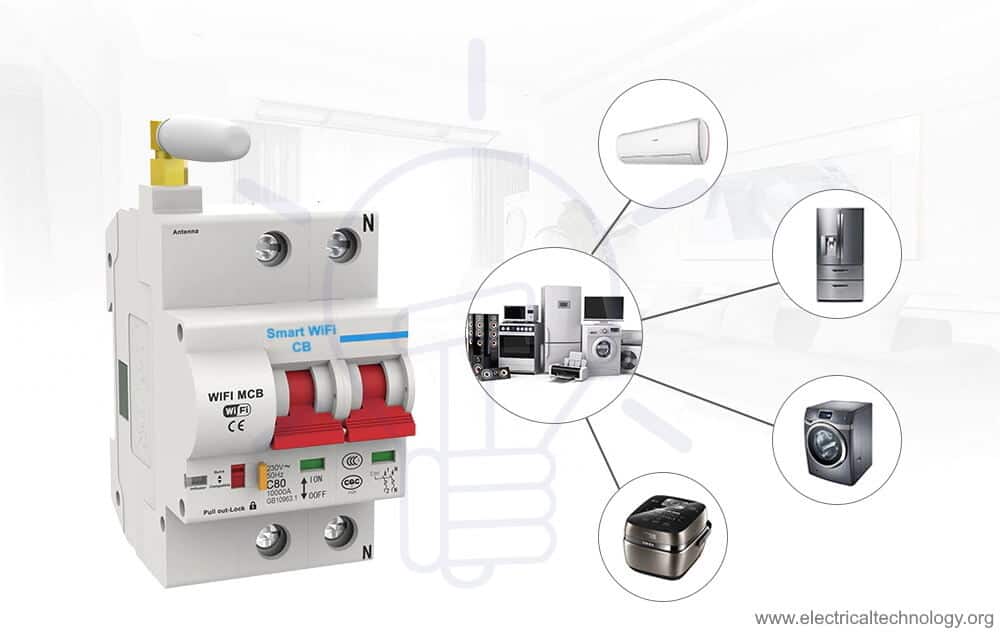
Smart Wi-Fi Circuit breakers can be used to control and protect various types of electrical appliances remotely through a smartphone, such as water pump motors, electric heaters, electric water geysers, air conditioners, refrigerators, washing machines, TVs, fans, bulbs, etc. They provide surge, short circuit, overload, and overvoltage protection.
It’s your turn now. Let us know in the comment box below your views and experiences with smart Wi-Fi circuit breakers. Will you go for it in the future, or will you stick to ordinary circuit breakers?
Safety Precautions:
Disconnect the main power supply before working on electrical circuits.
If you are unsure about any aspect of electrical work, seek help from a qualified electrician. Electrical work can be dangerous if not done correctly.
The author will not be liable for any losses, injuries, or damages resulting from the display or use of this information or any attempt to implement a circuit incorrectly. Therefore, exercise caution, as working with electricity poses inherent risks.
Related Posts:
- Air Circuit Breaker (ACB): Construction, Operation, Types and Uses
- SF6 Circuit Breaker – Types, Construction, Working and Applications
- Oil Circuit Breaker (OCB) – Types, Construction, Working and Applications
- Tripping Curves of Circuit Breakers – B, C, D, K and Z Trip Curve
- Vacuum Circuit Breaker (VCB) – Construction and Working
- HVDC Circuit Breaker – Types, Working and Applications
- Difference Between Circuit Breaker and GFCI
- Difference between Circuit Breaker and Isolator / Disconnector
- Difference Between Relay and Circuit Breaker
- Can We Use AC Circuit Breaker for DC Circuit and Vice Versa?
- AFCI: Arc Fault Circuit Interrupter. Types, Working & Applications
- GFCI: Ground Fault Circuit Interrupter. Types, Working & Applications
- Fuse, Circuit Breaker and Protection Symbols
-
 Germany’s Electric Drone Hits 699 km/h, Eyes World Record
-
 How to Wire and Use Tesla Gen 3 Mobile Connector Charger
-
 How to Wire 48A Level 2 Dual Port EV Charging Station
-
 How to Wire Smart Electric Vehicle Charging Station – 32A/80A
-
 How to Wire ChargePoint Home Flex Charger for Every EV
-
 How to Wire an EV Wall Charger – Hardwired and Plug-in