Is It Permissible to Use a Double Pole 240V Breaker on a 120V Circuit, or a Single Pole 120V Breaker on a 240V Circuit?
Over current protective devices (OCPDs) such as fuse and circuit breakers are safety devices with specific voltage and current ratings to protect electrical circuits. Circuit breakers are sized based on wire size as per NEC Table 310.16 to protect the branch circuit conductors. Using a breaker with an inappropriate voltage and current rating can be dangerous and may compromise the protection. Therefore, it’s always recommended to match the breaker rating to the properly sized branch circuit conductors and associated load.
- Related Post: Can you use 15A Breaker on 20A Circuit and Vice Versa?
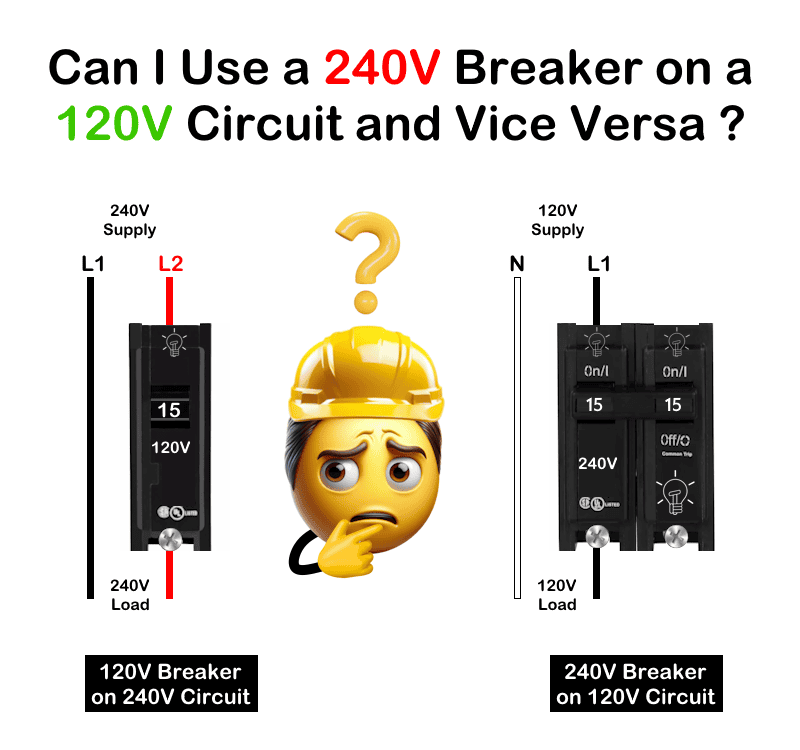
Using 240V Breaker on a 120V Circuit
In the U.S. and Canada, following the NEC (National Electrical Code) and CEC (Canadian Electrical Code) respectively, a two-pole breaker is used for 240V circuits and appliances. The breaker connects to both hot lugs (L1 and L2) in a 120V/240V main panel, and its output terminals connects to the load. In most modern 240V circuits, a neutral wire is not required. However, if the appliance or load needs a neutral, a separate neutral conductor must be run to it.
A 240V breaker is usually double-pole, which disconnects both hot wires (Hot 1 + Hot 2) simultaneously. On a 120V circuit, there’s typically only one hot wire and one neutral (Hot + Neutral). If you connect the Hot wire (Black or Red) to the one slot of double pole 240V breaker, the breaker will protect the 120V circuit successfully in the event of faults. But keep in mind that using a double-pole breaker for a single 120V load wastes a breaker space and may confuse future electricians. That’s why it is recommended to use 240V breakers for 240V circuits and 120V breaker for 120V circuits and appliances.
Is it Allowed by Code?
While there are no code restrictions to prohibit the use of 240V breaker (2P) for single or double 120V circuits, but this practice is not ideal or necessary with some of limitations as follow.
1. If you want to use a 240V breaker for single 120V load circuit, make sure to match the amperage rating of the breaker with the connected load. For instance, you can’t use one leg of 240V, 50-amp breaker used for EV to connect and operate the low amperage circuits at 120V e.g. 15 or 20-amp outlets and load circuits.
2. Most 240V breaker are dual rated and comes with an “internal common trip” as a built-in feature. It means, the breaker will trip even if it detects an overcurrent on a single leg. In case of fault, the internal mechanisms will trip both sides of the breaker. With this setup, it is OK if you use half of the 240V breaker for single 120V circuit. In case of 240V circuits, do not remove the switch connector toggle (handle tie), so both the (bonded) switches disconnect the circuit in the events of faults. In addition, improperly removing the toggle switch connector may damage the breaker.
- Related Post: Can You Use a 2-Pole Breaker Instead of a 1-Pole Breaker
Good to Know:
- A 240V breaker can be used for both 120V and 240V circuits, but not for 277V (common in commercial applications).
- It is against the code to use two separate single pole circuit breakers for 208V or 240V circuits.
- If two SP breakers as double pole are used for 240V circuit, the switches of both breakers should be bonded and connected together (both SP breakers should be switched ON & OFF in the event of fault.
- Check the nameplate rating of breaker to confirm if the breaker is “internal common trip” or “non-common trip”. If not sure, refer to the manufacture’s specifications or call a licensed electrician.
Using 120V Breaker on a 240 Circuit
OCPDs (fuse and breakers) are are designed to safely interrupt current at their rated voltage. In case of breakers, single pole 120V breakers are connected to one Hot leg and neutral to protect 120V circuits. The wires for load side is either black or red (as HOT) and white for neutral.
Using a single-pole 120V breaker for 240V circuits would leave one side unprotected and may not properly interrupt the arc in case of a fault. This scenario is potentially dangerous and can lead to arcing, fire or shock hazards, and failure to provide adequate protection.
Why it is Not Safe?
A single-pole breaker rated for 120V is designed to interrupt only one (hot let) or hot wire. A 240V circuit typically has two hot wires, each carrying 120V relative to ground but 240V relative to each other. If only one pole of the breaker trips, the other Hot wire may still remain live. Consequently, it poses a shock hazard for the person working on the circuit, and clearly violates the code.
Precautions:
- You can only use a 120V single-pole breaker on 120V circuits.
- You can use a 120-277V breaker on 120V, 240V, and 277V circuits.
- You cannot use a 120V breaker on a 240V circuit, and you cannot use a 240V breaker on a 120V circuit.
- It is dangerous to use 20A breaker on 15-A circuit.
- You should not use a 15A, 120V breaker on a 20A, 120V circuit
- For 240V circuits, use a double-pole breaker rated for 240V.
- Use #14 AWG wire for 15A circuit (15-amp breaker + 15-amp receptacles).
- Use #12 AWG wire for 20A circuit (20-amp breaker + 20-amp receptacles).
- Breakers must match the circuit’s voltage and amperage requirements.
- Refer to the NEC Article 240 and 310 for correct overcurrent protection for the system voltage, conductor size, and equipment rating.
- Always consult the breaker’s specifications and local electrical codes (e.g., NEC, IEC, IEEE.).
- For safety, consult a licensed electrician before making changes to your electrical system.
Good to Know:
Under IEC standards, the distribution voltage for residential and commercial applications differs from the voltage levels used under the NEC and CEC standards. The U.S. primarily uses a 120V/240V system, while countries following IEC standards typically use 230V for single-phase and 400V for three-phase systems. In 230V circuits following IEC standards, both single-pole and double-pole breakers can be used for single-phase 230V applications.
- When using a single-pole breaker, the phase (live) wire connects to the breaker, which then feeds the load.
- When using a double-pole breaker, one pole connects to the phase wire and the other to the neutral wire, allowing the breaker to disconnect both conductors simultaneously for enhanced safety.
Resources & Tutorials:
Related Posts:
- Can We Use AC Circuit Breaker for DC Circuit & Vice Versa?
- Can You use a 15A Outlet on a 20A Circuit and Vice Versa?
- Can I Use a 1-Phase Breaker on a 3-Phase Supply & Vice Versa?
- Can an AC Device Operate on DC Supply, and Vice Versa?
- How Does a Standard Breaker Respond to Electrical Fault?
- Why Doesn’t a Standard Breaker Protract Against Ground Faults?
- How Do GFCI and Standard Breakers Respond to Ground Faults?
- Difference Between 15-Amp and 20-Amp Outlet?
- Main Difference between Fuse and Circuit Breaker
- Difference Between GFCI and AFCI
- Difference Between Circuit Breaker and GFCI
- What is the Right Wire Size for 15A Breaker and Outlet?
- What is the Suitable Wire Size for 20A Breaker and Outlet?
- How to Find the Number of Outlets on a Single Circuit Breaker?
- How to Toggle Electric Water Heater Between 120V and 240V?
NEC – Wiring Guides for Breakers Installations
- How to Wire a 1-Pole Breaker
- How to Wire a 2-Pole Breaker
- How to Wire a 3-Pole Breaker
- How to Wire a 1-Pole GFCI
- How to Wire a 2-Pole GFCI
- How to Wire a 3-Phase, 3-Pole GFCI
- How to Wire a Tandem Breaker
- How to Wire GFCI Circuit Breakers
- How to Wire an AFCI Breaker
- How to Find the Proper Size of Circuit Breaker? Breaker Calculator & Examples
- How to Install EV Charging Outlet using GFCI Breakers
- How to Determine the Number of Circuit Breakers in a Panel Board?
- Sizing Motors FLC, HP, Voltage, Breaker Size and Wire Size
- How to Find The Suitable Size of Cable & Wire for Electrical Wiring Installation?
- How to Wire 120/240V Smart Load Center with Smart Breakers
- How to Wire a Smart Breaker in a Smart 120/240V Panel
- How to Wire a Smart GFCI Breaker in a 120/240V Smart Panel
- How to Wire Smart AFCI/GFCI Breaker in a Smart Load Center
- How to Wire 120V & 240V Main Panel? Breaker Box Installation
- How to Wire a Smart Switch in a 120/240V Load Center
-
 Germany’s Electric Drone Hits 699 km/h, Eyes World Record
-
 How to Wire and Use Tesla Gen 3 Mobile Connector Charger
-
 How to Wire 48A Level 2 Dual Port EV Charging Station
-
 How to Wire Smart Electric Vehicle Charging Station – 32A/80A
-
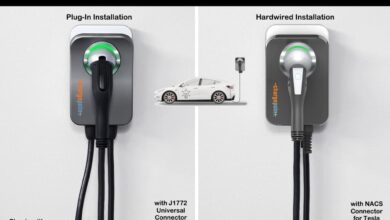 How to Wire ChargePoint Home Flex Charger for Every EV
-
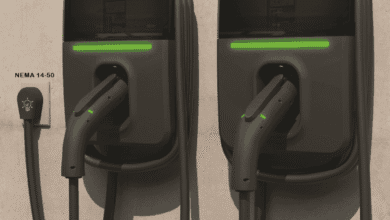 How to Wire an EV Wall Charger – Hardwired and Plug-in