Can You use a 15A Outlet on a 20A Circuit and Vice Versa?
Is It Permissible to Use a 15-Amp Receptacle on a 20-Amp Breaker, or a 20-Amp Receptacle on a 15-Amp Circuit?
Not everyone is familiar with electrical codes and their compliance requirements. In most cases, DIY enthusiasts unintentionally violate these codes when performing basic wiring tasks in homes or residential settings, especially when upgrading or modifying existing (mostly 15A and 20A) breakers and outlets/receptacles. Since working with electricity can be hazardous, it is always best to consult a licensed electrician for any electrical work, including repairs, maintenance, and troubleshooting.
In our previous post, we discussed whether it is acceptable to use a 15-amp breaker on a 20-amp circuit, and vice versa. Today, we received another similar question: Is it permitted by code to install a 15-amp outlet on a 20-amp circuit breaker, or a 20-amp outlet on a 15-amp circuit breaker?
Using different amperage-rated outlets on mismatched circuit breakers can raise important safety and code compliance concerns. Let’s see both the scenarios with different reasons and consequences.
- Related Post: Can you use 15A Breaker on 20A Circuit and Vice Versa?
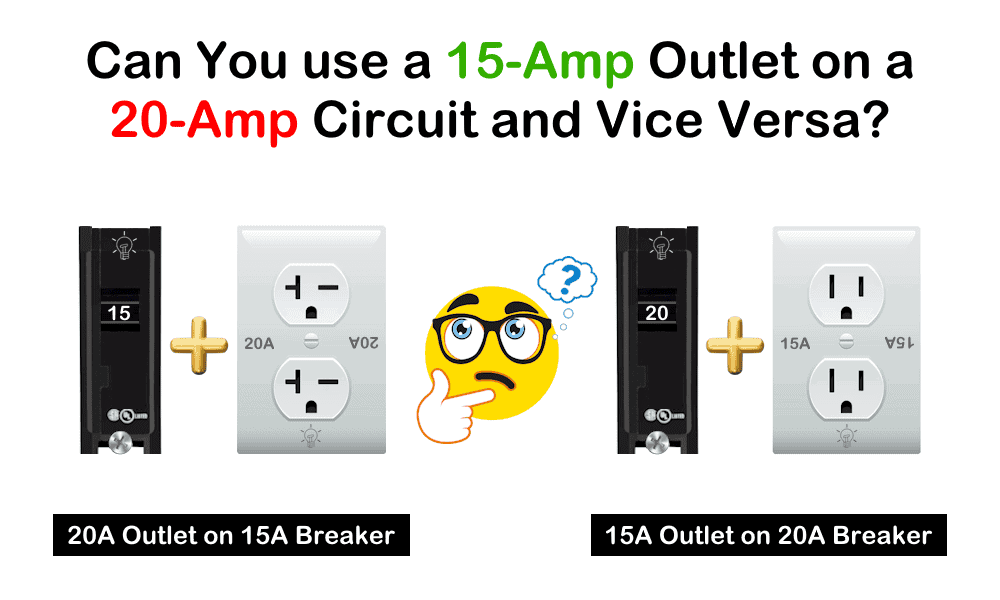
Using 15-Amp Outlet on a 20-Amp Circuit
A duplex 15-amp outlet is the most commonly used standard receptacle in residential wiring for small-load applications such as lighting, ceiling fans, televisions, phone chargers, and similar devices. Examples of 15-amp outlets and receptacles are NEMA 5-15 and 6-15.
A 15-amp outlet is typically connected to a 15-amp circuit, which can safely handle a maximum non-continuous load of 1,800 watts at 120V AC or 3,600 watts at 240V AC, depending on the supply voltage.
In case of continuous load (which runs 3 or more hours simultaneously), the actual safe loading is limited to 80% of the circuit capacity as per NEC – 210.19(A), 210.20(A) and 230.42(A) for 125% OCPD or 80% load for sizing branch circuit conductors. Hence, for a continuous load circuit, a 15-amp outlet can be used for:
- At 120V: 15A × 120V × 0.8 = 1,440 watts
- At 240V: 15A × 240V × 0.8 = 2,880 watts
In other words:
A 15-amp outlet can be used for:
- 15 amp non-continuous load.
- 12 amp continuous load.
Related Post: Can You Use a 2-Pole Breaker Instead of a 1-Pole Breaker
Is it Allowed by Code?
Yes – but only under certain conditions! Lets see how and why?
✅ Permitted:
A 15-amp outlet can be installed on a 20-amp circuit only if there are multiple receptacles (devices) on the circuit (e.g., multiple receptacles in a room). According to NEC 210.21(B)(3), 210.21(B)(3) and NEC 210.24, you can install 15-amp outlet on a 20-amp branch circuit, provided there is more than one receptacle on the circuit (i.e., duplex outlets, not a single receptacle).
This is because a duplex 15A outlet can serve two loads, and NEC allows this under the assumption that both outlets are not likely to be fully loaded simultaneously. For instance, a 20-amp circuit can handle more current, but a single 15-amp outlet is only rated for 15A. If multiple devices share the load (e.g., a lamp + TV + phone charger), the total can safely stay below 20A. This is what we see as a common practice in residential settings.
A 20-amp circuit can handle up to 20 amps of current, and a 15-amp outlet is designed to handle devices drawing up to 15 amps. The circuit breaker will protect the circuit by tripping if the load exceeds 20 amps, and the outlet will limit devices to those with 15-amp plugs (standard household plugs). This setup is common in residential wiring, especially in kitchens or bathrooms, where 20-amp circuits are used with 15-amp receptacles for flexibility. Hence, this practice is safe and compliant with the National Electrical Code (NEC).
❌ Not Permitted:
On the other hand, it is not permitted to use a single 15-amp receptacle on a 20-amp breaker. The reason is that if it’s the only receptacle on the circuit, it may overload the outlet since a single device could draw up to 20A from the 20-amp circuit. This clearly violates the NEC 210.21(A) and (B), which requires that a single receptacle must have an ampacity not less than the branch circuit.
Using 20-Amp Outlet on a 15-Amp Circuit
A 20-amp receptacle or outlet is capable to handle up to 20 amp of current at 120V/240V. It is used for heavy-duty load points and commonly found in high power consumption areas such as kitchen, washroom, laundry etc. Examples of 20-amp outlets and receptacles are NEMA 5-20 and 6-20.
A 20-amp outlet connected to a 20-amp circuit can handle a maximum non-continuous load of 2,400 W at 120V or 4,800 W at 240V AC, depending on the supply voltage.
For continuous load (which lasts 3 or more hours continuously), safe limit of 80% rule applies as per NEC – 210.19(A), 210.20(A) and 230.42(A). In this case, a 20-amp outlet can be used for:
- At 120V: 20A × 120V × 0.8 = 1,920 watts
- At 240V: 20A × 240V × 0.8 = 3,840 watts
Alternatively:
A 20-amp outlet can be used for:
- 20 amp non-continuous load.
- 16 amp continuous load.
Why it is Not Allowed?
Technically, a 20-amp receptacle can be installed on a 15-amp circuit, but it can be dangerous. Hence, this is not safe and is generally not allowed by the code. NEC 210.21(B)(2) forbids installing a receptacle that exceeds the rating of the wire size used in branch circuit.
A 20-amp outlet is designed to accept 20-amp plugs (which have a different configuration, like a T-shaped neutral prong) and is rated to handle up to 20 amps. However, a 15-amp circuit is only rated for 15 amps, and the circuit breaker may not trip until the load exceeds 15 amps. Consequently, it will potentially overload the circuit’s wiring, which could lead to overheating and fire hazards.
If a 20-amp plug is installed on a 15-amp breaker, a user might plug in a 20A device, expecting the circuit to support it, which may cause unwanted tripping of the breaker. This is because the 20-amp outlet can handle more current than the 15-amp circuit provides, but the 15-amp breaker protects the branch circuit conductors. When the current exceeds from 15-amp, the nuisance tripping of breaker will occur and disconnect the circuit. In this case, the circuit won’t work smoothly or properly as per requirements.
The following table shows the code compliance of 20A outlet on 15A breaker and vice versa.
| Receptacle Rating | Breaker Rating | Allowed? | Notes |
| 15A Duplex | 15A | ✅ | Fully compliant |
| 15A Duplex | 20A | ✅ | Allowed if more than one receptacle |
| 15A Single | 20A | ❌ | Not compliant – No circuit’s protection |
| 20A Outlet | 15A | ❌ | Not allowed – Unwanted tripping |
| 20A Outlet | 20A | ✅ | Fully compliant |
Precautions and Best Practices
- Ensure the wiring matches the circuit’s amperage. Always match the outlet type with current and voltage ratings to the associated circuit and properly sized breaker ratings.
- Use 15A receptacles on 15A or 20A circuits as per code while use 20A receptacles only on 20A circuits
- A 20-amp circuit requires at least 12-gauge AWG wire, while a 15-amp circuit can use 14-gauge AWG wire.
- Using undersized wire (e.g., 14-gauge on a 20-amp circuit) is unsafe.
- 15-amp outlets accept standard 15-amp plugs, while 20-amp outlets can accept both 15-amp and 20-amp plugs due to their T-slot design.
- The NEC allows 15-amp receptacles on 20-amp circuits for general use but requires 20-amp receptacles for specific appliances needing 20 amps.
- If you’re unsure about the circuit’s configuration, consult a licensed electrician for any new installation, modifications of existing outlets and breaker or any other related electrical works.
Related Posts & Tutorials:
- Can an AC Device Operate on DC Supply, and Vice Versa?
- Can We Use AC Circuit Breaker for DC Circuit & Vice Versa?
- Can I Use a 1-Phase Breaker on a 3-Phase Supply & Vice Versa?
- How Does a Standard Breaker Respond to Electrical Fault?
- Why Doesn’t a Standard Breaker Protract Against Ground Faults?
- How Do GFCI and Standard Breakers Respond to Ground Faults?
- Difference Between 15-Amp and 20-Amp Outlet?
- Difference Between Socket, Outlet and Receptacle?
- Main Difference between Fuse and Circuit Breaker
- Difference Between GFCI and AFCI
- Difference Between Circuit Breaker and GFCI
- Why is the Neutral Prong or Slot Wider on a Plug or Outlet?
- Why is the Long Prong Neutral Instead of the Narrow Prong?
- Why Do Prongs in Electrical Plugs Have Holes in Them?
- Why is Earth Pin Thicker and Longer in a 3-Pin Plug?
- Why are there Grooved Slots in the Pins of Two Pin Plugs?
- What Will Happen If You Connect a Male-to-Male Plug Between Outlets
- What is the Right Wire Size for 15A Breaker and Outlet?
- What is the Suitable Wire Size for 20A Breaker and Outlet?
- What is the Correct Wire Size for 100A Breaker and Load?
- How to Find the Voltage Ampere Rating of Plugs & Outlet & Receptacle?
- How to Find the Number of Outlets on a Single Circuit Breaker?
- How to Determine the Number of Branch Circuits? – 3 Ways
- How to Wire and Install an Electrical Outlet Receptacle?
- How to Toggle Electric Water Heater Between 120V and 240V?






Good practice is to a 20 amp breaker on a 20amp receptacle with number 12 conductors, however, a 15 amp breaker would work with a reduction in overload protection.
A 20 amp breaker on 15 amp receptacles is permitted as long as you use # 12 connectors.
A circuit breaker has two functions, overload protection and short circuit protection. Of course, new breaker do more.