Backfed Main Breaker on a Bus Stabs in a Load Center
Backfeed Main Breaker
A backfeed main breaker is a standard branch circuit breaker installed in an electric panel and used as the main disconnect by feeding power “backward” into the bus bars rather than receiving it from top-mounted main lugs.
In other words, the breaker is back-fed when the incoming supply (service entrance) conductors land on the breaker terminals, and the breaker then energizes the panel’s busbars. It is commonly used for solar interconnections or generators.
Backfeed breakers usually placed at the opposite end of the bus bar from the main service entrance (often the top left) and must be labeled “MAIN”. It is used to allows main power supply or power from a secondary source (like a solar inverter or generator) to energize the entire panel.
Difference Between Backfeed Main Breakers and General Backfeed Breakers
Backfeed Main Breaker:
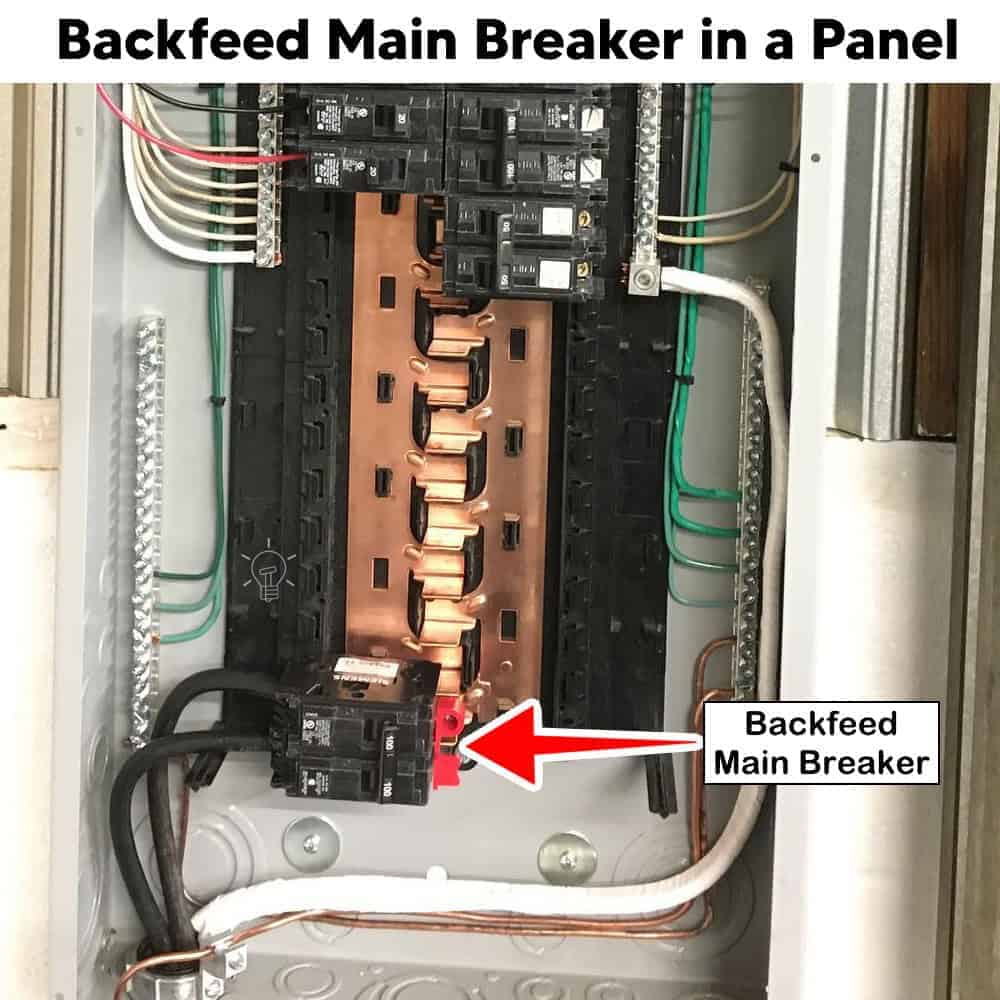
A backfeed main breaker is a branch circuit breaker that is used as the primary service disconnect for the panel. It is typically installed at the opposite end of the busbars from the service entrance conductors (for example, bottom-fed instead of top-fed). In this configuration, no separate main breaker is installed in the panel; the backfed breaker serves as the only main disconnecting means.
This condition is illustrated in Fig. 1, where a standard branch circuit breaker is used as a backfeed main breaker in a 120/240V panel.
Backfed Breaker (General Backfeed Breaker):
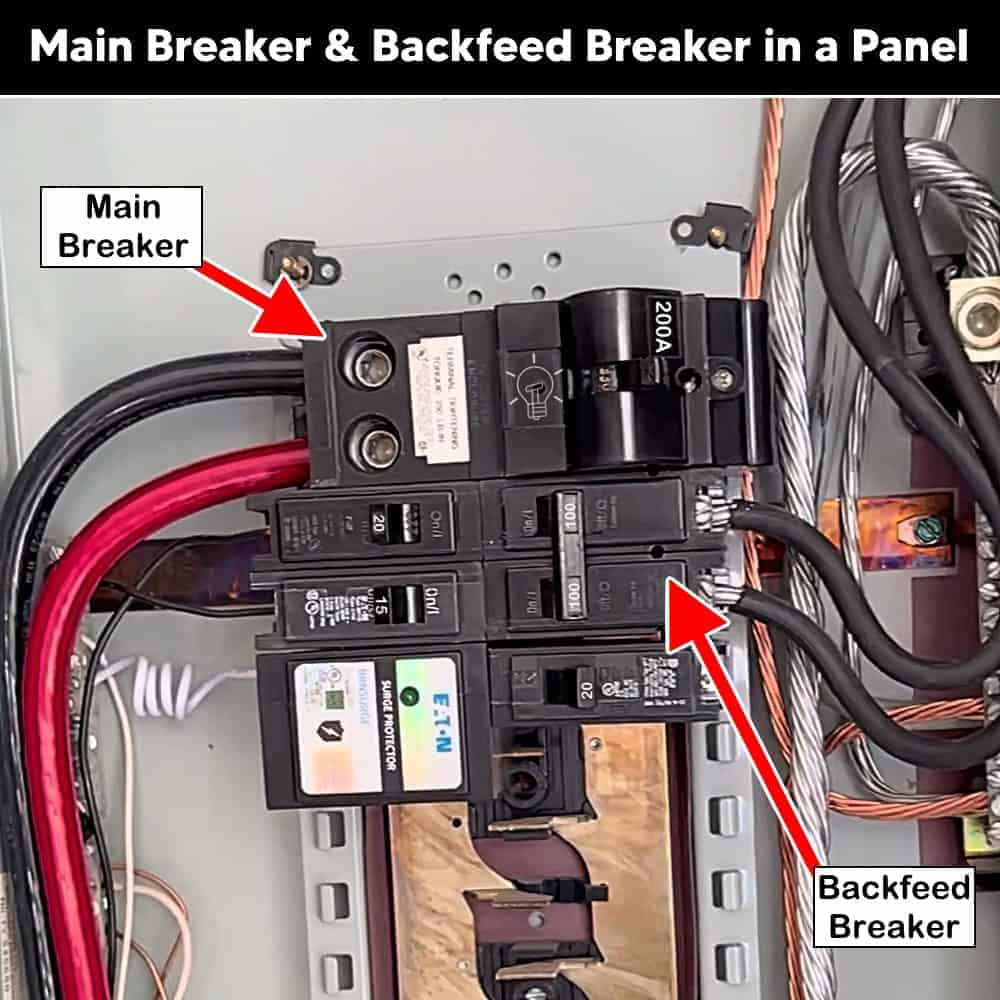
A backfed breaker is a standard branch circuit breaker used to supply power into the panel from an alternate source, such as a solar PV system or generator. In this case, the panel already contains a main breaker, and the backfed breaker is installed in addition to it. The breaker is called backfed because it supplies power into the busbars from its load terminals, meaning the breaker operates as a source rather than protecting a load.
This configuration is shown in Fig. 2, where both the main breaker and a backfed breaker are installed in the same electric panel.
How a Backfeed Main Breaker Works
In a typical residential load center, utility power is supplied to the main breaker through the service entrance conductors. The main breaker is usually located at the top (or sometimes the bottom) of the panel and is directly connected to the panel’s busbars. The branch circuit breakers then snap onto these energized busbars and distribute power to the individual branch circuits through branch circuit conductors.
In a backfeed configuration, the utility power is supplied directly to a branch circuit breaker installed among the other branch circuit breakers in the panel. In this arrangement, that breaker functions as the main disconnect. It connects to the panel busbars and energizes them, which in turn supply power to the remaining branch circuit breakers and their associated circuits.
In this configuration, the breaker feeds the busbars from what is normally considered the load side of the breaker. Because the busbars are energized from the load terminals rather than the line terminals, which is why it is called backfeeding.
Good to Know: A hold-down kit is mandatory to mechanically secure the backfeed breaker to prevent it from being accidentally pulled out while energized.
Where a Backfed Breaker Used
- A backfed main breaker is commonly used in:
- Main-lug-only (MLO) panels
- Subpanels requiring a local disconnect
- Retrofit installations
- Solar or generator interconnections (with electrical interlocks)
Instead of a factory-installed main breaker, a two-pole breaker is installed at the top of the panel and backfed to act as the main disconnect.
A backfeed breaker can also be used in a typical panel that already has a regular main breaker located above the busbars. In this case, the backfeed breaker is used to supply power to the panel during a power outage, usually from an alternate source such as a generator.
To ensure safe operation, a special protective device, such as a mechanical interlock (Using ATS with generator) or hold-down kit, is installed. These devices prevent the main breaker and the backfeed breaker from being switched ON at the same time. This safety mechanism ensures that only one power source can supply the panel at a time. Hence, it prevents backfeeding into the utility lines and protecting both equipment and utility workers.
According to NEC 408.36(D), when a plug-in type breakers or main lug used as backfed device, it must be secured in place by an additional fastener.
As the NEC 408.36(D) states that back-fed devices must be fastened with a hold-down kit. It is because if the breaker is not secured, It could pull out of the bus stab and the live conductors would still be energized. This dangerous case creates a serious shock and arc-flash hazard.
To prevent this issue, manufacturers provide a retaining clip or hold-down screw kit to lock the breaker to the panel.
Similarly, for equipment over 1000V AC / 1500V DC, a permanent sign using the words “Danger: Contact either side of this device may be energized by backfeed” and a single-line diagram within sight clearly showing the connection of high voltage end of the backfed device – NEC 495.25(A) & (B), and 495.44(B).
Moreover, in an interconnected electric power production sources (generators, solar panels, batteries), any overcurrent protective device such as fuse or breaker with or without “Line” and “Load” marking may suitable for backfeeding or reverse current when rated for the applications. NEC 705.30(D).
Good to Know: When a backfed breaker is used for generator interlocks, a mechanical interlock kit must be used to ensure the main grid breaker is OFF before the generator backfeeds the panel.
Main Backfeed Breaker on a Bus Stab & Its Rating
When a backfeed main breaker is snapped onto a bus stab, make sure its rating does not exceed the “maximum sum of breaker ratings per stab” specified by the manufacturer. The allowable bus stab rating can be found on the printed label or nameplate located inside the main panel.

For example, if the maximum sum of breaker ratings per stab is 200A, the rating of the backfeed main breaker should not exceed 200A, assuming the opposite side of the stab is blank and unused.
Similarly, if the backfeed breaker used as the main breaker is rated 150A and installed on one side of the bus stab, the breaker installed on the opposite side of the same stab should not exceed 50A.
When installing a backfeed breaker on a bus stab, the best practice is to leave the opposite side of that stab blank. It means, no additional branch circuit breaker should be installed on it. This ensures the stab rating is not exceeded and helps maintain the producing heat within limits.
Precautions:
- Always disconnect the power supply by switching OFF the circuit breaker at the main service panel before performing any electrical work.
- Electrical equipment must be installed according to manufacturer instructions as required by the NFPA and NEC 110.3(B)).
- Never touch the terminal screws above the main breaker. These terminals are always energized and remain live even when the main breaker is switched OFF.
- If you are unsure about any part of the installation, consult a licensed electrician and ensure compliance with applicable local electrical codes.
Disclaimer: Electrical work is dangerous. The author assumes no responsibility for any loss, injury, or damage resulting from the use or misuse of this information, including improper circuit installation.
Resources:
Related Posts:
- National Electrical Code (NEC) Requirements for Panelboards
- Busbar, Bus Stab, Breaker Slot and Circuit Space in a Panel
- What Happens if the Neutral is Lost in the Main or Subpanel?
- Why Must Neutral and Ground Wires Be Bonded in the Main Panel?
- Why are Neutral and Ground Wires Separated in a Subpanel?
- Should GFCI Protection Be in the Main Panel or Receptacle?
- Difference Between BR and CH Breakers and Load Centers
- Difference Between Homeline and QO Breakers and Panels
- Difference Between 1-Pole and 2-Pole Breakers – NEC & IEC
- Can the Neutral Wire Cause Electric Shock? Different Cases
- Will I Get an Electric Shock If I Touch the Ground Wire?
- Will a Man Get an Electric Shock If He Hangs on a Live Wire?
- What Happens When You Touch an Electrical Busbar?
- Can We Use AC Circuit Breaker for DC Circuit & Vice Versa?
- Can I Use a 240V Breaker on a 120V Circuit and Vice Versa?
- Can You Use 15A Breaker on 20A Circuit and Vice Versa?
- What is the White Powder on the Circuit Breaker Terminals?
- Why Doesn’t a Standard Breaker Protract Against Ground Faults?
Sizing & Rating
- How to Size a Load Center, Panelboards and Distribution Board?
- How to Determine the Right Size Capacity of a Subpanel?
- How to Size a Circuit Breaker? Breaker Size Calculator
- How to Determine the Number of Circuit Breakers in a Panel Board?
- How to Find the Right Wire Size for 100A Service 120V/240V Panel?
- What is the Correct Wire Size for 100A Breaker and Load?
- How to Find the Number of Lights on a Single Circuit Breaker?
- How to Size a Breaker and Wires in AWG with EGC for Load?
- How to Size a Branch Circuit Conductors with Protection?
- How to Size Feeder Conductors with Overcurrent Protection
- How to Size Service-Entrance Conductors and Feeder Cables?
- How to Size Equipment Grounding Conductor (EGC)?
- How to Size Grounding Electrode Conductor (GEC)?
- How to Find the Proper Size of Wire & Cable In Metric & Imperial Systems
Wiring Tutorials
- How to Wire 120V & 240V Main Panel? Breaker Box Installation
- How to Wire a Subpanel? Main Lug Installation for 120V/240V
- How to Wire 120V & 208V – 1 & 3-Phase Main Panel? 3-Φ Load Center Wiring
- How to Wire a GFCI Circuit Breaker? 1, 2, 3 4 Poles GFCIs Wiring
- How to wire a GFCI Outlet? GFCI Wiring Circuit Diagrams
- How to Wire an AFCI Combo Switch – AFCI Switch Wiring Diagrams
- How to Wire a Single-Pole Circuit Breaker in a 120/240V Panel
- How to Wire a Two-Pole Circuit Breaker in a 120/240V Panel
-
 California Solar Power Beats Natural Gas for First Time
-
 Germany’s Electric Drone Hits 699 km/h, Eyes World Record
-
 How to Wire and Use Tesla Gen 3 Mobile Connector Charger
-
 EU Solar Generates Record 25% of Electricity for First Time
-
 How to Wire 48A Level 2 Dual Port EV Charging Station
-
 AI Data Centers Could Boost US Fossil Power by 123 Billion kWh