What is the Difference Between Classified and Specified Circuit Breakers?
The terms specified and classified circuit breakers relate to breaker compatibility with load centers (panels) and are mainly defined by safety listings such as Underwriters Laboratories (UL). The difference is about who approves the breaker for use in a particular panel. The difference between specified and classified breakers helps determine whether a breaker can be used in the same panel or in a panel manufactured by a different brand.
In short, it allows you to decide whether breakers from different manufacturers can be mixed in a panel or not. Now let’s find out as follows.
Specified Circuit Breakers
A specified breaker is a breaker that the panel manufacturer explicitly approves for its own panel. In other words, specified circuit breakers are OEM-approved, brand-specific breakers mandated for use in a particular panel, often made by the same manufacturer.
Specified breakers are designed and tested by the same manufacturer as the panel. They are listed for use only in specific panels identified by the manufacturer.
Identification and ratings of specified breakers are generally mentioned directly on the label inside the panel or documentation manual for installation.
For example, a panel made by Square D is intended to use Square D specified breakers (e.g., QO or Homeline depending on the panel type). Similarly, Leviton smart circuit breakers can only be installed in a smart load center by Leviton.
Good to Know: Specified breakers are usually not approved to be used in panels from other brands, even if they physically fit.
Classified Circuit Breakers
A classified breaker is made by one manufacturer but tested and approved for use in panels made by other manufacturers. In other words, classified breakers are third-party (UL) certified for use across multiple different brands of panels. It is a safe alternative for repairs, modification, replacement of circuit breakers or when the original brand is unavailable.
Specified circuit breakers are independently tested and UL-classified for compatibility with specific panels. The breaker label lists which brands and panel models it can replace. They are used as replacement breakers when the original brand breaker is unavailable. This particularly helps in older panels when the original brand is no longer in service and the new breakers for replacement are unavailable. So you can use classified breakers instead.
For instance, BRC classified breakers from Eaton Corporation (such as Type CL 1-inch and Type CHQ 3/4-inch) can be used in certain panels manufactured by Schneider Electric (Square D – HOM/QO), Siemens, General Electric, Crouse-Hinds, Murray and Thomas & Betts etc.
Good to Know:
- Specified breaker: Approved by the panel manufacturer for its own panels.
- Classified breaker: Approved by independent testing for use in other brands of panels.
Can You Use Classified Breakers instead of Specified Breakers and Vice Versa?
If a breaker fits into the busbar slot of a panel made by a different manufacturer, it does not necessarily mean it is safe, acceptable, or code-compliant. Even if the breaker has the same rating, installing mismatched breakers (mixing different brands) in a panel may void the manufacturer’s warranty and fail electrical inspection.
The cluster situation is commonly found in older homes and electrical panels where breakers from different brands have been installed over time.
A specified breaker generally cannot replace a classified breaker unless it is specifically approved for that panel.
This is because a specified breaker is designed and listed only for the manufacturer’s own panels. It is not tested or classified for other brands. Even if it physically fits another panel, it may:
- Violate NEC -110.3(B) requirements ,
- Fail inspection,
- Create poor busbar contact,
- Increase overheating or arcing risk.
This is why Original Equipment Manufacturers (OEMs) discourage the use of competitors’ equipment and devices. They often warn that the panel warranty may be voided if classified breakers are installed in their panels. (see the printed note from Square D).

On the other hand, a classified breaker can be used instead of a specified breaker, but only if it is UL listed for that panel as per NEC 110.3(B). A classified breaker is tested and approved to replace certain specified breakers in panels made by other manufacturers.
The following fig shows Siemens QD/QP (or Type MP-T) classified breakers are installed in a Square D QO panel (having both Homeline and QO breakers)
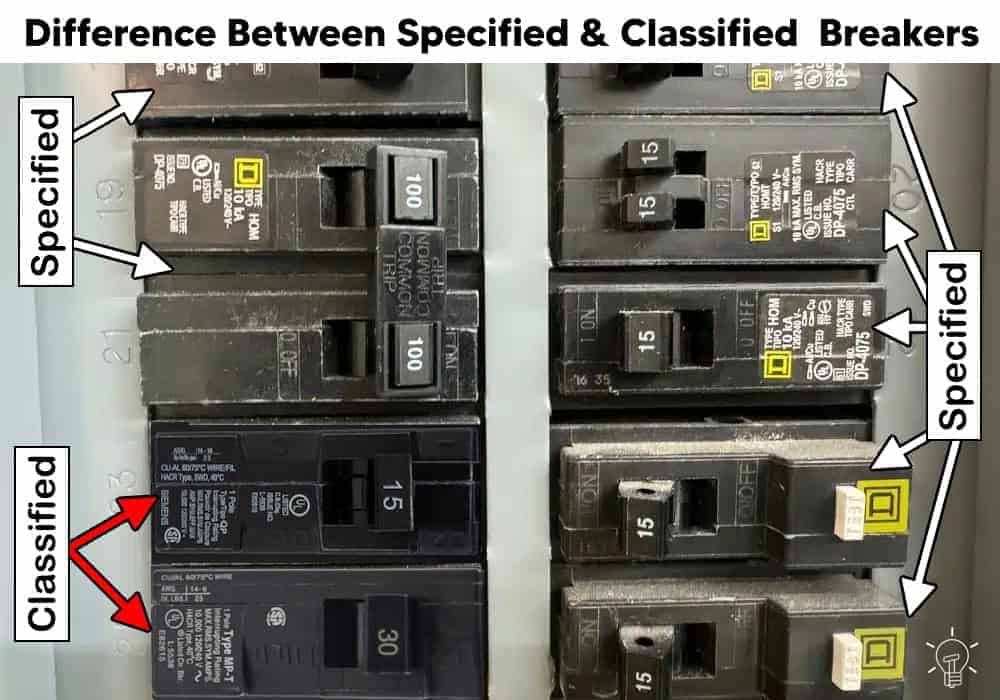
Good to Know: Using non-specified, non-classified breakers can void panel warranties, whereas “UL Classified” breakers are specifically approved by UL for use in those panel boards.
Precautions:
- Always disconnect the power supply by switching OFF the circuit breaker at the main service panel before performing any electrical work.
- Electrical equipment must be installed according to manufacturer instructions as required by the NFPA and NEC 110.3(B)).
- Never touch the terminal screws above the main breaker. These terminals are always energized and remain live even when the main breaker is switched OFF.
- If you are unsure about any part of the installation, consult a licensed electrician and ensure compliance with applicable local electrical codes.
Disclaimer: Electrical work is dangerous. The author assumes no responsibility for any loss, injury, or damage resulting from the use or misuse of this information, including improper circuit installation.
Resources:
Related Posts:
- National Electrical Code (NEC) Requirements for Panelboards
- Busbar, Bus Stab, Breaker Slot and Circuit Space in a Panel
- What is a Backfeed Main Breaker in an Electric Panel?
- What is Double Tapped Breaker and Double Lug in Main Panel
- What is the Max Number of Breakers Allowed in a Main Panel?
- What Happens if the Neutral is Lost in the Main or Subpanel?
- Why Must Neutral and Ground Wires Be Bonded in the Main Panel?
- Why are Neutral and Ground Wires Separated in a Subpanel?
- Should GFCI Protection Be in the Main Panel or Receptacle?
- Difference Between BR and CH Breakers and Load Centers
- Difference Between Homeline and QO Breakers and Panels
- Difference Between 1-Pole and 2-Pole Breakers – NEC & IEC
- Can the Neutral Wire Cause Electric Shock? Different Cases
- Will I Get an Electric Shock If I Touch the Ground Wire?
- Will a Man Get an Electric Shock If He Hangs on a Live Wire?
- What Happens When You Touch an Electrical Busbar?
- Can We Use AC Circuit Breaker for DC Circuit & Vice Versa?
- Can I Use a 240V Breaker on a 120V Circuit and Vice Versa?
- Can You Use 15A Breaker on 20A Circuit and Vice Versa?
- What is the White Powder on the Circuit Breaker Terminals?
- Why Doesn’t a Standard Breaker Protract Against Ground Faults?
Sizing & Rating
- How to Size a Load Center, Panelboards and Distribution Board?
- How to Determine the Right Size Capacity of a Subpanel?
- How to Size a Circuit Breaker? Breaker Size Calculator
- How to Determine the Number of Circuit Breakers in a Panel Board?
- How to Find the Right Wire Size for 100A Service 120V/240V Panel?
- What is the Correct Wire Size for 100A Breaker and Load?
- How to Find the Number of Lights on a Single Circuit Breaker?
- How to Size a Breaker and Wires in AWG with EGC for Load?
- How to Size a Branch Circuit Conductors with Protection?
- How to Size Feeder Conductors with Overcurrent Protection
- How to Size Service-Entrance Conductors and Feeder Cables?
- How to Size Equipment Grounding Conductor (EGC)?
- How to Size Grounding Electrode Conductor (GEC)?
- How to Find the Proper Size of Wire & Cable In Metric & Imperial Systems
Wiring Tutorials
- How to Wire 120V & 240V Main Panel? Breaker Box Installation
- How to Wire a Subpanel? Main Lug Installation for 120V/240V
- How to Wire 120V & 208V – 1 & 3-Phase Main Panel? 3-Φ Load Center Wiring
- How to Wire a GFCI Circuit Breaker? 1, 2, 3 4 Poles GFCIs Wiring
- How to wire a GFCI Outlet? GFCI Wiring Circuit Diagrams
- How to Wire an AFCI Combo Switch – AFCI Switch Wiring Diagrams
- How to Wire a Single-Pole Circuit Breaker in a 120/240V Panel
- How to Wire a Two-Pole Circuit Breaker in a 120/240V Panel
-
 Germany’s Electric Drone Hits 699 km/h, Eyes World Record
-
 How to Wire and Use Tesla Gen 3 Mobile Connector Charger
-
 How to Wire 48A Level 2 Dual Port EV Charging Station
-
 How to Wire Smart Electric Vehicle Charging Station – 32A/80A
-
 How to Wire ChargePoint Home Flex Charger for Every EV
-
 How to Wire an EV Wall Charger – Hardwired and Plug-in