Scientists Discover Two New Electric Eel Species, Including Electrophorus Voltai that can Shock up to 860 Volts
Deep within the rivers of the Amazon and Orinoco basins lives a fish that truly lives up to its electrifying reputation, Electrophorus voltai. This species can generate shocks of up to 860V and 800 Watts power (at ~1A current). With these electric parameters, it makes electrophorus voltai the world’s most powerful electric eel among other bioelectric organism ever recorded.
To put that into perspective, a typical household outlet delivers between 110 and 240 volts. This eel can produce several times that amount using only its own body, making it one of the most striking examples of how far evolution can push biological systems.
Discovery and Classification
Although electric eels have fascinated scientists for centuries, Electrophorus voltai wasn’t officially recognized as a separate species until 2019. For a long time, all electric eels were thought to be a single species but a large-scale study across South America changed that.
Researchers examined 107 specimens from Brazil, Suriname, French Guiana, and Guyana. By looking at both DNA and physical traits, they found that electric eels actually belong to three distinct species: E. electricus, E. varii, and E. voltai.
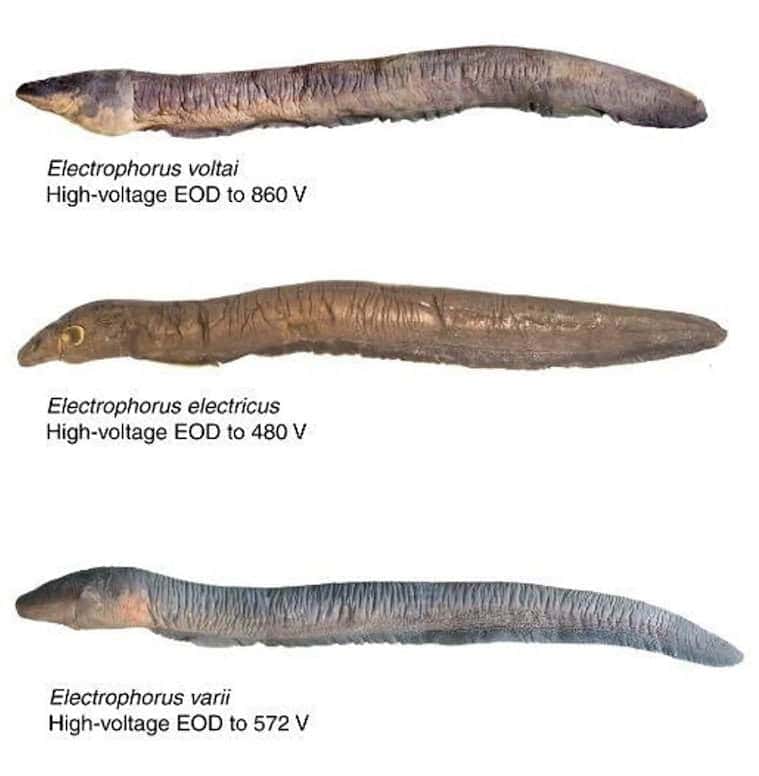
What made this discovery especially remarkable was the method scientists used. Instead of focusing only on anatomy or genetics, they also measured the electric voltage the eels produced something never done before to identify a species.
The new species was named in honor of Alessandro Volta, the Italian physicist who invented the electric battery, highlighting the eel’s extraordinary electrical abilities.
What Makes This Eel So Powerful
Electrophorus voltai is a large and powerful freshwater fish, often reaching up to 2.5 meters in length and weighing around 22 kilograms.
Its long, cylindrical body is completely scaleless, allowing it to glide effortlessly through the water. Its dark brown to gray coloring helps it blend perfectly into the muddy rivers it calls home.
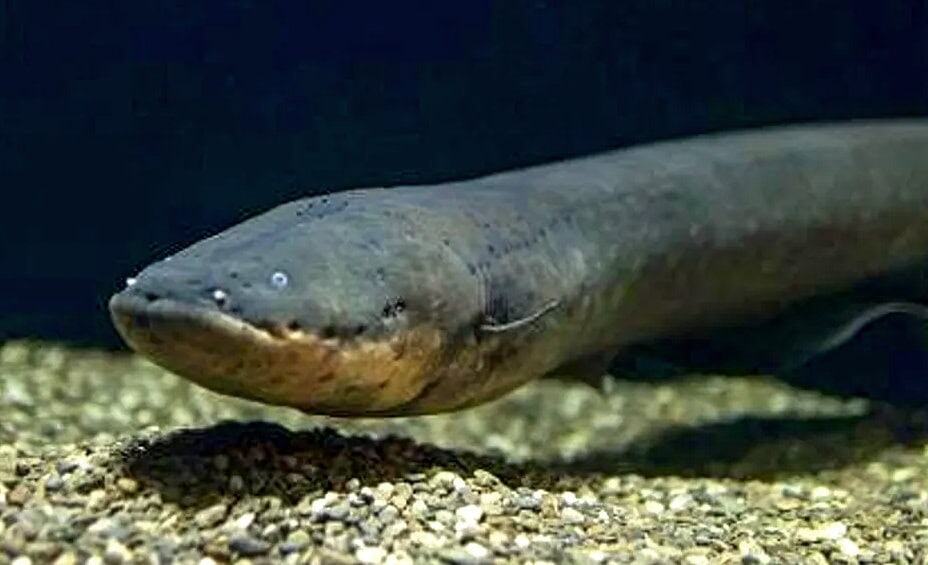
What really sets this eel apart are its electric organs which make up about 80 percent of its body. Its small eyes provide little vision and the eel mainly “sees” the world through electricity.
It moves gracefully using a long anal fin along the underside of its body, creating slow, wave-like motions that propel it silently through its watery environment.
How It Generates Electricity
The incredible power of Electrophorus voltai comes from special cells called electrocytes, which act like tiny biological batteries. When they fire together, they release a strong electrical shock.
These cells are arranged into three distinct electric organs. The main organ and Hunter’s organ deliver high-voltage shocks for hunting and defense, while the Sach’s organ produces low-voltage pulses that help the eel navigate and communicate.
When millions of electrocytes fire in perfect sync, they generate a short but intense burst of electricity. This precise control lets the eel adjust both the strength and timing of its shocks with amazing accuracy.
Breaking Nature’s Voltage Record
What really makes Electrophorus voltai stand out is its record-breaking electrical power. It can unleash shocks between 600 and 860 volts, the strongest ever recorded in any animal.
Before this discovery, the highest known output from an electric eel was around 650 volts, so the 860-volt shock set a new biological record.
Scientists think this extreme voltage is closely tied to the eel’s environment. E. voltai usually lives in clear, low-salt waters, which don’t conduct electricity well. To catch prey effectively in these conditions, it needs to generate much stronger shocks.
By comparison, its relative E. varii lives in saltier, more conductive waters and produces lower voltages, generally between 151 and 572 volts. This striking difference shows how evolution shapes species to thrive in their unique habitats.
Habitat and Adaptations
Electrophorus voltai is native to the freshwater systems of northern South America, especially within the Amazon Basin, the Orinoco River, and parts of the Guiana Shield. It thrives in a variety of habitats slow-moving streams, fast-flowing rivers, floodplains, oxbow lakes, and forest pools.
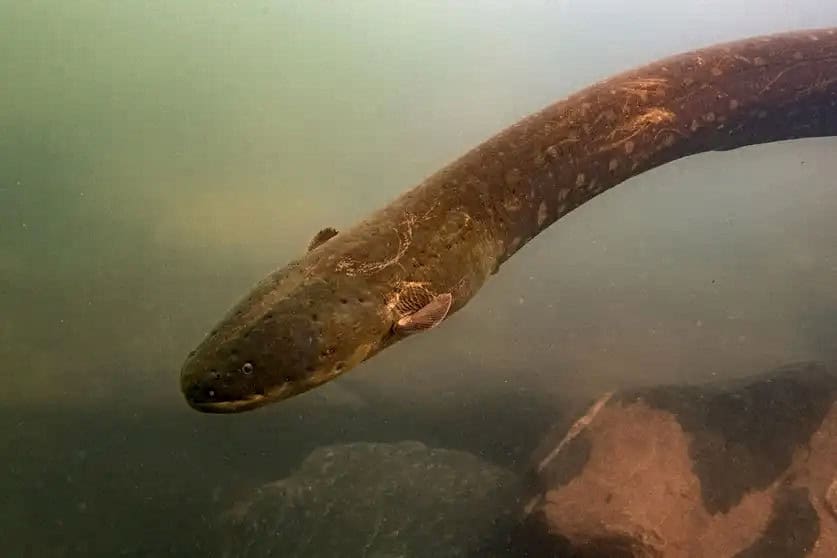
Many of these waters are murky and low in oxygen, but this eel is perfectly adapted. It is an obligate air-breather, meaning it must surface regularly to take in air, a skill that lets it survive in places where other fish would struggle.
Relying on electrical sensing instead of sight, Electrophorus voltai navigates and hunts efficiently even in dark, sediment-filled waters where visibility is almost zero.
Behavior and Hunting Strategy
Electricity is vital to the survival of Electrophorus voltai. When hunting, it sends out powerful high-voltage bursts that can instantly stun fish, frogs, and even small mammals, making it an exceptionally efficient predator.
Sometimes, the eel coils its body around its prey to focus the electric field, boosting the shock’s impact. This lets it overpower larger or more resistant animals with ease.
For defense, it uses the same strong discharges to keep predators at bay. In some cases, the eel has even been seen leaping partly out of the water to press its chin against a threat, delivering a direct, intensified shock.
At the same time, the eel constantly emits low-voltage pulses that act like a built-in radar. These signals help it sense objects, navigate murky waters, and communicate with other eels.
Scientific Importance
Studying Electrophorus voltai offers insights that go far beyond biology. Its electric organs reveal how living systems can generate and control electricity.
Scientists have already mapped its genome in detail, uncovering the genetic blueprint behind its powerful electric organs. This knowledge could inspire innovations in biomedical engineering, energy storage, and robotics.
Learning how the eel produces such high-voltage shocks without harming itself may also lead to new medical technologies and bio-inspired devices. At the same time, its discovery is a reminder of how much biodiversity in the Amazon remains unexplored, underscoring the importance of protecting these fragile ecosystems.
What It Means for Humans
A discharge of 860 volts sounds terrifying, but for a healthy human, a shock from Electrophorus voltai is rarely deadly. Locals along the Amazon and Orinoco rivers describe it as a sharp, surprising jolt rather than a fatal strike.
Scientists studying these eels report that even brief contact can trigger intense muscle contractions and leave a lingering tingling sensation.
The main risk comes not from the electricity itself, but from temporary paralysis, which could be dangerous in deep water. Still, this electric powerhouse inspires more awe than fear. Experiencing or even just learning about its shocking abilities is a vivid reminder of the extraordinary adaptations hiding beneath South America’s rivers.
Nature’s Electric Genius
Electrophorus voltai is truly one of nature’s most remarkable creatures. With the ability to generate up to 860 volts, it holds the record as the most powerful electric animal ever found.
From its fascinating discovery and classification to its specialized electric organs and record-breaking shocks, this eel is a striking example of nature’s ingenuity.
Lurking beneath the waters of South America’s rivers, it continues to astonish scientists and serves as a powerful reminder that the natural world still holds countless secrets waiting to be discovered.