MSU Develops Clear Solar Glass That Generates Electricity
MSU Scientist Develops Transparent Glass that Generates Electricity – Could Turn Your Windows into Free Power Generators
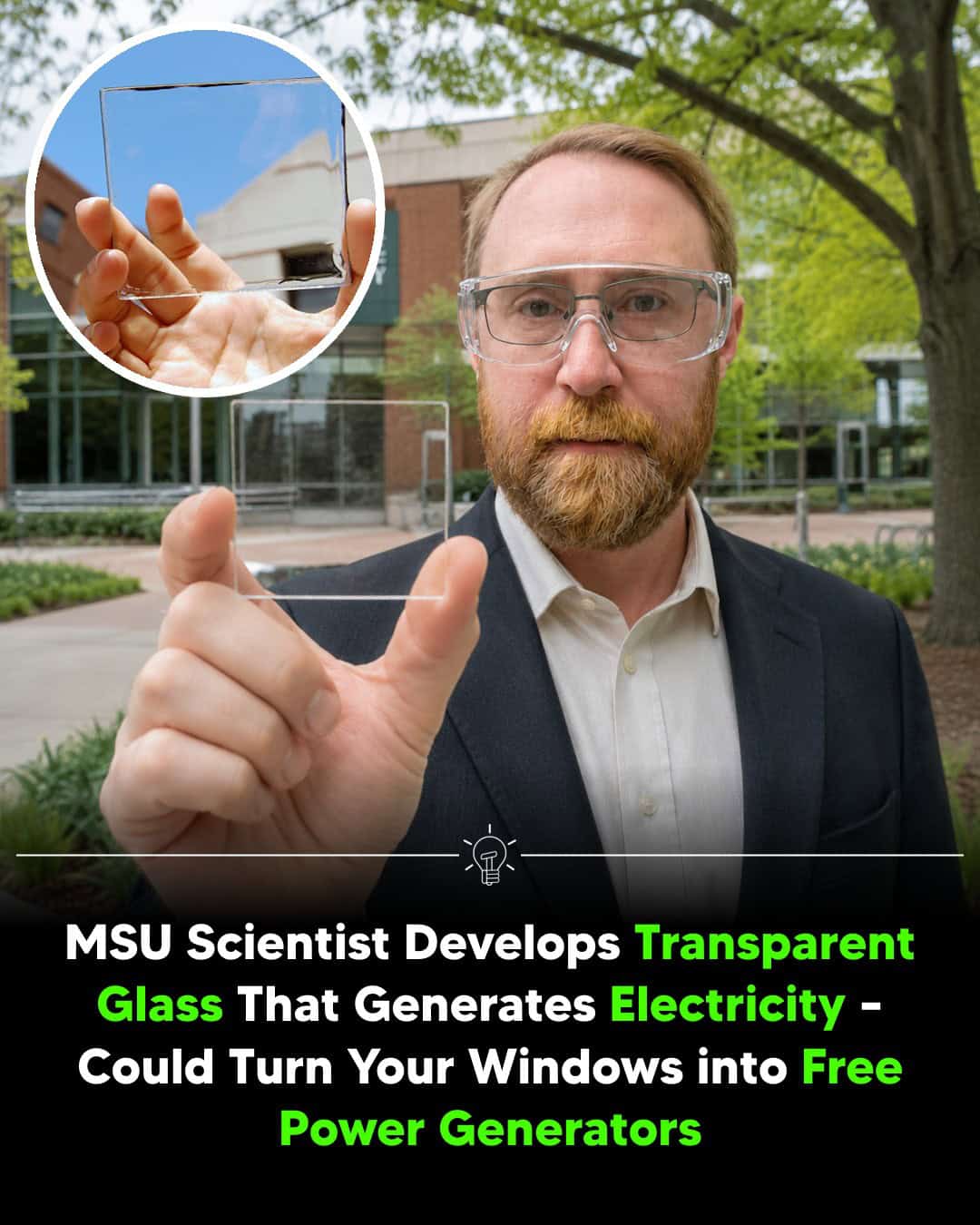
Researchers at Michigan State University (MSU) are advancing transparent solar window technology that can generate electricity while remaining nearly as clear as ordinary glass. Led by Professor Richard Lunt, the innovation allows windows to produce clean energy without blocking the view or changing a building’s appearance. The technology could transform millions of square meters of unused glass into electricity-generating surfaces.
Unlike conventional solar panels, the transparent material does not absorb visible sunlight. Instead, specially engineered organic molecules capture invisible ultraviolet and near-infrared light. That energy is guided to thin photovoltaic cells placed around the edges of the glass, where it is converted into electricity while the window remains transparent.
The technology is designed for building-integrated photovoltaics (BIPV). It could be installed in office towers, homes, greenhouses, vehicles, smartphones, and other glass surfaces. Modern skyscrapers covered with glass could eventually generate part of their own electricity while still providing natural daylight.
Transparent solar windows currently produce less electricity than traditional rooftop solar panels. Researchers say they are best suited as a complementary energy source rather than a replacement. Scientists continue working to improve power conversion efficiency, durability, transparency, and large-scale manufacturing.
Research into transparent and semi-transparent photovoltaics has accelerated worldwide. Recent studies have reported significant improvements in efficiency while maintaining high levels of visible transparency. New materials such as perovskites, organic photovoltaics, and luminescent solar concentrators are bringing commercial applications closer to reality.
Several research groups are also developing smart solar windows that combine electricity generation with energy-saving features. These windows can reduce heat entering buildings, lower cooling demand, and improve overall energy efficiency. Such advances could help cities cut carbon emissions while making better use of existing building surfaces.
Although the technology is still under development, Richard Lunt’s work has helped establish transparent solar cells as one of the most promising future clean-energy solutions. As performance improves and manufacturing costs decline, ordinary windows may become silent power generators, helping buildings produce renewable electricity without changing their design.
Sources:
- Michigan State University
- University of Delaware
- University College London