BYD Orders 10 More Ships to Carry 130,000+ EVs Worldwide
After Buying the World’s Largest Car Carrier, BYD Orders 10 More Ships to Carry 130,000+ EVs Worldwide
BYD is reportedly preparing to add 10 more vehicle-carrier ships to its growing maritime fleet as the Chinese automaker expands its international business. The reported order would involve vessels capable of carrying 9,200 car-equivalent units (CEU) each, with deliveries expected between 2027 and 2029.
The ships are reportedly being built by China Merchants Industry at its Jinling and Haimen shipyards in China.
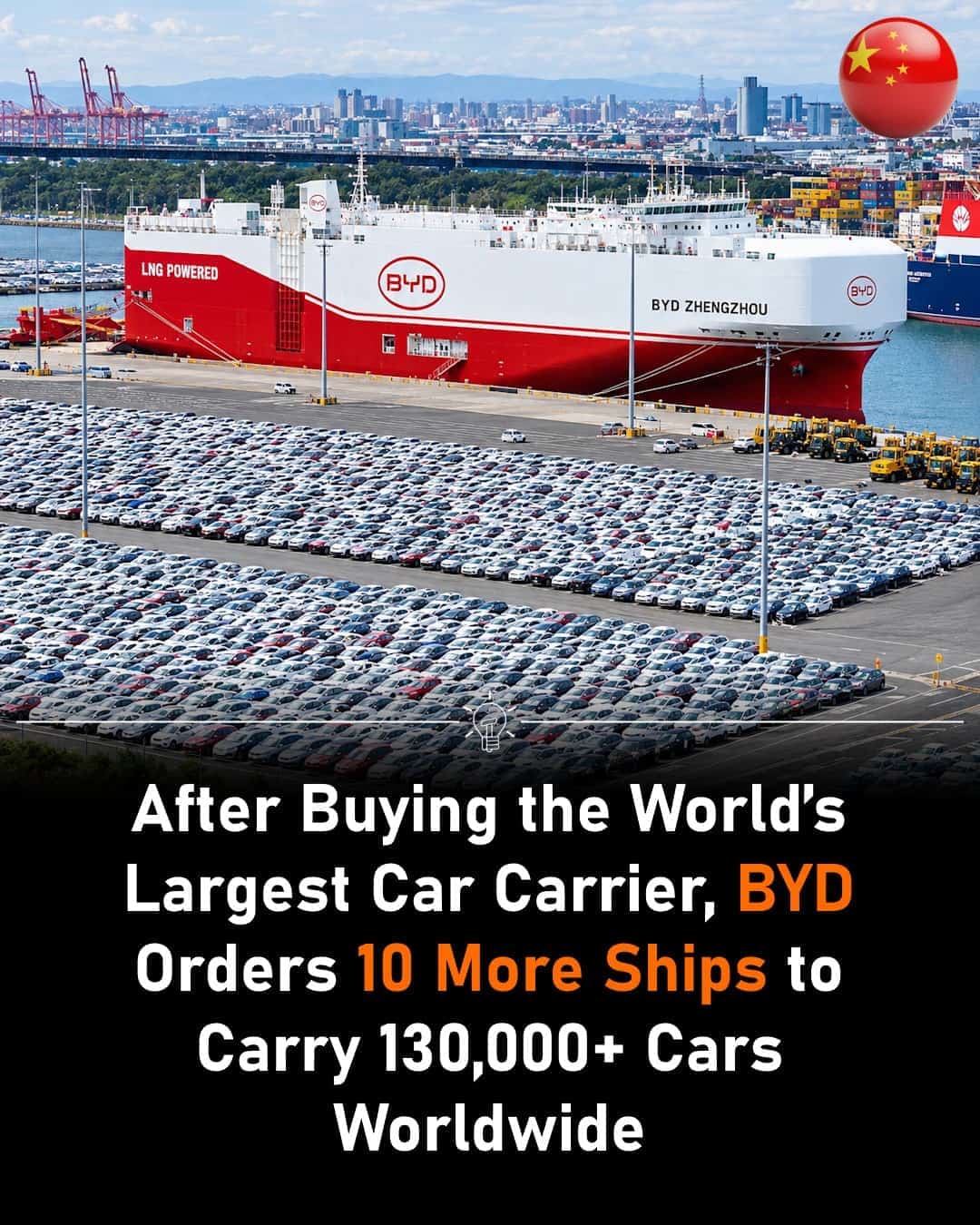
If all 10 vessels are delivered, they would add about 92,000 CEU of vehicle-carrying capacity. BYD currently has eight car carriers, meaning its fleet would reach 18 vessels with a combined capacity of more than 130,000 CEU. CEU is a standardized shipping measure and does not mean the ships will carry exactly 130,000 individual vehicles at one time.
BYD has already built a fleet of large roll-on/roll-off (Ro-Ro) pure car and truck carriers (PCTCs). These ships allow vehicles to be driven directly onto the vessel and driven off at the destination, avoiding the need for containers. BYD’s existing ships have capacities ranging from about 7,000 to 9,200 standard vehicle spaces.
The BYD Shenzhen, for example, has 9,200 standard vehicle spaces and measures about 219.9 meters long and 37.7 meters wide. BYD says the vessel uses LNG dual-fuel propulsion, along with shore-power and other energy-efficiency technologies.
The expansion comes as BYD’s overseas shipments continue to rise. In August 2026, BYD exported 184,446 passenger vehicles from China, according to China Passenger Car Association data, making it the country’s largest passenger-vehicle exporter that month. The figure was about 131% higher than August 2025.
From January through August, BYD’s exports reached about 1.127 million vehicles, an increase of roughly 88% year over year. Reuters also reported that BYD’s total overseas shipments have become an increasingly important part of its global growth strategy.
The wider Chinese market is also seeing a sharp difference between domestic and overseas demand. China’s passenger-vehicle exports reached 894,000 units in August, up 77.5% year over year, while domestic passenger-vehicle sales fell 23.7% to 1.55 million units, according to CPCA data reported by Reuters.
BYD is also reportedly targeting more than 2.5 million vehicle exports in 2027. Reuters said the figure came from information provided by Deutsche Bank and Citi following meetings with BYD management, but BYD has not officially confirmed the target. The reported shipping expansion would provide additional capacity if the company moves toward that level of overseas sales.
The reported ship order therefore represents more than just an expansion of BYD’s transport fleet. It would give the automaker greater control over an important part of its international supply chain, from vehicle production to overseas delivery. BYD has already used its ships to move vehicles from China and, in at least one case, transport vehicles produced at its Thailand factory to the UK, showing that the company’s maritime logistics network can support production outside China as well.
For scale, the reported 130,000-plus CEU capacity of an 18-ship fleet should not be confused with annual sales or annual shipping volume. A Ro-Ro vessel can make multiple voyages, so its annual transport capability can be considerably higher than its capacity on a single voyage.
CarNewsChina previously estimated that BYD’s eight-ship fleet could provide more than 1 million vehicles of annual transport capacity, although that is an estimate rather than an official BYD figure.
The new ships would arrive as BYD continues expanding production and sales outside China. Reuters reported in September that BYD is also preparing additional manufacturing capacity in Europe, including a second European production site, while the company has begun production at its first European plant in Hungary. This combination of overseas factories and dedicated maritime logistics could gradually reduce BYD’s reliance on shipping every vehicle from China.
Related EE Updates: