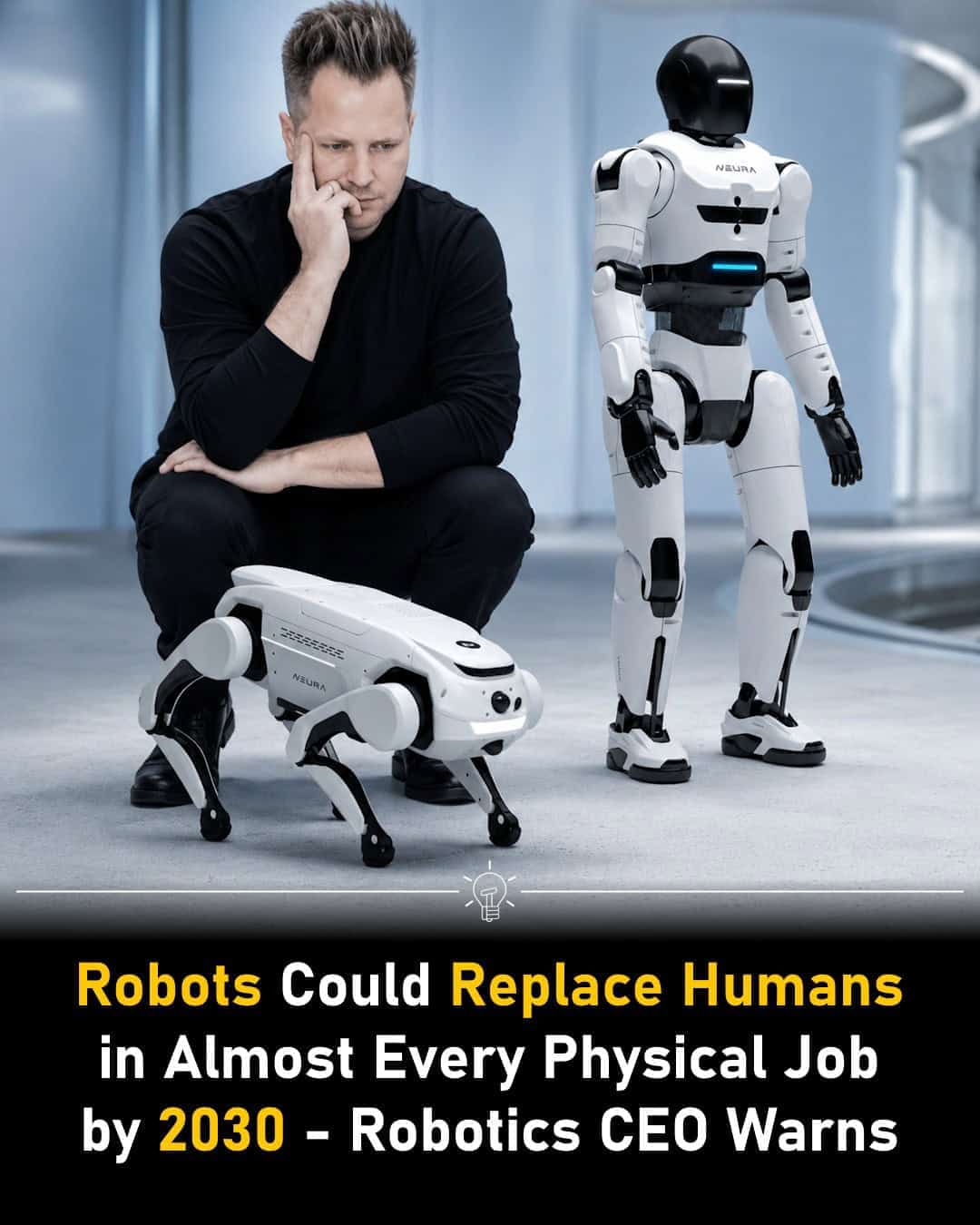
Robot Could Replace Humans in Almost Every Physical Job by 2030 – NEURA Robotics CEO Warns
David Reger, founder and CEO of German robotics company NEURA Robotics, says physical AI and robotics could take on essentially every physical task within the next two to five years. He made the prediction while speaking with Bloomberg’s Tom Mackenzie, arguing that the pace of development in robotics is accelerating rapidly.
Reger’s forecast would put the potential transition around 2028 to 2031, depending on how the two-to-five-year window is interpreted. His statement is a prediction from a robotics-industry executive, rather than an established industry forecast or evidence that robots will actually replace nearly all physical workers within that period.
One reason Reger gives for his confidence is the changing way robots learn new skills. He says NEURA can already train a robot to perform some complicated tasks faster than a human can be trained, and the company measures “time to skill” as an important performance indicator.
The technology behind this shift is generally described as Physical AI. It combines AI models with cameras, microphones, tactile sensing, computing hardware and robotic actuators, allowing machines to perceive their surroundings and respond to physical conditions instead of simply following fixed instructions. NEURA says its robots are designed to see, hear, feel and learn in real-world environments.
Robotics is already used extensively in controlled industrial applications, particularly manufacturing. However, moving from repetitive factory operations to almost any physical task would require robots to handle unpredictable environments, different objects, changing conditions, safety requirements and tasks that demand dexterity. These remain significant technical and deployment challenges.
Recent industry data also shows that humanoid robotics is still at an early stage. The International Federation of Robotics (IFR) estimates that around 7,000 humanoid robots were sold globally in 2025, while about 542,000 conventional industrial robots were installed in 2024. Many of the humanoids sold in 2025 were acquired for research and AI development rather than widespread replacement of human workers.
NEURA itself is pursuing large-scale deployment. The company has announced an ambition to deliver five million cognitive and humanoid robots by 2030, including machines for industry, services and homes. It has also developed partnerships intended to generate real-world production data for training and improving its Physical AI systems.
The potential applications extend well beyond factories. Robots could eventually be used in warehouses, logistics, maintenance, construction and other physically demanding environments, but each sector presents different requirements. A robot that works reliably in a structured factory may still need additional training, sensing and safety systems to operate around people in a construction site or other unpredictable setting.
There are also competing timelines within the robotics industry. In an April 2026 McKinsey interview, Reger described a more gradual path toward widespread robotics, saying humanoids could handle roughly 50% to 60% of workforce tasks worldwide within the context he discussed, while describing robots as everyday tools by 2040. That earlier view illustrates why the latest two-to-five-year statement should be treated as an ambitious forecast rather than a confirmed timeline.
Related EE Updates: