What Happens if You Plug Two USB Chargers into Each Other?
Although it is not recommended, it is technically possible to connect two USB chargers (whether Type-A or Type-C) to each other using a cable. In practice, this should be avoided, as chargers are designed to supply power, not receive it. Connecting two power sources together can lead to unpredictable electrical behavior and potential damage. In this article, we will explore what happens when two USB chargers are connected and outline the different scenarios and possible consequences of doing so.
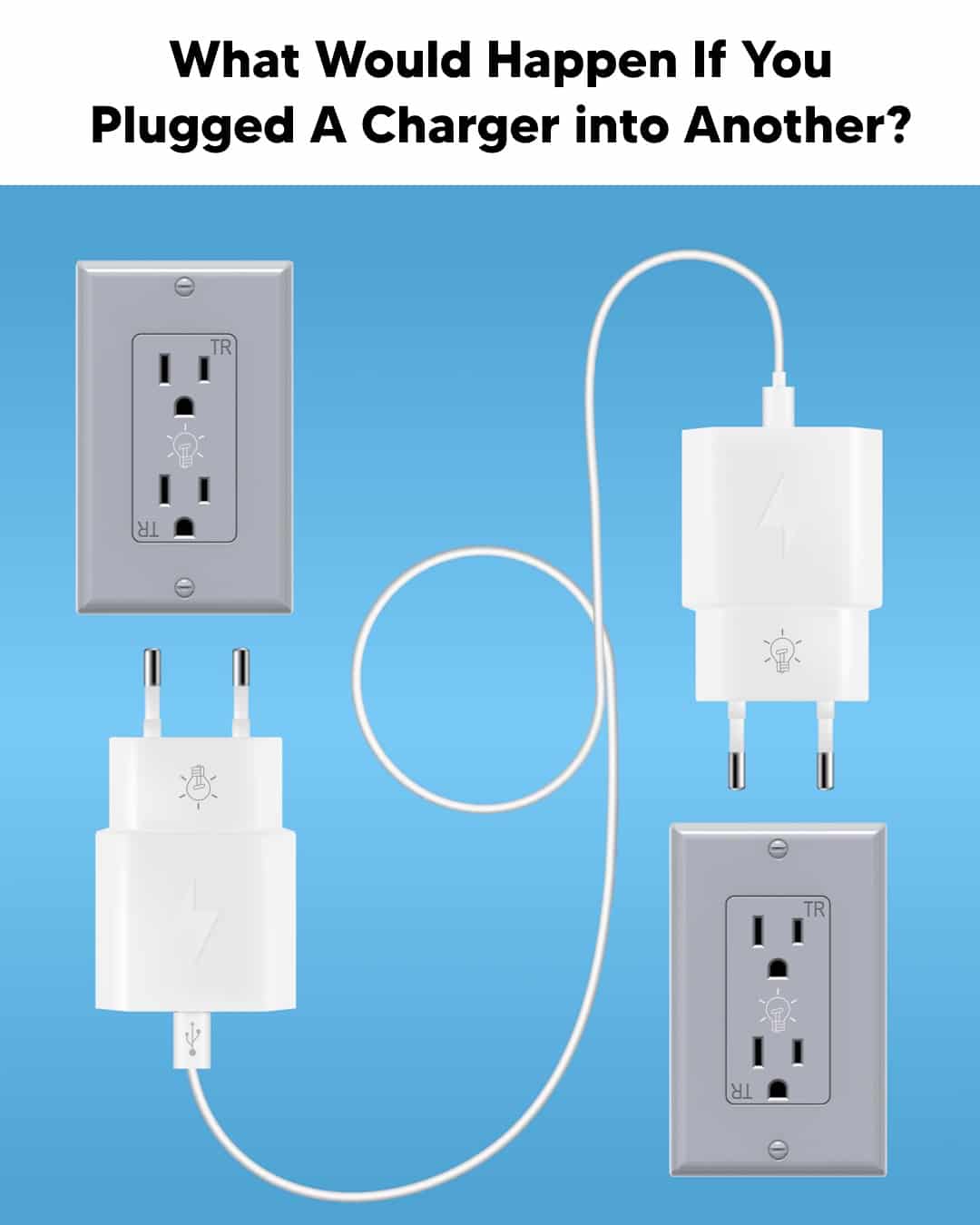
Case 1: USB Charger to USB Charger (Output to Output)
For instance, if you plug a wall charger 1 into a socket/outlet receptacle. Now, the output USB port of charger A connects to the output of USB charger 2.
As a result, nothing happens meaningful. This is because USB outputs are power sources, not power receivers. Each charger is trying to supply 5V (or negotiated higher voltage). Since neither side is designed to accept incoming voltage on its output pins, no charging occurs.
In this case, both outputs attempt to regulate voltage. Because they are nominally at the same potential (e.g., 5V), there is essentially no voltage differential, so no current flows.
In addition, modern chargers include, backfeed protection (similar like blocking diode in solar panels), output regulation circuitry and current limiting, so damage is unlikely, but it’s pointless.
Case 2: USB Output of Charger A into Input Port of Charger B
In this case, charger A plugged into the wall. Its USB output connected to the USB-C input port of Charger B (if B supports USB input).
As a result, the practice is still meaningless because the latest models of most chargers do not have power input circuitry and their USB ports are designed to supply output only. Consequently, nothing happens and charger B will not turn on at all.
One possible working scenario in this case is that if charger B is designed to accept USB power input. For example, if charge A is actually a power bank or a device with USB-C power delivery input, then it may charge normally. This is the same case charging a smartphone via USB power banks.
Case 3: AC Charger Plugged into AC Output of Another Inverter
In this scenario, a wall charger is plugged into a portable power station, while the power station itself is also plugged into the wall outlet.
This configuration will function, but it is inefficient. The power station charges from the AC wall supply, stores energy in its battery, and then inverts that stored DC power back to AC. The wall charger then converts the AC power back to DC to charge the device.
The power flow path is therefore: battery → inverter (DC to AC) → wall charger (AC to DC) → device.
Each conversion stage introduces efficiency losses, typically around 10–20% per stage. Because multiple conversions occur in sequence, the total energy loss becomes significant.
In short, this setup is electrically valid but inefficient and wasteful.
Case 4: Dangerous Scenario (Output Shorted Incorrectly)
If someone connects positive to positive incorrectly, modifies cables, or uses nonstandard wiring, there is a possibility you could get:
- Backfeeding current
- Overcurrent conditions
- Damage to voltage regulators
- Blown protection circuits
While modern chargers include thermal protection as well as short-circuit and overcurrent protection, but cheap and poorly designed chargers may fail and cause serious electrical hazards. Therefore, never ever try this meaningless practice.
Is It Dangerous to Plug Two USB Chargers Together?
You might expect it to explode, but you may wonder why it does not when two chargers are connected together.
This is because chargers are switch-mode power supplies (SMPS). They regulate output voltage actively and include protection circuits especially to prevent reverse current flow. In addition, they are not passive transformers that freely pass energy backward.
Since both chargers are designed to supply power rather than receive it, connecting them together can cause electrical conflict. In most cases, modern chargers have protection circuits that prevent damage, but doing this is unnecessary and may risk overheating or damaging the chargers.
As we know that current only flows when there is a voltage difference. When two regulated 5V outputs connected together, both sit at ~5V. This way, No meaningful voltage differential. Hence, no current flow. As a result, no charging occurs.
This is the same case like connecting two batteries or solar panels together, or connecting male-to-male plug into outlets.
This is why plugging one charger into another typically results in nothing happening due to safety protections. Because both devices are designed to output, not receive, power, they fight each other to regulate the supply rather than transferring energy.
Warning: Connecting low-quality chargers, particularly those lacking proper overcurrent, overvoltage, or thermal protection, can result in overheating, fuse failure, component damage, and potentially a fire hazard. Similarly, you should never use male-to-male extension cord, because it poses serious electric shock hazards.
Related Posts:
- What Will Happen If You Connect a Male-to-Male Plug Between Outlets
- Why You Should Never Buy or Use Male-to-Male Extension Cords
- Why Avoid Plugging Space Heaters into Power Strips or Extensions?
- List of Electrical Appliances You Should Never Plug Into an Extension Cord
- What Happens if a Power Line Falls into the Ocean Water?
- What Happens if the Neutral is Lost in the Main or Subpanel?
- What Happens When You Touch an Electrical Busbar?
- What Happens When Aircraft and Plane are Struck by Lightning?
- What happens if You Connect a 3-Φ Induction Motor to 1-Phase Supply?
- What Happens if We Connect a Polar Capacitor the Wrong Way?
- What Happens if a Battery is Connected to the AC Supply?
- What Happens to the Battery with Reverse Polarity Wiring Connection
- What Happens When an AC Line Touches a DC Line?
- How Do Some Devices Operate on Both AC and DC Supplies?
- Is It Dangerous to Carry a Battery in an Elevator?
- Can an AC Device Operate on DC Supply, and Vice Versa?
- How Do Some Devices Have Dual Input Voltage Ratings?
- What Happens if You Use a 120V Device on 240V & Vice Versa?
- Is It Possible to Get Electrocuted by an Electric Vehicle?
- Can the Neutral Wire Cause Electric Shock? Different Cases
- Will I Get an Electric Shock If I Touch the Ground Wire?
- Will a Man Get an Electric Shock If He Hangs on a Live Wire?
- Can you Combine AC and DC Ground in a Solar Installation?
- Why Don’t Birds and Squirrels Get Electrocuted on Power Lines?
- Why Does the Heating Element Glow but Not the Cord of Heater?
- Why Can’t a 12V Car Battery Electrocute You?
- Which One Kills – Current or Voltage and Why? Amps vs Volts
- Which One is More Dangerous And Why? AC or DC ?
- Which One is More Dangerous? 120V or 230V and Why?
-
 Germany’s Electric Drone Hits 699 km/h, Eyes World Record
-
 Arkansas School Uses Rooftop Solar to Raise Teacher Pay
-
 Why are Inductive & Capacitive Reactances Measured in Ohms?
-
 What Happens If You Install a Larger Capacitor in a Fan?
-
 Robotic Snakes that Crawl Power Lines to Detect Faults
-
 Can You Install Breakers and Switches on Neutral Conductor