What Happens if a Battery is Connected to the AC Supply?
What Will Happen If We Connect a Battery to an AC Source?
We know that a battery cannot store AC; it can only store DC as an energy storage device. Therefore, never attempt to connect a battery directly to an AC supply at home, in a lab, or anywhere else. Now, let’s examine what happens if you connect a 12V DC battery to 120/240V, 230V AC or even to a 12V AC supply.
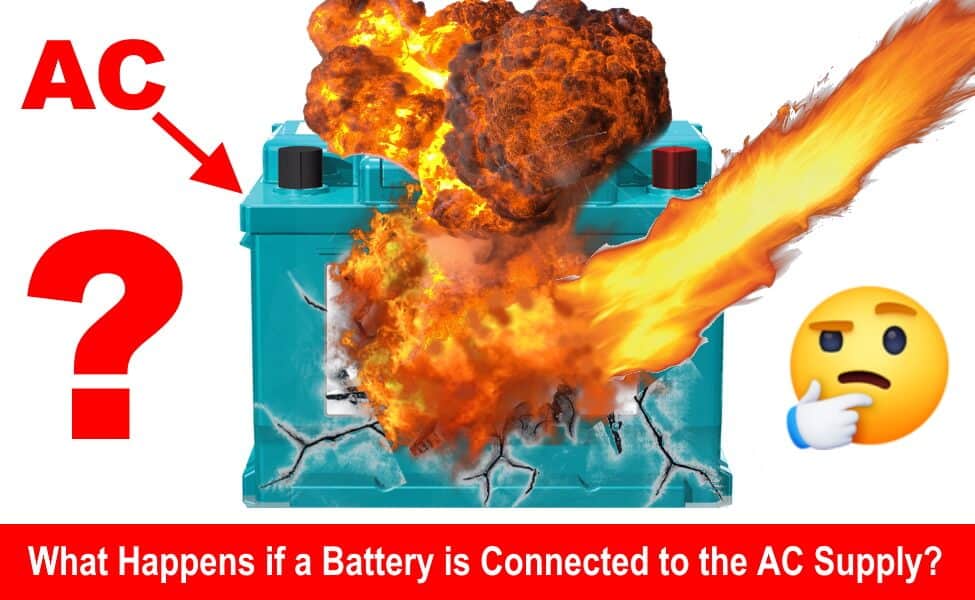
Connecting a 12V DC Battery to 110V or 230V AC
If we connect a battery directly to an AC source (such as 120V or 230V AC from a wall socket, outlet or receptacle), it may heat up and eventually explode with a loud boom, posing serious risks of injury and fire hazards.
The reason is that AC supply has a frequency (50 Hz in the UK and 60 Hz in the US), meaning its direction and magnitude change multiple times per second. In this case, the battery would attempt to charge during the positive half-cycle and discharge during the negative half-cycle of the AC waveform. This process would repeat 50 or 60 times every second.
Such rapid charging and discharging cause excessive heating of the battery plates due to constant stress. Since the battery cannot switch its polarity (positive and negative terminals) to match the alternating nature of AC, it becomes unstable. This is why AC (which changes direction and magnitude continuously) cannot be stored in a battery, while DC (which has a constant direction and zero frequency) can.
If we connect a battery with an AC source (say 120V or 230V AC from a wall plug), It may heat up and explode with a boom having risk of serious injuries and hazardous fire. The reason is that AC supply has frequency (50Hz in UK and 60Hz in the US) i.e. the direction and magnitude of AC supply changes multiple times in a second according to the rate of frequency.
Similarly to batteries, a transformer also cannot operate when connected to a DC supply.
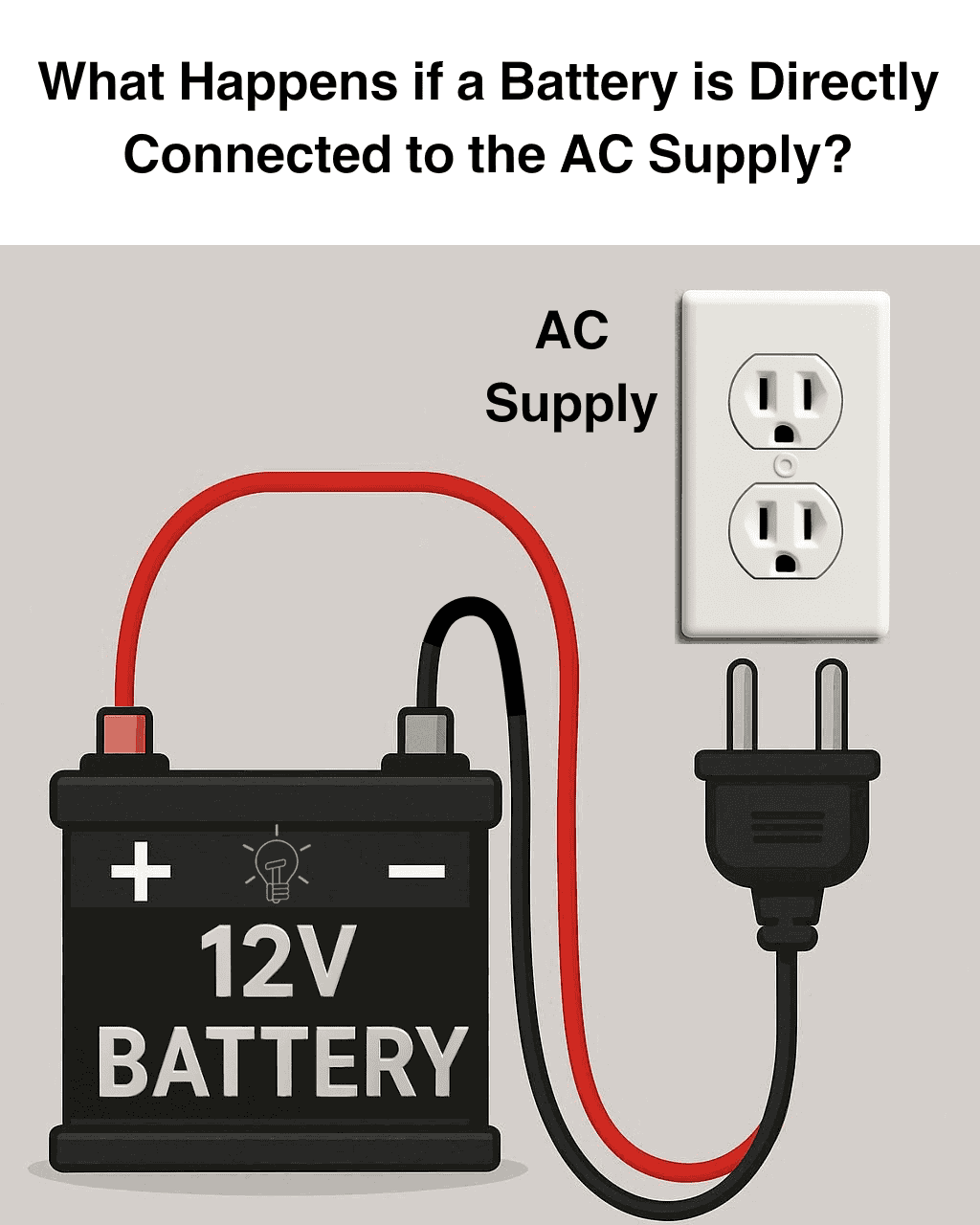
Connecting a 12V DC Battery to 12V AC
Lowering the AC voltage does not make it behave like DC, nor will it charge a battery. The same charging and discharging actions will continue, causing frequent chemical reactions at both terminals of the battery, with no actual storage of energy taking place.
Also, keep in mind that 12V AC is not the same as 12V DC. The 12V in AC is usually given as an RMS (Root Mean Square) value, which means that 12V AC produces the same heating effect as 12V DC in a resistive load. However, unlike DC, AC has peak and peak-to-peak values as well as frequency, while DC has only a constant value with no frequency.
For example:
12V DCRMS = 12V ACRMS = 16.97 AC VPeak
But
12V ACRMS = 16.97 AC VPeak ….. (VPeak = √2 x VRMS or VPeak = 1.414 x VRMS)
Or
12V ACRMS = 33.94 AC VPeak-to-Peak ….. (VPeak = 2 x VPeak or VPeak = 2.828 x VRMS)
The same principle applies to electric current as it does to voltage.
For instance, a 12V DC (constant) is equal in heating effect to 12V AC RMS, but in reality, that 12V AC RMS corresponds to about 16.97V AC peak or 33.94V AC peak-to-peak. In other words, the instantaneous value of AC voltage can be much higher than the equivalent DC voltage with the same RMS value.
This is why DC-operated equipment should never be connected to an AC supply, and vice versa. Simply put, a battery is a DC-operated device and must never be connected to an AC source.
Cautions:
- Hazardous chemical reactions take place inside a battery to convert chemical energy into electrical energy. Therefore, always wear safety glasses, rubber gloves, and other protective equipment when working around batteries or related hazardous devices.
- Never connect an AC source to DC equipment, or DC to AC equipment. The only exception is for universal motors, which are designed to operate on both AC and DC; however, always read and follow the manufacturer’s user manual before attempting this.
- The author(s) will not be responsible for any losses, injuries, or damages resulting from the use of this information or from attempting any circuit incorrectly. Please be cautious! electricity is extremely dangerous and must be handled with the utmost care.
Video:
The following video demonstrates a battery explosion and expulsion caused by connecting it directly to a wall outlet (AC voltage).
Conclusion:
- Q: Can a battery be connected to an AC supply?
- A: Absolutely not! Under no circumstances should a battery be connected directly to an AC source. Doing so is extremely dangerous and can result in severe injury, fire, or explosion.
Related Posts:
- Why Can’t a 12V Car Battery Electrocute You?
- What Happens When an AC Line Touches a DC Line?
- Why Do Electronic Circuits Use DC Current instead of AC?
- Can We Use AC Circuit Breaker for DC Circuit & Vice Versa?
- Can an AC Device Operate on DC Supply, and Vice Versa?
- Can I Use a 240V Breaker on a 120V Circuit and Vice Versa?
- Why is a Battery Rated in Ah (Ampere hour), Not in VA?
- AC or DC – Which One is More Dangerous And Why ?
- Can You Use 15A Breaker on 20A Circuit and Vice Versa?
- Can You use a 15A Outlet on a 20A Circuit and Vice Versa?
- What Happens if You Use a 120V Device on 240V & Vice Versa?
- Can I Use a 1-Phase Breaker on a 3-Phase Supply & Vice Versa?





AC has a sinusoidal flow of electrons , so the charging effect nullifies. +/- cancels each time it completes a cycle. But the path of electrons is lengthier in AC than in DC, so this will definitely cause more friction and heat… The battery will get damaged soon.
You will be lucky to trip the breaker before acid in battery literally boils up and explode
When I was about 12 I connected a 3 volt DC motor to a 120 volt ac wire. When I plugged it in it was just buzzing so I reached down and spun it. That was my first experience that I remember of being thoroughly shocked by something.
The battery is designed for 12 volt and now you are putting 120 in it. First the plates will probably all fuse together and then an instant short!