France Requires 40% of New Building Roofs for Solar Panels
France Orders New Buildings to Cover 40% of Rooftops with Solar Panels or Greenery
France has increased the share of rooftops that must be dedicated to renewable-energy production or vegetation on certain new buildings and major renovations. From July 1, 2026, the minimum requirement rises to 40% of the relevant roof area.
The new rule applies to several categories of non-residential buildings, including commercial, industrial, craft and administrative buildings, offices, warehouses, certain hangars, hospitals, schools, universities, sports facilities and publicly accessible covered parking.
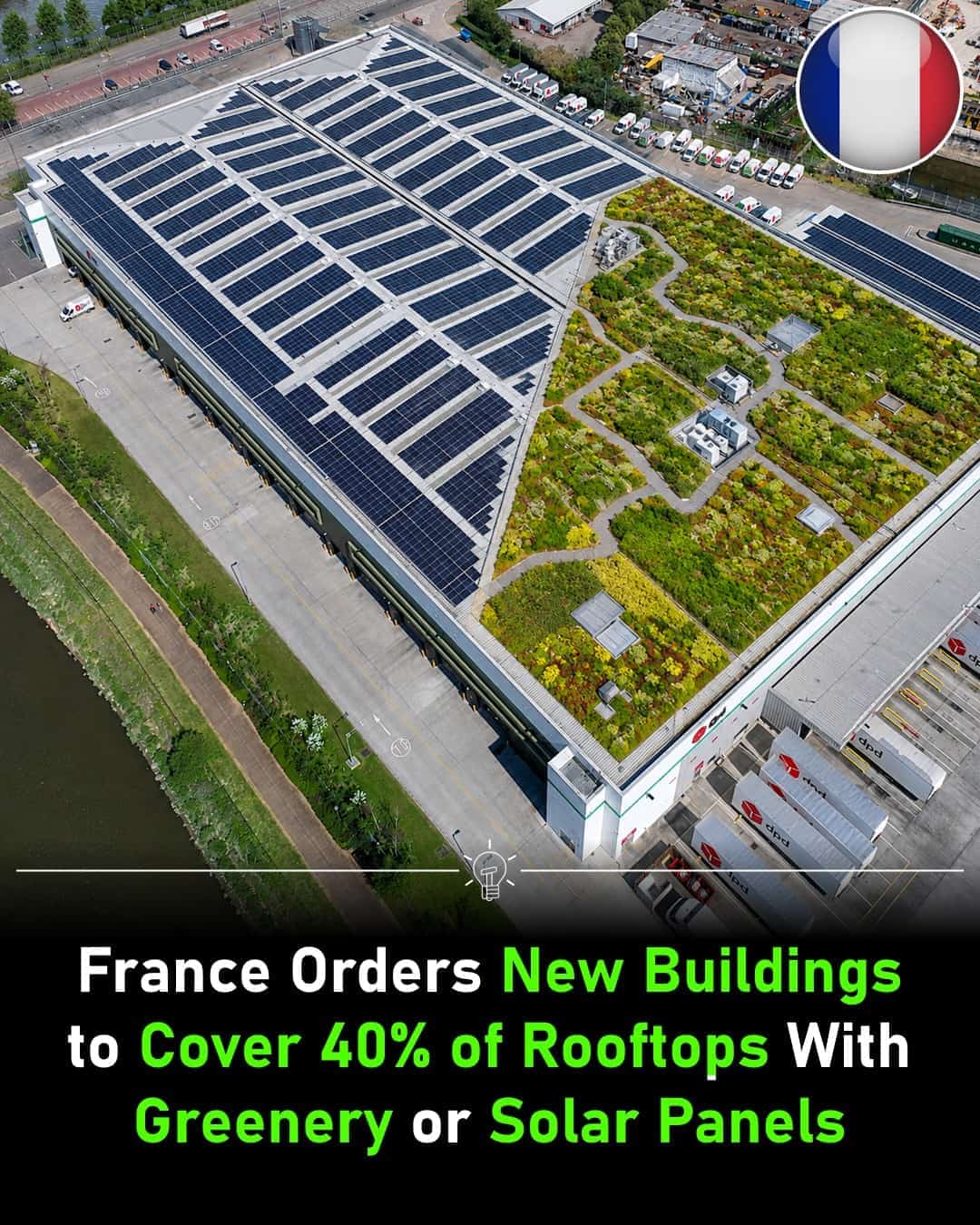
The requirement is part of Article L171-4 of France’s Construction and Housing Code by Légifrance. It does not simply require every qualifying roof to be covered with solar panels. Building owners can generally meet the requirement by installing a renewable-energy production system, such as photovoltaic panels, or by creating a qualifying green-roof system. The French rules also allow other systems that achieve the required environmental result.
The percentage has been increased in stages. The requirement by Légifrance was set at 30% for buildings constructed or heavily renovated from January 1, 2024. It rises to 40% from July 1, 2026 and is scheduled to reach 50% from July 1, 2027. The percentages apply to the roof area of buildings covered by the regulation, rather than requiring a fixed percentage of the entire property.
For example, a qualifying building with a 1,000-square-meter roof would generally need at least 400 square meters dedicated to an eligible renewable-energy or vegetation system under the 40% requirement. From July 1, 2027, that minimum would rise to 500 square meters. This creates a significant opportunity for rooftop photovoltaic installations, particularly on large warehouses, commercial buildings and industrial facilities with extensive roof areas.
France’s rules also cover certain building extensions and major renovations when the relevant extension or renovation has a footprint exceeding 500 square meters. The obligation therefore extends beyond entirely new construction. The official French government guidance lists commercial, industrial, craft and administrative buildings, offices, warehouses, certain commercial hangars, hospitals, educational buildings, sports facilities and other specified structures among the covered categories.
The legislation gives building owners a choice between different approaches. A photovoltaic system can turn unused roof space into an electricity-generating asset, while vegetation can provide thermal and environmental benefits. The official guidance says qualifying vegetation systems should provide a high level of thermal efficiency and insulation and support biodiversity, while using drinking water only as a supplement to recovered water.
Authorities can allow all or part of the requirement to be waived when technical, safety, architectural or heritage constraints prevent installation. Exemptions can also apply when meeting the requirement would not be economically acceptable. The regulations specifically recognize situations involving protected buildings, difficult roof structures and technical conditions that make the required installation impractical.
The rooftop requirement is part of a broader set of French measures targeting energy and environmental performance in buildings. Separate rules also address parking areas associated with qualifying buildings. For example, certain outdoor parking lots larger than 500 square meters that are newly constructed or heavily renovated must incorporate measures for shading and rainwater management over at least 50% of their area.
Existing large parking lots are also entering a separate solar-shading requirement. France’s official guidance says existing parking areas larger than 1,500 square meters will progressively need shading structures over half their surface between July 1, 2026 and July 1, 2028, with the structures required to include renewable-energy production systems such as photovoltaic panels, subject to exceptions.
The immediate threshold is 40% from July 2026, followed by 50% from July 2027. For the solar industry, however, the rules could create additional demand for commercial and industrial rooftop PV as more new buildings and major renovations have to put a portion of their roof space to productive environmental use.
Related Posts:
- New French Law Requires Solar Panels Over Parking Areas
- Arkansas School Uses Rooftop Solar to Raise Teacher Pay
- Dubai Airports to Install World’s Largest 60,000 MWh Solar Roof
- UK Finally Makes Plug-In Solar Panels Legal at Home
- German Startup Turns Shop Awnings into Mini Solar Power Plants
- Germans Install Solar Panel Fences for Free Electricity