Finland Successfully Tests Wireless Electricity Transmission
Finland’s Wireless Power Transmission – Fact vs. Hype
Lately, social media has been full of stories about a Finnish invention that can supposedly send electricity through the air without wires, plugs, or any physical connection. Many headlines make it sound like a major breakthrough that could change how we power homes, cities, and industries.
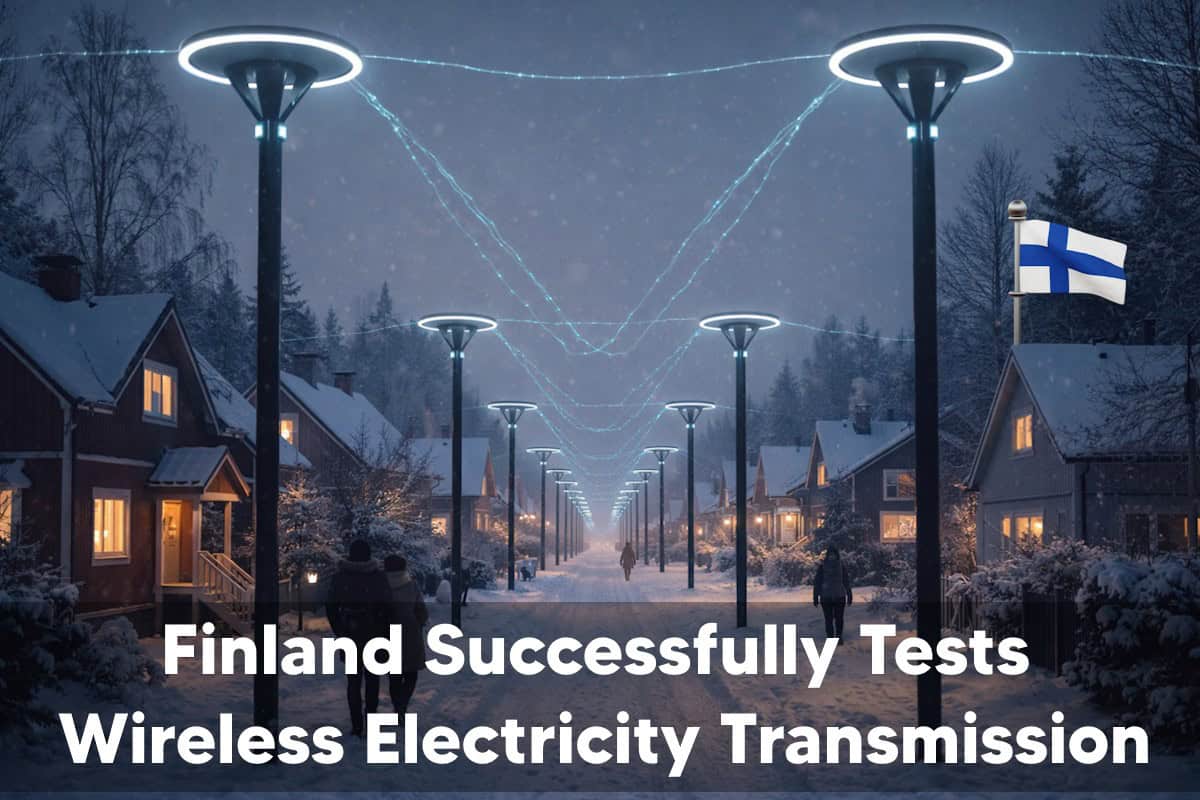
Does that mean we will need to charge our phones while walking under those snowy rings, and also remove traditional receptacles and electrical outlets from our homes? It may not be possible at the moment, but depending on future technological developments, we might soon experience this in reality rather than just imagining it.
The Origins of the Claim
In early 2026, social media and YouTube were buzzing with excitement about Finnish engineers allegedly sending electricity “through the air” using sound waves, lasers, radio waves, or electromagnetic fields. Headlines hinted at a wire-free future powering everything from drones to factories and even brought up Nikola Tesla’s old experiments with wireless power.
But is it really true? The reality is more grounded. Many of these claims are exaggerated or misunderstood. Current technology can’t transmit electricity over long distances without significant energy loss, because physics simply won’t allow it and the system would be inefficient due to huge power loss. What researchers are actually doing is finding smart ways to use existing principles for small scale and controlled applications.
Some viral posts mention “acoustic wires” or “superconducting receivers” that promise long-distance, loss-free power. In truth, these ideas mix fact with speculation. The hype often overlooks inefficiencies, safety concerns, and the need for specialized equipment. Because it creates the impression that wireless electricity could replace power grids overnight, when it really can’t.
What is Wireless Electricity?
Wireless electricity means sending power without using wires and cables. Instead, energy can travel through electromagnetic fields, sound waves, lasers, or radio signals. Similar like how a Wi-Fi network sends data through the air.
The idea isn’t new. Nikola Tesla experimented with it over a century ago, from 1901 to 1917, using high-voltage towers and special circuits. His Wardenclyffe Tower showed energy could move through the air under certain conditions, but large-scale wireless power was never achieved.

Today, most wireless charging (like for smartphones) works only over very short distances using magnetic induction. Finnish researchers from universities like Aalto, Helsinki, and Oulu, along with startups like Willo Technologies, are exploring new ways to send small amounts of electricity over short distances using sound waves, lasers, and radio signals.
What Finnish Scientists Actually Did
In early 2026, Finnish researchers grabbed worldwide attention by showing new ways to send electricity through the air without wires. Scientists from the University of Helsinki, Aalto University, and the University of Oulu, often working with startups, ran experiments that guided energy along controlled paths.
One team in Helsinki used strong sound waves to create “invisible wires,” while teams at Aalto and Oulu tested electromagnetic systems that could power devices without needing perfect alignment.
While these experiments led to viral claims about “Wi-Fi electricity,” they are far from replacing traditional power grids. So far, only small amounts of electricity can be sent safely in controlled lab conditions, and large-scale wireless power over long distances is still not possible.
Ultrasonic “Acoustic Wire” Experiments
At the University of Helsinki, researchers tested an idea called an ultrasonic “acoustic wire.” They used strong sound waves to change the air’s density along a path, which let them guide tiny electrical sparks instead of letting them scatter like lightning. Simply put, the sound waves created an invisible channel to steer electricity. This work shows that energy can be controlled more predictably, laying the groundwork for future wireless power research.
Electromagnetic and Radio-Frequency Experiments
At Aalto University and the University of Oulu, scientists have been experimenting with wireless systems that can send electricity without cables or even perfect alignment. In lab tests, radio-frequency (RF) fields were able to transmit small amounts of power over short distances, letting devices charge while moving or rotating.
Startups like Willo Technologies are now working to turn these experiments into practical solutions. Willo recently raised €2.9 million to develop wireless charging for robots, sensors, and other moving industrial equipment. By combining research with real-world applications, these efforts hint at a future where controlled wireless power could actually become part of everyday technology.
What the Experiments Showed
Public demos, including work from Aalto University, show real progress in small-scale wireless power. In lab tests, researchers were able to power LEDs, sensors, and small devices across short distances without cables. The setups were over 80% efficient at close range about 7 inches (17 cm) using circular loop antennas, each 2.8 inches in diameter, which is enough for low-power gadgets but not big machines. Safety and stability were key, with energy carefully controlled to avoid affecting people or nearby electronics.
Can this Replace Power Lines and Plug Points?
It’s important to clarify that these experiments were not designed to power homes or cities. The energy transmitted was very small, enough for tiny devices or sensors, and only worked under controlled laboratory conditions. While the experiments are scientifically significant, they do not represent a ready-to-use wireless power system.
Scientists in Finland point out that wireless power is more likely to complement existing systems rather than replace them. It could be useful in special situations where running wires is difficult or unsafe.
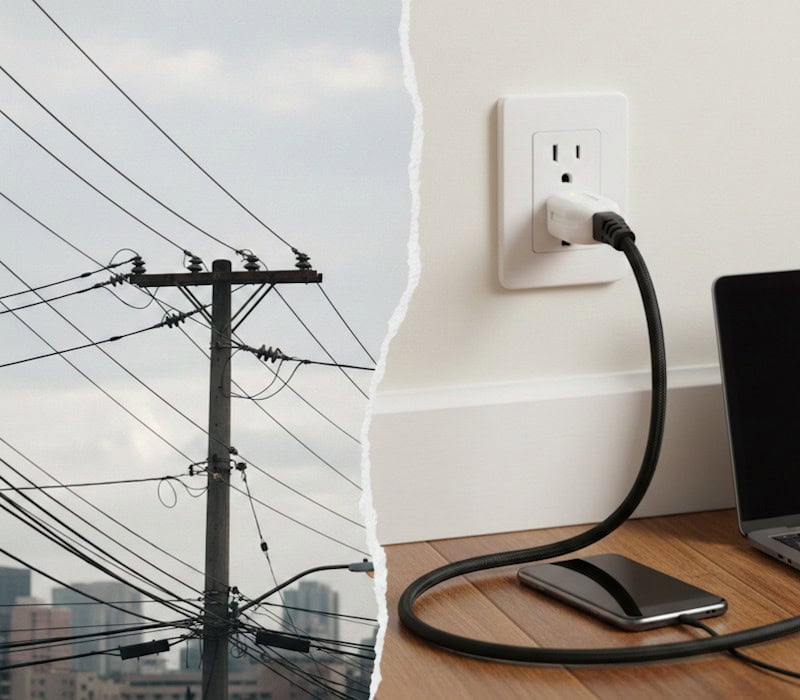
This research doesn’t mean we’ll soon live in a world where electricity floats through the air. But it does show that energy doesn’t always need cables i.e. sound waves, light, and radio signals can sometimes carry power where wires can’t go.
Potential Applications
In the future, this research could lead to real products through startups and partnerships. Some companies are already exploring chargers that work in all directions. With better materials like superconductors, wireless power might reach farther but sending electricity over very long distances is still far off.
Even with today’s limits, wireless electricity could change many areas:
- Smart Homes and Offices
Devices could charge automatically as soon as they enter a room, no cables or pads needed. - Wearables and Medical Gear
Medical implants, sensors, and health monitors could work without batteries or wires, making them safer and more convenient. - Factories and Remote Sites
Places where wiring is tricky or dangerous, like factories, construction sites, or remote locations, could use temporary or permanent wireless power. - Electric Vehicles
EVs could one day charge wirelessly when parked or even on the move. It will reduce the need for charging stations.
Limitations
- Efficiency and Distance: Long-distance wireless power is inefficient. Energy is lost to heat and dispersion, making scaling difficult.
- Safety and Regulation: Higher-power transmission raises safety and regulatory concerns. Fields must avoid interfering with people, animals, or devices.
- Commercial Scaling: Turning lab experiments into real-world solutions requires engineering, investment, and approvals. Progress is steady, but widespread adoption will take time.
What Should We Expect?
Finnish scientists have found ways to send small amounts of electricity through air using sound waves, lasers, and radio waves, like creating invisible wires in the lab. It’s exciting research, but it doesn’t mean we have a wireless power grid yet or can charge devices at home. The media headlines made it sound bigger than it is. The experiments show real progress, but we need patience and realistic expectations as this research develop.
Related Posts:
- Norway Sets Up World’s First Wireless EV Charging Road
- Poland Builds Solar-Powered Bike Lane That Glows Blue in the Dark
- Japan Uses Electrically Heated Sidewalks to Prevent Snow Accumulation on Roadways
- Wave, Wind, and Solar Hybrid Energy Raft Could Power 1,000 Homes a Day
- Colorful and Transparent Solar Panel to Replace Your Windows
- Swedish Scientists Develop Liquid that Stores Solar Energy for 20 Years
- US Firm Unveils Small Nuclear Reactor to Power 300K Homes
- Japan Introduces Magnetic Levitation Car Technology – The End of Engines and Batteries




What connects a spacecraft far away in space with earth based command center that can move switches in the spacecraft to perform commanded functions?