Nobel-Winning Chemist Turns Thin Air into Clean Drinking Water
Noble Prize Winner Builds Solar Device that Pulls 1,000 Liters of Clean Water from Thin Air Every Day
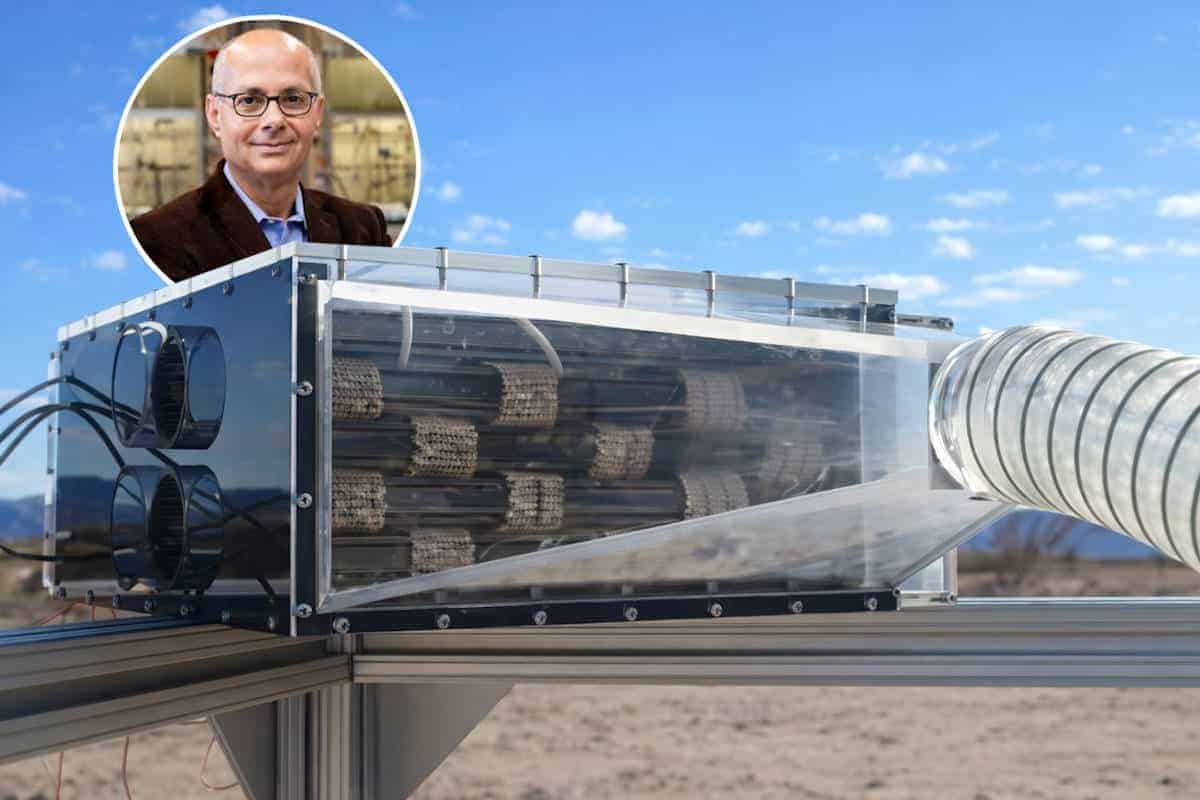
Professor Omar Yaghi, a chemist at the University of California, Berkeley and a 2025 Nobel Prize winner, has developed a machine that can pull up to 1,000 liters of clean drinking water a day straight from the air.
Built by his company Atoco, the system works even in extremely dry places with humidity below 20 percent. That means it can produce water in deserts, drought-hit regions, and remote communities where traditional water systems fail.
Unlike conventional atmospheric water generators that rely on heavy electricity use and cooling systems, this device runs on ultra-low-grade thermal energy, allowing it to operate off-grid.
About the size of a 20-foot shipping container, the units are designed to be deployed quickly. They could be sent to hurricane-stricken islands, desert communities, or refugee camps where infrastructure has been damaged or doesn’t exist.
Yaghi describes his work as “reimagining matter” using smart materials to solve one of the world’s most urgent challenges: access to clean water.
How It Works
At first, the idea of pulling water from dry desert air seems like science fiction. Yet, Professor Omar Yaghi’s invention makes it real, built on decades of research in advanced materials called metal-organic frameworks, or MOFs.
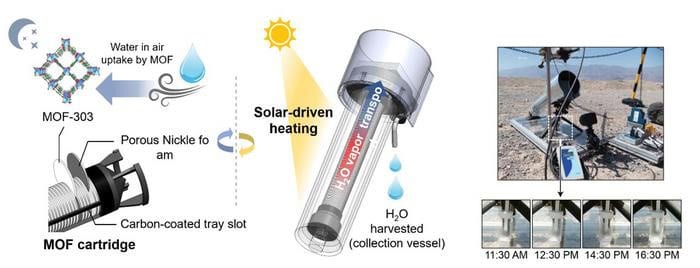
These materials are like microscopic sponges. Even when humidity drops below 20 percent, they can trap water molecules from the air. Once captured, gentle heat often from sunlight releases the moisture, which then condenses into clean and drinkable water.
The secret lies in reticular chemistry, a field Yaghi pioneered, which allows scientists to design materials with precise internal structures. MOFs have tiny pores that can hold vast amounts of water; in fact, a small amount of MOF has as much internal surface area as a football stadium.
As air passes through the machine, the MOFs capture water molecules. Sunlight or low-grade heat then releases the trapped moisture as vapor. This vapor cools into liquid water, ready to drink. The system runs on solar energy, needs no heavy electricity, and works efficiently even in the driest regions.
Proven in Harsh Conditions
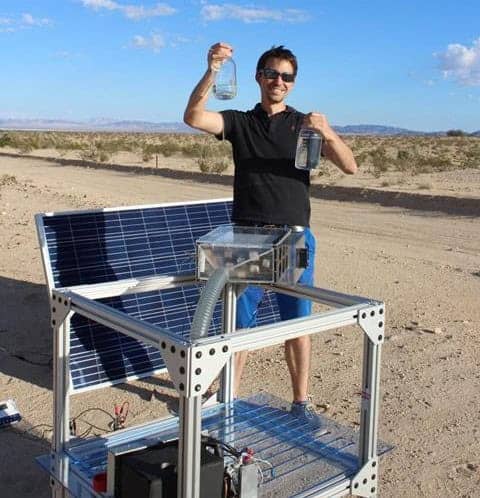
To see how tough the system really is, researchers tested a prototype in the Mojave Desert in the United States, one of North America’s driest regions where humidity can sometimes fall as low as 10 percent.
The device ran continuously for three days under these harsh conditions and still managed to collect measurable amounts of water. This showed that the material could work in places where most traditional water-capture methods would struggle or fail.
Experts like David Fairén-Jiménez from the University of Cambridge point out that MOFs outperform older materials such as silica gel and zeolites in extremely dry environments.
While traditional adsorbents either need high humidity or consume a lot of energy to release the water they capture, MOFs provide a more efficient and reliable solution.
Environmentally Friendly
Unlike traditional desalination plants that use a lot of electricity and create salty waste, Yaghi’s machine runs mainly on solar heat or other low-energy sources. It produces clean water without harmful byproducts and needs very little maintenance.
Since it doesn’t rely on groundwater, it helps protect aquifers and prevents land from sinking—a problem in many fast-growing cities. Its low carbon footprint also makes it an eco-friendly solution in the fight against climate change.
Solving the Water Crisis
Billions of people around the world face water insecurity each year. Climate change is making the problem worse, triggering droughts, shrinking glaciers, and disrupting rainfall. Rivers, lakes, and underground aquifers are under growing pressure from overuse and pollution.
At this critical moment, Professor Omar Yaghi’s invention offers a fresh approach. Instead of drawing water from already stressed sources, his machine extracts it directly from the air. The atmosphere holds trillions of liters of water vapor at any given time, making it a vast and renewable resource.
This shift from ground-based water collection to air-based harvesting could change how countries plan and manage their water infrastructure.
Unlike traditional solutions such as desalination which consume large amounts of energy and generate waste air-to-water technology is cleaner, more flexible, and portable. Units can be deployed to remote villages, disaster zones, or small islands.
Who is Omar Yaghi
Omar Yaghi is a world-famous chemist known for his work in creating new materials called metal-organic frameworks (MOFs) and covalent organic frameworks (COFs). These materials can be built with very precise structures at the molecular level.
He is a professor at the University of California, Berkeley, and won the Nobel Prize in Chemistry in 2025. His discoveries are helping solve big problems like clean energy, capturing carbon, making water and protecting the environment.
Yaghi is also the founder of Atoco, a company that built a machine that can turn air into clean drinking water. The device works even in very dry places, giving hope to communities that struggle to get enough water.
Future of Water Security
For communities struggling with chronic water shortages, the ability to draw clean water straight from the air could change everything. Instead of relying solely on centralized systems, regions vulnerable to drought or extreme weather could produce their own dependable supply.
Yaghi often talks about his work as “reimagining matter.” In this case, that vision has become a tangible solution turning dry air into water that can sustain life.
As water insecurity grows around the world, innovations like this could reshape the way nations safeguard one of their most vital resources.
Related Posts:
- Ulmer Nests – Solar-Powered Pods to Shelter the Homeless in Harsh Weather
- Colorful and Transparent Solar Panel to Replace Your Windows
- Swedish Scientists Develop Liquid that Stores Solar Energy for 20 Years
- Wave, Wind, and Solar Hybrid Energy Raft Could Power 1,000 Homes a Day
- Norway Sets Up World’s First Wireless EV Charging Road