QO vs Homeline Breakers and Panels: What’s the Difference and Where Are They Used?
When selecting an electrical panel or circuit breaker, Square D by Schneider Electric is one of the most trusted brands in residential and commercial electrical systems. Two of its most popular product lines are Homeline and QO.
Homeline and QO breakers are residential circuit breakers manufactured by Square D (Schneider Electric) and are used to protect electrical circuits from overloads and short circuits. They are designed to fit only their respective panel types, which ensures proper compatibility and safe operation.
Similarly to the breakers, a Homeline and QO panel are two common types of residential electrical load centers manufactured by Schneider Electric under the Square D brand. Both panels are designed to safely distribute electrical power throughout a building while providing circuit protection through circuit breakers.
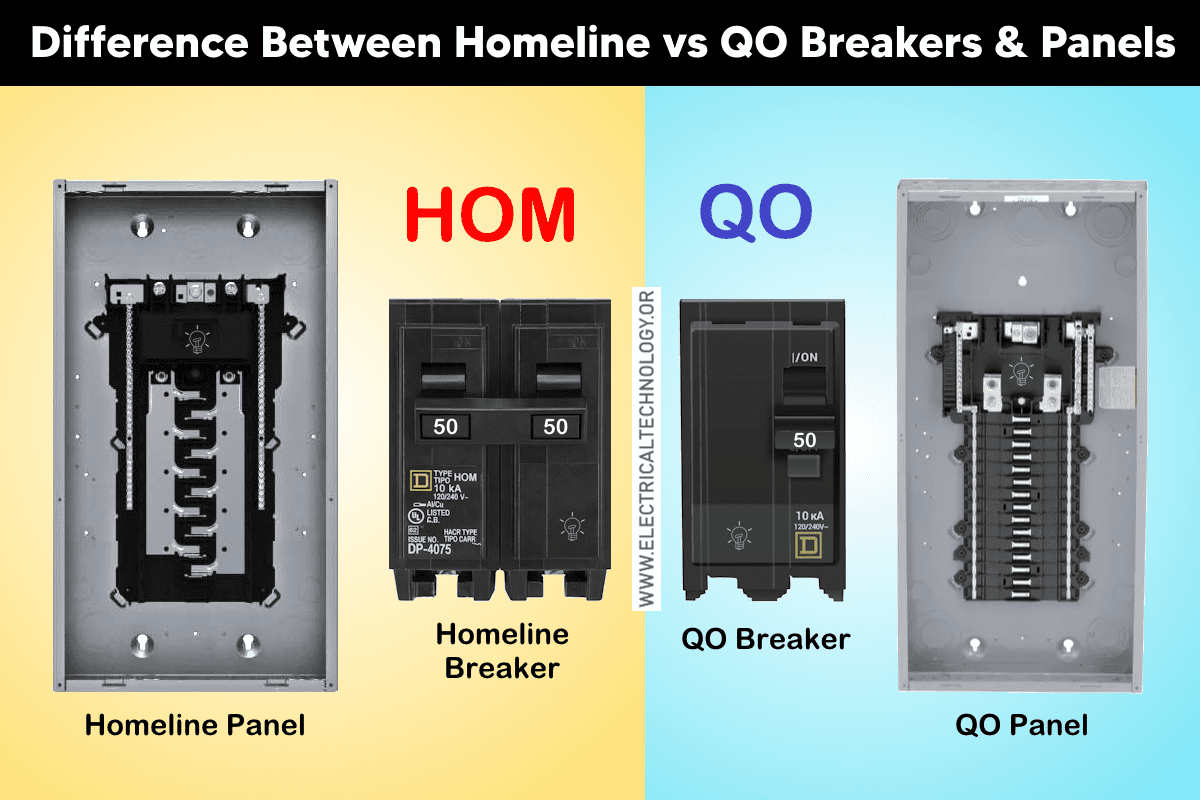
Although both are NEC and UL-listed, Homeline and QO breakers and panels are not interchangeable and serve different applications. The following article explains the difference between Homeline and QO breakers, Homeline vs QO panels, and where each system should be used.
What is a Homeline Breaker?
A Homeline (HOM) breaker is Square D’s standard residential plug-in circuit breaker manufactured by Schneider Electric. These 1-inch per pole size, 120/240V breakers are designed specifically for Homeline load centers. They offer reliable and cost-effective circuit protection for household lighting, outlets, and appliances.
Homeline breakers are available in single-pole (15-100A), double-pole (100A+), tandem (two circuits in one slot), and Quad breakers. Homeline offers a wide range of options such as standard thermal-magnetic breakers, as well as GFCI (Ground Fault Circuit Interrupter) and AFCI (Arc Fault Circuit Interrupter) for specialized safety.
They are identified by their black handle and a tripped Homeline breaker handle will be in a “midway” position between ON and OFF. In a 2-pole breaker, there are handle for each pole which are connected by handle tie. This way, it trips both lines when it detects a fault on a single line. In addition, a white “pigtail” wire for neutral connections in GFCI/AFCI, although newer models support Plug-On Neutral “PON” design which speeds up installation.
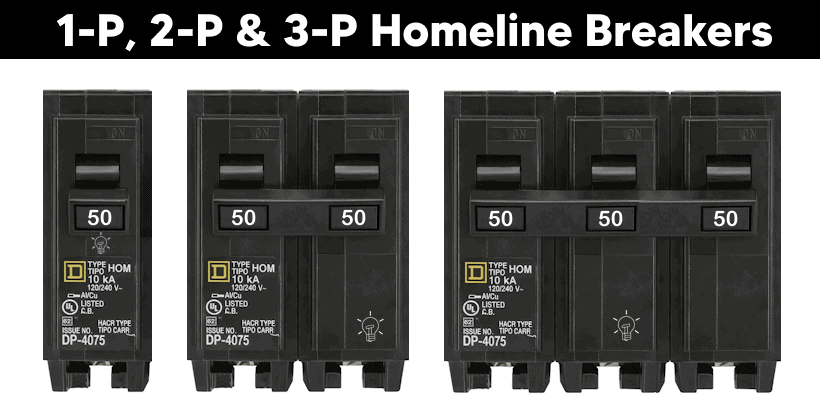
Key Features of Homeline Breakers
- Designed exclusively for Homeline panels
- Rated for 120/240V
- Typical interrupting rating of 10 kA
- Thermal-magnetic trip mechanism
- Available in standard, quad tandem, GFCI, AFCI, and dual-function types
Homeline breakers are optimized for typical residential fault levels and everyday household electrical loads.
What is a QO Breaker?
A QO breaker (Qwik-Open) is a premium circuit breaker line from Schneider Electric’s Square D brand. It is a renowned for its fast-acting “Qwik-Open” mechanism, which shuts off power in milliseconds during overloads or short circuits. These 3/4 inch per pole size are plug-on breakers that fit into QO load centers (panels) only.
QO breakers are available in single, double, or triple-pole configurations for single-phase and three-phase voltage systems in 100A+ ratings. They comes in High Intensity Discharge (HID), Equipment Protection Device (EPD with 30mA and EPE with 100mA) ground fault protection.
As identification, QO breakers comes with black handle and “Visi-Trip” orange colored indicator under the handle. It will turns orange when the breaker trips. In two or three-pole breakers, there is single handle which tripes all the hot phases when it detects a faults even on a single line. These breakers are widely used in residential and mostly in commercial applications, especially in plug-on panel boards.
Good to Know: QO breaker has bolt-on version known as “QOB”.
- QO Breaker (Plug-On Type) are clip on i.e. snaps onto the bus bar using spring clips without using mounting screws. They are mostly used for residential applications.
- QOB Breaker (Bolt-On Type) are screw mounted i.e. bolted directly to the bus bar using screws and used for commercial/industrial settings
Note: Not all bolt-on breakers are QOB. For examples, Square D QOB, GE TED bolt-on, Eaton BAB bolt-on, Siemens BQD bolt-on etc.
NEC requires breakers to be listed and labeled for the panel. Therefore, you cannot replace a QO with QOB unless the panel is listed for both. Mixing breaker types voids UL listing and may violate NEC 110.3(B).
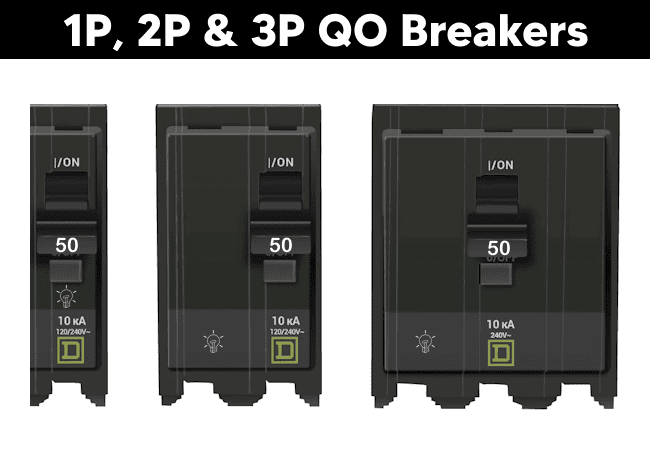
Key Features of QO Breakers
- Designed exclusively for QO panels
- Rated for 120/240V – single-phase and three-phase
- Interrupting ratings up to 22 kA
- Visi-Trip® indicator (orange window shows when the breaker has tripped)
- Faster and more precise tripping response
- Robust internal construction
Good to Know: QO breakers are often considered commercial-grade, even when used in residential applications.
Key Differences between Homeline vs QO Breakers
| Feature | Homeline Breaker | QO Breaker |
| Application | Residential | Commercial |
| Voltage rating | 120/240V, 1-Phase | 120 to 480V, 3-Phase |
| Size | 1 Inch per Pole | ¾ Inch per Pole |
| Handle | Two handles in 2P | 1 Handle in 2/3P |
| Interrupting Rating | ~10 kA | 10-22 kA |
| Trip Indicator | No | Yes (Visi-Trip®) |
| Durability | Standard | High |
| Price | Lower | Higher |
| Panel Compatibility | Homeline only | QO only |
Good to Know:
- QO breakers include a Visi-Trip® indicator that clearly shows when the breaker has tripped.
- A Homeline breaker will NOT fit into a QO panel, and vice versa.
- QO breakers offer higher fault protection and easier fault identification especially designed for commercial applications, while Homeline breakers focus on cost-effective residential use.
What is a Homeline Panel?
A Homeline panel (or load center) is a residential-grade electrical panel produced by Square D (Schneider Electric). Homeline load centers are budged friendly which are designed for homes and standard residential installations. It typically uses aluminum bus bars, features a 1-inch per pole breaker size, and supports Plug-on Neutral (PON) technology for cleaner, faster, and easier installation of branch circuit breakers.
HOM panels are primarily used for residential, smaller loads, and light agricultural or commercial settings. They are available only for single-phase power supply system (120/240V), which offers amperages ranging from 70A to 225A.
Good to Know: A Homeline panel are designed to work exclusively with Homeline breakers. In other words, Homeline panels only accept Homeline-type breakers. They are not interchangeable with Square D QO breakers.
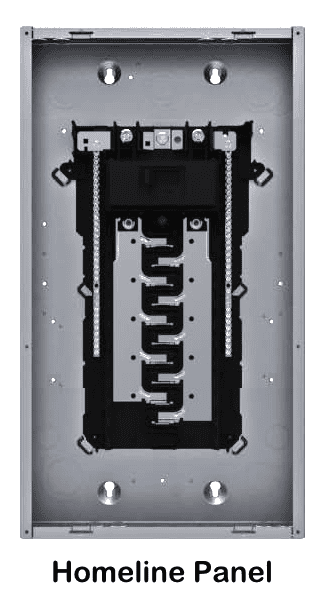
Characteristics of Homeline Panels
- Aluminum bus bars
- Plug-on breaker design
- Lower short-circuit ratings
- Compact and budget-friendly
- Meets NEC and UL standards
What is a QO Panel?
A Square D QO Panel (Qwik-Open) is a high-quality, premium electrical service panel or load center designed for commercial applications. Known for its durability and copper bus bars, it provides advanced protection via QO circuit breakers.
QO load centers comes with tin-plated copper bus bars, which makes them more durable than aluminum-based busbars (like in Homeline panels).
Modern QO panels (newer models supporting Plug-on Neutral (PON) feature a fully distributed, split-neutral design, which allows neutral wires to plug directly into the bar, reducing clutter and installation time.
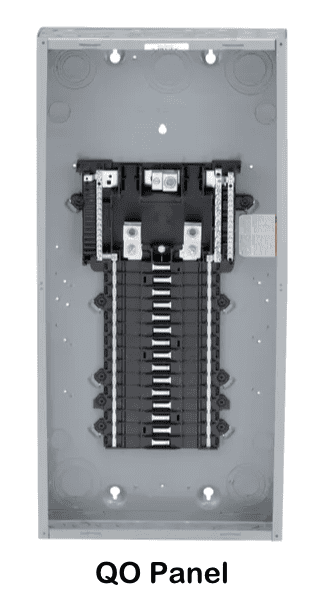
Characteristics of QO Panels
- Copper bus bars
- Higher short-circuit withstand ratings
- Supports higher fault current environments
- Designed for professional and commercial installations
- Superior heat dissipation and durability
Warning: Homeline breakers do not fit QO panels, and QO breakers do not fit Homeline panels. They are mechanically and electrically incompatible. Mixing them or forcing to fit in different panel is unsafe and violates manufacturer and NEC guidelines.
Comparison of Homeline vs QO Panels
| Feature | Homeline Panel | QO Panel |
| Breaker Type | Homeline only | QO only |
| Bus Material | Aluminum | Copper |
| Bus Type | Open Bus | Shielded Bus |
| Neutral Bus | Down the interior | Located near the top |
| Fault Current Rating | Lower | Higher |
| Build Quality | Standard | Premium |
| Supply System | Single-phase | 1-Phase / 3-Phase |
| Cost | Lower | Higher |
| Applications | Residential | Commercial |
Good to Know: QO is available in both single-phase and three-phase configurations. Homeline is generally limited to single-phase.
Where are Homeline and QO Systems Used?
Homeline System is Best For:
- Residential homes
- Apartments
- Small offices
- Light electrical loads
- Budget-friendly installations
QO System is Best For:
- Commercial buildings
- Industrial environments
- High fault-current locations
- Critical loads
- Premium residential projects
Which One Should You Choose?
- Choose Homeline if you want a reliable, cost-effective solution for standard residential wiring e.g. 120/240V single-phase system.
- Choose QO if you need three-phase power distribution, higher safety margins, better fault visibility, and long-term durability.
Both systems are NEC-compliant / UL-listed and safe when installed correctly, but QO clearly stands out where performance matters.
FAQ:
Can I use a QO breaker in a Homeline panel?
No. They are mechanically and electrically incompatible.
Is QO better than Homeline?
Yes, in terms of durability, fault current handling, and safety features. Homeline is better for budget installations.
Are QO breakers worth the extra cost?
For commercial, industrial, or high-end residential projects, yes.
Can You Use Square D Homeline or QO Breakers in Eaton BR or CH Load Centers?
Warning:
Although Square D Homeline and QO breakers might physically fit into an Eaton BR or CH panel (due to their similar 1-inch (for BR/Homeline-style) and ¾-inch (for CH/QO-style) mounting dimensions) it is not recommended and typically not approved.
Same is the case for Siemens, Leviton and ABB breakers i.e. they should only be used on correspond panels manufactured by the same brand.
Square D Homeline and QO breakers are tested and UL-listed only for use in Square D Homeline and QO panels, respectively. Installing Eaton BR or CH breakers in a Square D panel (or vice versa) can:
- Violate the National Electrical Code (NEC) requirements,
- Void the panel and breaker warranties,
- Create unreliable or high-resistance bus bar connections.
Resources:
- Difference Between BR and CH Breakers and Load Centers
- National Electrical Code (NEC) Requirements for Panelboards
- Difference Between 1-Pole and 2-Pole Breakers – NEC & IEC
- Difference Between Circuit Breaker and GFCI
- Should GFCI Protection Be in the Main Panel or Receptacle?
- How Does a Standard Breaker Respond to Electrical Fault?
- Why Doesn’t a Standard Breaker Protract Against Ground Faults?
- How Do GFCI and Standard Breakers Respond to Ground Faults?
- Can you use 15A Breaker on 20A Circuit and Vice Versa?
- Can I Use a 1-Phase Breaker on a 3-Phase Supply & Vice Versa?
- Can I Use a 240V Breaker on a 120V Circuit and Vice Versa?
- Can You use a 15A Outlet on a 20A Circuit and Vice Versa?
Standard Breakers & GFCI Breakers Wiring Installations
- How to Wire a 1-Pole GFCI
- How to Wire a 2-Pole GFCI
- How to Wire a 3-Phase, 3-Pole GFCI
- How to Wire a 1-Pole Breaker
- How to Wire a 2-Pole Breaker
- How to Wire a 3-Pole Breaker
- How to Wire a Tandem Breaker
- How to Wire GFCI Circuit Breakers
- How to Wire an AFCI Breaker
General Outlets and GFCI/AFCI Receptacles Wiring
- How to Wire an Outlet Receptacle? Socket Outlet Wiring Diagrams
- How to wire a GFCI Outlet?
- How to Wire GFCI Combo Switch and Outlet
- How to Wire an AFCI Combo Switch
- How to Wire an AFCI Outlet?
- How to a Wire 3-Way Combination Switch and Grounded Outlet?
- How to Wire Combo Switch and Outlet? – Switch/Outlet Combo Wiring Diagrams
- How to Wire a 15A – 120V Outlet – NEMA 5-15 Receptacle
- How to Wire a 20A – 120V Outlet – NEMA 5-20 Receptacle
- How to Wire a 15A – 240V Outlet – NEMA 6-15 Receptacle
- How to Wire a 20A – 240V Outlet – NEMA 6-20 Receptacle
- How to Wire a 50A – 125/250V Outlet – NEMA 14-50 Receptacle
Sizing Breakers, Wires, and Panels
- How to Size a Circuit Breaker?
- How to Size a Breaker and Wires in AWG with EGC for Load?
- How to Find the Proper Size of Wire & Cable In Metric & Imperial Systems
- How to Size a Load Center, Panelboards and Distribution Board?
- How to Determine the Right Size Capacity of a Subpanel?
- How to Find the Right Wire Size for 100A Service 120V/240V Panel?
- How to Determine the Number of Circuit Breakers in a Panelboard?
- How to Find the Number of Outlets on a Single Circuit Breaker?
- How to Size Service-Entrance Conductors and Feeder Cables?
- How to Size Feeder Conductors with Overcurrent Protection
- How to Size a Branch Circuit Conductors with Protection?
- How to Size Equipment Grounding Conductor (EGC)?
- How to Size Grounding Electrode Conductor (GEC)?
- How to Size Motors FLC, HP, Voltage, Breaker Size and Wire Size
- What is the Correct Wire Size for 100A Breaker and Load?
- What is the Right Wire Size for 15A Breaker and Outlet?
- What is the Suitable Wire Size for 20A Breaker and Outlet?
Main Panels Wiring Tutorials
- How to Wire 120V/240V Main Panel? Breaker Box Installation
- How to Wire 208V/120V, 1-Phase & 3-Phase Main Panel?
- How to Wire 240V, 208V & 120V, 1 & 3-Phase, High Leg Delta Main Panel?
- How to Wire 277V/480V, 1-Phase & 3-Phase Main Service Panel?
- How to Wire a Subpanel? Main Lug Installation for 120V/240V
- Single Phase Electrical Wiring Installation in Home according to NEC & IEC
- Three Phase Electrical Wiring Installation in Home – NEC & IEC
- How To Wire a Single Phase kWh Meter – 120V/240V
- How to Wire a Three-Phase Meter? 120/208/240/277/347/480/600V
-
 How to Wire and Use Tesla Gen 3 Mobile Connector Charger
-
 How to Wire 48A Level 2 Dual Port EV Charging Station
-
 How to Wire Smart Electric Vehicle Charging Station – 32A/80A
-
 How to Wire ChargePoint Home Flex Charger for Every EV
-
 How to Wire an EV Wall Charger – Hardwired and Plug-in
-
 How to Wire AC Level 2 EV Smart Breaker Charger – 40A/32A