Is It Possible for Humans to Capture, Control, and Store Lightning Energy for Practical Use?
Although a lightning bolt contains an enormous amount of energy, it discharges in an extremely short time i.e. often just a few milliseconds.
An average lightning discharge can release billions of joules of energy. It generates extremely high temperatures (up to 30,000°C), produce plasma, and emit magnetic radiation and flashes of visible light due to the rapid movement of electrons.
Currently, we do not have any capacitors or batteries that can instantly capture and store such a massive surge (approximately one billion volts and thousands of amperes) of electricity within such a brief moment. At present, we can only control lightning for safety and protection purposes, rather than for its practical use or energy storage.
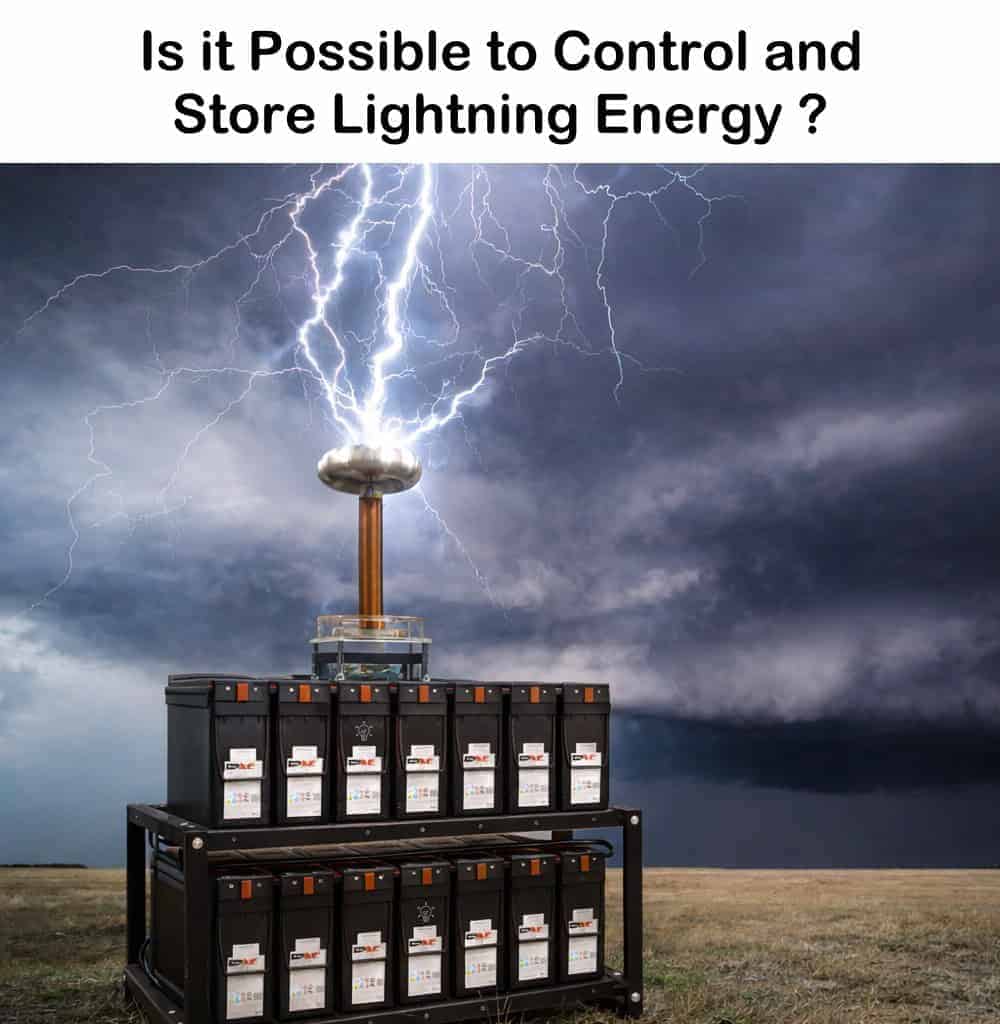
Storing of Lightning Energy
A typical lightning bolt contains a huge amount of electrical energy. It is roughly 1 to 10 gigajoules which is enough to power an average U.S. household for several days. However, several major obstacles prevent effective control and storage as follows:
The main discharge lasts only tens to hundreds of microseconds (millionths of a second). Capturing and converting this sudden surge (which lasts for Extremely short duration) into usable electricity requires extraordinarily fast and robust systems that don’t yet exist at scale.
Similarly, We cannot predict precisely when or where a lightning bolt will strike. A practical power plant requires a continuous and dependable supply of energy. However, lightning strikes are entirely random and unpredictable in timing and location. For this reason, you can’t “summon” a bolt when you need energy.
In addition, lightning bolt can exceed 100MV and +10,000A, and can reach temperatures five times hotter (approximately 30,000°C) than the surface of the Sun. Most of the energy dissipates as heat, light, and sound rather than usable electrical current by the time it reaches the ground. Creating devices that can withstand such extreme heat and voltage is not only a significant engineering challenge but also an extremely costly process.
Even if we were able to capture lightning energy, controlling the process would be extremely difficult because lightning is a transient electrical impulse. This means it is neither purely alternating current (AC) nor direct current (DC), but a combination of both. In other words, lightning contains both AC and DC components within its surge waveform. As a result, designing devices that can safely filter, separate AC from DC, and store the energy for later use is highly challenging.
Moreover, storage capabilities are limited for this huge amount of energy produced by thunder bolts. Even if captured, the energy must be stored instantly (e.g., in supercapacitors or advanced batteries) and then converted to stable, usable forms like household AC power or DC power. Current technology cannot efficiently handle the massive, brief power spike without damage or huge losses.
Control of Lightning
humans cannot fully control lightning in the way often depicted in movies or science fiction. However, we can control lightning to a limited extent and harness its power for limited use in specific controlled ways such as:
Trigger Lightning Artificially
In scientific experiments, researchers have successfully triggered lightning using techniques like launching small rockets trailing thin wires into storm clouds to create a conductive path. In an experimental phase, high-powered lasers are used to ionize the air and guide electrical discharges. This helps study lightning but does not produce storable energy for practical use.
In small-scale experiments, some tests have used towers, capacitors, or shunting systems to capture tiny fractions of energy from triggered or natural strikes. For example, one early experiment reportedly lit a 60W bulb for about 20 minutes using artificial lightning. However, these remain proof-of-concept and far from efficient or scalable.
Harness & Harvesting of Lightning Energy
A single lightning stoke carries enormous energy, roughly equivalent to the energy in a small nuclear explosion. However, capturing and storing this energy is extremely difficult due to its brief duration, high voltage, unpredictable timing/location, and massive power surge.
Harvesting lightning energy is the theoretical process of capturing the immense electrical power from lightning strikes and storing it for use.
Several theories propose generating hydrogen from water by utilizing the rapid heating caused by lightning. Other approaches suggest using a network of lightning & surge arresters to capture a strike, either directly or by converting its energy into heat or mechanical energy. Another concept involves placing inductors at a safe distance to capture a fraction of the lightning’s energy. Practically, large-scale lightning energy harvesting remains largely science fiction for now.
Lightning Control for Safety
What actually we can do is to protect against it. For this purpose, lightning rods, surge protectors, and grounding systems are used to safely direct and dissipate lightning’s energy. This protective measure prevents damage to buildings, aircraft, and electrical systems and installations. Overall, this is limited “controls” which means, controlling of its effects but does not store the energy.
Why It’s Not Practical, Even If Possible?
If we are able even with perfect capture, lightning would contribute only a tiny fraction of global energy needs. The equipment would sit idle most of the time, making it far less cost-effective than solar, wind, or other renewables. Many attempts, including commercial projects, have concluded that harvesting lightning energy from the ground is largely “hopeless” compared to the total energy in a thunderstorm.
Although a lightning bolt may seem incredibly powerful, the estimated usable energy from an average strike is only a few hundred kilowatt-hours (kWh). Even if we successfully captured and stored it, this amount would barely suffice to power an average home for a few days. By comparison, solar and wind energy are far cheaper and more sustainable.
To keep the hopes alive, ongoing research explores better triggering methods. For instance, drone swarms or lasers, ultra-fast storage like advanced supercapacitors, and indirect uses (such as generating hydrogen from water). While breakthroughs could improve feasibility someday, lightning energy harvesting remains more science fiction than reality for now.
At the moment, humans can study and occasionally trigger lightning, but we cannot yet control it or store its energy in a way that makes it a viable power source. Focusing on predictable renewables is currently far more effective.
Related Posts:
- Is Lightning AC or DC ?
- If Lightning Strikes the Sea, How Far Away is it Dangerous?
- What Happens When Aircraft and Plane are Struck by Lightning?
- AC or DC – Which One is More Dangerous And Why ?
- Which One Kills – Current or Voltage and Why? Amps vs Volts
- Which One is More Dangerous? 50Hz or 60Hz in 120V/230V?
- Which One is More Dangerous? 120V or 230V and Why?
- Why are “High Voltage” Signs used when Only Current Kills?
- What Happens When an AC Line Touches a DC Line?
- What Happens if a Power Line Falls into the Ocean Water?
- What Would Happen If You Plugged A Charger into Another?
- Why Can’t a 12V Car Battery Electrocute You?
- Why Can’t We Store AC in Batteries instead of DC?
- What Happens to the Battery with Reverse Polarity Wiring Connection
- What Happens if We Connect a Polar Capacitor the Wrong Way?
- Will I Get an Electric Shock If I Touch the Ground Wire?
- Can the Neutral Wire Cause Electric Shock?
-
 California Solar Power Beats Natural Gas for First Time
-
 EU Solar Generates Record 25% of Electricity for First Time
-
 AI Data Centers Could Boost US Fossil Power by 123 Billion kWh
-
 China Builds World’s Largest 17.7 GW Solar Park on Tibetan Plateau
-
 China Builds 300 MW Sahara Solar Plant for Algeria’s 15 GW Plan
-
 MSU Develops Clear Solar Glass That Generates Electricity