What is the Difference Between AFCI, CAFCI, DFCI and GFCI
AFCI (Arc-Fault Circuit Interrupter), CAFCI (Combination Arc-Fault Circuit Interrupter), and DFCI (Dual-Function Circuit Interrupter) are protective devices and circuit breakers designed to provide different types of electrical fault protection in residential and commercial installations.
Like GFCI (Ground-Fault Circuit Interrupter) devices, AFCI, CAFCI, and DFCI protection is required by the National Electrical Code (NEC) for certain circuits, locations, and environmental conditions. While a GFCI is totally differ than an AFCI, each device serves a specific purpose and offers a different level of protection. Before discussing the NEC requirements, let’s distinguish these devices as follows.
Good to Know: The NEC requires GFCI protection (210.8(A)) and AFCI protection (210.12) for circuits serving certain areas such as kitchens, laundry rooms, and outdoor locations.
- Related Post: Difference Between GFCI and AFCI
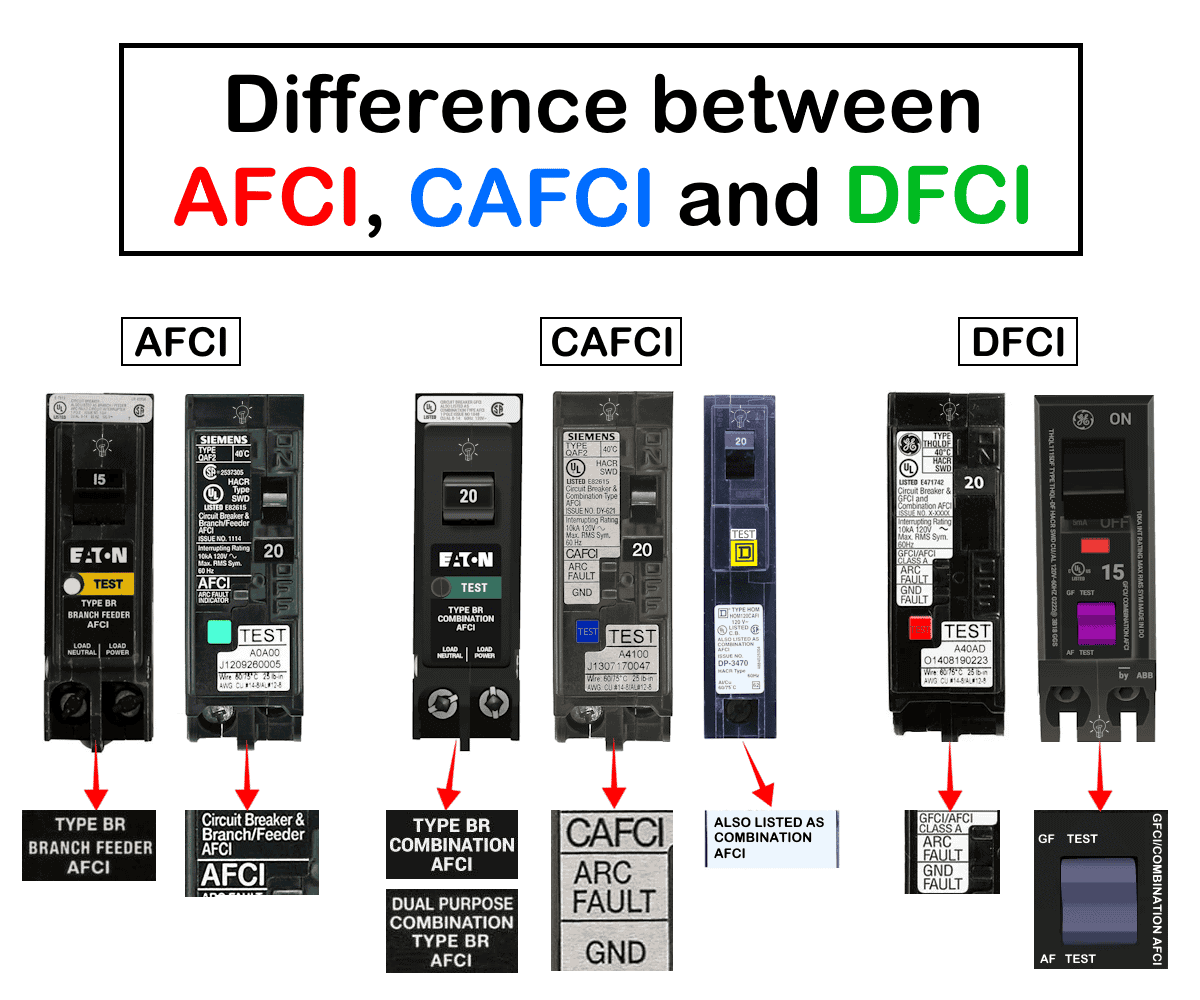
AFCI
An Arc-Fault Circuit Interrupter (AFCI) is a protective device designed to detect dangerous electrical arcing (or sparking) and automatically disconnects power before the arc can generate enough heat to start a fire hazard.
Early AFCIs (also known as Branch/Feeder AFCI or Arc-Fault Detection Device(AFDD)) primarily detected parallel arc faults. Parallel arcs occur between two conductors such as (line-to-neutral or line-to-ground). The damage wiring may cause make a contact of hot to neutral or hot to grounded surface.
AFCI = Protects against Parallel Arc Faults
In this case, the AFCI protects the wiring within the walls (branch/feeder wiring) and disconnect power before ignition occurs.
However, AFCIs generally did not provide protection against series arc faults caused by loose connections or damaged conductors especially in frayed area or small gap in the same conductor. To counter this issue, CAFCI and DFCI were developed and mandated by the NEC to replace the older versions of AFCIs.
- Related Post: Difference Between GFCI and Circuit Breaker
CAFCI
A CAFCI (Combination Arc-Fault Circuit Interrupter) provides protection against both parallel and series arc faults, which makes it a superset of standard AFCI protection. It is the advanced and improved version of the typical standard AFCI breaker.
CAFCI = Protects Against Series Arc Faults + Parallel Arc Faults
Series arcs occur within a single conductor i.e. it can occur when current flows through a damaged conductor while remaining in series with the load. For example, a broken wire that still carries current across a small gap, or a loose connection in a lamp cord or extension cord.
These faults may not draw enough current to trip a standard circuit breaker but can generate enough heat to start a fire.
CAFCI breakers can usually be identified by the markings and test-button color provided by the manufacturer. For example, Eaton/Cutler-Hammer CAFCI breakers are clearly marked with the wording “Combination Type AFCI” on the front label. In the case of Square D Homeline breakers, Green Test Buttons are typically used for CAFCI breakers, while Blue Test Buttons identify AFCI breakers. In newer versions of Square D by Schneider, they use a white Test Button, with the front nameplate clearly labeled “Combination AFCI” for easy identification.
Good to Know: Many people assume “combination” in a CAFCI means AFCI + GFCI protection. It does not. The term Combination AFCI refers to the combination of protection against parallel arc faults, and series arc faults in a single device.
DFCI
DFCI is a type of protective circuit breaker which provides protection against ground faults and series/parallel arcing. It is the combo of GFCI and CAFCI (not the typical AFCI) used for protection against electric shock and fire hazards.
In simple words, a DFCI (Dual Function Circuit Interrupter) is the combination of Ground Fault Circuit Interrupter (GFCI) and Combination Arc Fault Circuit Interrupter (CAFCI) in a single unit.
DFCI = GFCI + CAFCI
DFCI = Protects against Ground Faults + Parallel + Series Arc Faults
A DFCI is used for fire and electric shock protection in case of series/parallel arcs (between two wires or within single conductor) and leakage current from hot conductor to ground.
While some CAFCI breakers offer limited protection against both arc faults and ground faults, their ground-fault trip level and response time are not sufficient to qualify as Class A GFCI protection. Therefore, they are not rated or listed as GFCI devices under applicable standards. This is why DFCI breakers are used when both AFCI and GFCI protection are required, as it combines both protections in a single device and complies with the code requirements.
When both ground fault and arc fault protections are required on the same circuit, a DFCI breaker provides GFCI and AFCI protection in a single unit, which reduces the number of devices needed and saving panel space.
- Related Post: GFCI Outlet – Line vs Load – What is the Difference?
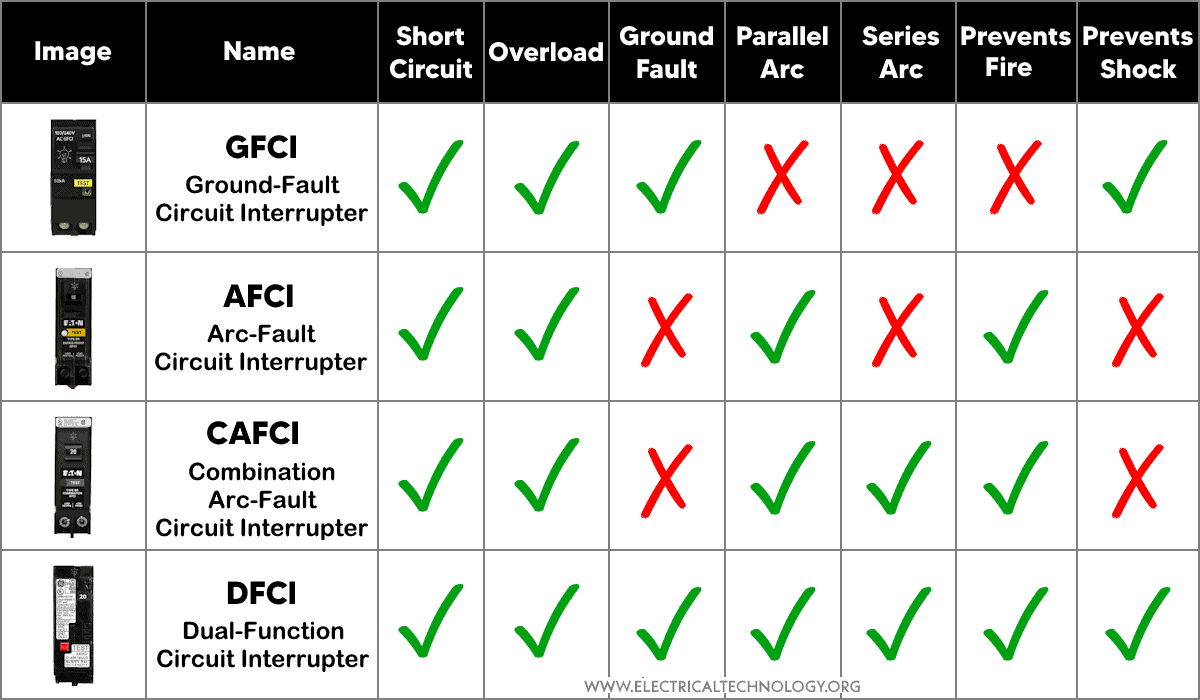
Comparison Between GFCI, AFCI, CAFCI and DFCI
The following comparison table shows the differences and level of protection provided by GFCI, AFCI, CAFCI and DFCI
| Feature | GFCI | AFCI | CAFCI | DFCI |
| Detects Parallel Arc Faults | ✘ | ✔ | ✔ | ✔ |
| Detects Series Arc Faults | ✘ | ✘ | ✔ | ✔ |
| Detects Ground Faults | ✔ | ✘ | ✘ | ✔ |
| Personnel Shock Protection | ✔ | ✘ | ✘ | ✔ |
| Overload Protection* | ✔ | ✔ | ✔ | ✔ |
| Short-Circuit Protection* | ✔ | ✔ | ✔ | ✔ |
| Fire Protection from Arc Faults | ✘ | ✔ | ✔ | ✔ |
| Fire Protection from Ground-Fault Leakage | Limited | ✘ | ✘ | ✔ |
| Primary Purpose | Shock Protection | Basic Arc-Fault Protection | Comprehensive Arc-Fault Protection | Arc-Fault + Ground-Fault Protection |
| Typical Trip Threshold | ~4–6 mA Ground Fault | Arc Signature Detection | Arc Signature Detection | Arc Signature + ~4–6 mA Ground Fault |
| Common Residential Use | Required in wet/damp and specified locations | Rare | Very Common | Common where AFCI and GFCI are both required |
Good to Know: * Breaker-type GFCIs include overcurrent (overload and short-circuit) protection because they are circuit breakers. Receptacle-type GFCIs provide only ground-fault protection and must be used with a separate circuit breaker for overcurrent protection.
- Related Post: What Happens When You Press TEST and RESET on a GFCI
Here is the chart in image format available for download as a reference.
Resources:
Comparison
- Difference Between 1-Pole and 2-Pole Breakers
- Difference Between MCB, MCCB, ELCB, RCD & RCBO Breakers
- Difference Between 15-Amp and 20-Amp Outlet?
- Difference Between NEMA 14-50 Standard Vs EV Receptacle
- Difference Between Socket, Outlet and Receptacle
- Difference Between EGC and GEC in Electrical Grounding
- Difference Between Specified & Classified Circuit Breakers
- Difference Between BR and CH Breakers and Load Centers
- Difference Between Homeline and QO Breakers and Panels
Related GFCI Wiring Tutorials
- How to Wire 1-P & 2-P, 1-Phase & 3-P, 3-Phase GFCI Breakers
- How to Wire a 1-Pole GFCI Breaker
- How to Wire a 2-Pole GFCI Breaker
- How to Wire a 3-Phase, 3-Pole GFCI Breaker
- How to Wire an AFCI Breaker?
- How to Wire a Smart GFCI Breaker
- How to Wire Smart AFCI/GFCI Breaker
- How to Wire a GFCI Outlet – Wiring a GFCI Receptacle
- How to Wire Wi-Fi Smart GFCI Outlets
- How to Wire GFCI Combo Switch and Outlet
- How to Wire an AFCI Outlet?
- How to Wire an Outlet Receptacle?
- How to Wire a 1-Pole Breaker
- How to Wire a 2-Pole Breaker
- How to Wire a 3-Pole Breaker
- How to Wire a Smart Breaker
Related Posts:
- Why Do We Need a GFCI & How Does it Protect During Faults?
- How Do GFCI and Standard Breakers Respond to Ground Faults?
- How to Find the Number of Outlets on a Single Circuit Breaker?
- How to Find Voltage & Ampere Rating of Switch, Plug, Outlet & Receptacle
- Can You use a 15A Outlet on a 20A Circuit and Vice Versa?
- What Happens if You Use a 120V Device on 240V & Vice Versa?
- Can I Use a 240V Breaker on a 120V Circuit and Vice Versa?
- Ground Terminal Up or Down: Which Way Should Outlets Face?
- What Do the Green Dot or Orange Triangle Outlets Mean?
- What Do the Different Colors of Electrical Outlets Indicate?
- Why are Outlets and Receptacles in Hospitals Upside Down?
- How to Size a Load Center, Panelboards and Distribution Board?
- How to Determine the Number of Circuit Breakers in a Panelboard?
- How to Find the Proper Size of Circuit Breaker? Breaker Size Calculator & Examples
- How to Find The Suitable Size of Cable & Wire for Electrical Wiring Installation?
- Why is the Neutral Prong or Slot Wider on a Plug or Outlet?
- What Will Happen If You Connect a Male-to-Male Plug Between Outlets
- Will a Man Get an Electric Shock If He Hangs on a Live Wire?
- Can the Neutral Wire Cause Electric Shock? Different Cases
- Will I Get an Electric Shock If I Touch the Ground Wire?
-
 Germany’s Electric Drone Hits 699 km/h, Eyes World Record
-
 How to Wire and Use Tesla Gen 3 Mobile Connector Charger
-
 How to Wire 48A Level 2 Dual Port EV Charging Station
-
 How to Wire Smart Electric Vehicle Charging Station – 32A/80A
-
 How to Wire ChargePoint Home Flex Charger for Every EV
-
 How to Wire an EV Wall Charger – Hardwired and Plug-in