Will a DC Shunt Motor Operate on an AC Supply?
What Happens if We Connect a DC Shunt Motor to the AC Supply?
The Shunt winding has a large number of turns so that it has appreciable inductance. When A.C is applied to a shunt motor, the large inductive reactance of shunt winding will reduce the field current too much. Consequently, Shunt motor will not usually run on A.C Supply.
A DC shunt motor has a wound field winding and an armature winding, both designed for direct current. In DC operation, the current through the field winding produces a steady magnetic field, and the armature current interacts with it to produce torque.
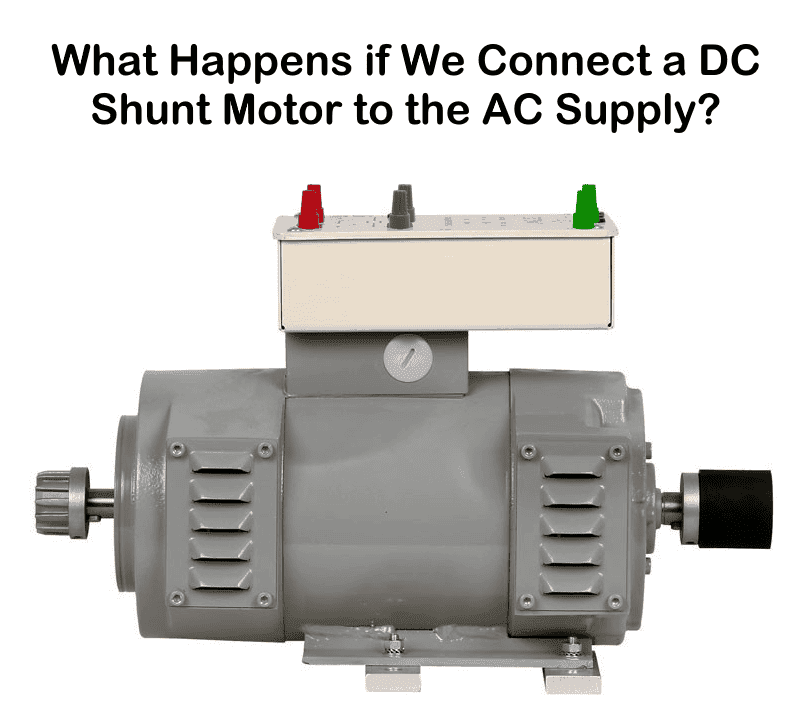
DC Shunt Motor on AC Supply
A DC shunt motor will not operate satisfactorily on AC supply and is likely to be damaged.
In a DC shunt motor, both the armature and field windings have significant inductance. On AC, the inductive reactance (XL = 2πfL) greatly limits the current and reduces torque.
Instead of a steady field, the field flux will alternate at the supply frequency (50 Hz or 60 Hz). This will cause rapid torque reversals which leads to vibration or no rotation at all.
In addition, alternating current causes high eddy current and hysteresis losses in the iron core. The armature and field windings will also experience excessive heating.
Moreover, the commutator and brushes are designed for DC. With AC, current reverses every half-cycle, which causes heavy sparking, pitting of segments, and rapid wear.
As a result:
- The motor may hum or vibrate but will not develop useful torque.
- Extended AC operation will overheat and damage the windings and commutator.
Related Posts:
- Can We Use AC Circuit Breaker for DC Circuit & Vice Versa?
- Can an AC Device Operate on DC Supply, and Vice Versa?
- Can I Use a 1-Phase Breaker on a 3-Phase Supply & Vice Versa?
- Can I Run 1-Phase Load on 3-Phase Supply and Vice Versa?
- What happens if You Connect a 3-Φ Induction Motor to 1-Phase Supply?
- Why is the Synchronous Motor Not Self Starting?
- Why is a Capacitor Needed for a Single-Phase Motor?
- Why Do DC Motors Have Higher Starting Torque than AC Motors?
- Why Do Some Devices Have Dual Input Voltage Ratings?
- Why is AC Commonly Used in Households Instead of DC?
- Why are High-Power Devices Not Designed to Run on DC Voltage?
- Difference between AC and DC (Current & Voltage)
- Difference Between AC and DC Generator
- Difference Between AC and DC Motors
- AC or DC – Which One is More Dangerous And Why ?




yes,But with less Torque and more losses
bcoz of reversal of direction of current, in a shunt connection it is not necessary that when the field current exhibits negative half cycle at the same time the armature current will also exhibit negative half cycle. as a result there is a phase diff between field current and armature current. so the torque produce will be a still torque, that is the torque is of very less magnitude and not
If we decrease no of turns in shunt field then what happen