Comparison Between NEMA and IEC Contactors, Controllers and Motor Starters
Motor starters, controllers, and contactors are essential components used to control electric motors in industrial, commercial, and general electrical systems.
A motor starter is a device designed to control the flow of electric power to a motor, enabling its starting, stopping, and forward/reverse operations. In simple terms, a motor starter (also called a motor controller) is a combination of a contactor and a thermal overload relay in a single unit used to control the ON/OFF operation and protect the motor from overload.
A contactor is an electrotechnical switch used to turn a circuit ON or OFF. It is an advanced form of a relay but does not provide protection against motor overload conditions.
According to NEC – Article 100 – Definitions, A motor controller is a device or switch used to start or stop the motor by making or breaking the motor circuit current. Motor controllers are extensively covered in NEC Article 430 – Part VII.
A thermal overload relay is used to protect the motor from overload conditions, particularly those caused by high starting (inrush) currents. When a thermal overload relay is combined with a contactor, the assembly is referred to as a motor starter or motor controller.
Good to Know:
- Contactor is a device used to switch ON or OFF a circuit
- Thermal Overload Relay is used to protect the motor from high inrush current.
- If a contactor and thermal overload relay is combined in a single unit, it is known as motor starter or controller.
Two of the most widely recognized global standards for classifying and designing motor starters and contactors are NEMA (National Electrical Manufacturers Association) and IEC (International Electrotechnical Commission). Both standards serve the same core purpose but differ significantly in design, sizing, characteristics, and application.

What is a NEMA Motor Starter?
NEMA starters are motor control devices designed and built according to standards set by the National Electrical Manufacturers Association (NEMA). These starters are widely used in the United States, Canada, and some parts of Latin America. These starters are known for their robust construction, durability, and ability to withstand harsh conditions.
NEMA contactors and starters are built for durability and can typically withstand higher levels of mechanical and electrical stress. These starters are classified and sized standard types categories (e.g., Size 00, 0, 1, 2, etc.) rather than by precise current ratings. Selecting a NEMA starter is generally easier, as the sizing is standardized and application-specific.
Due to conservative design and robust construction, NEMA starters tend to be physically larger than their IEC counterparts. Additionlly, they may be more expensive initially due to their rugged build and broader safety margins. Overall, with wide safety margins, rated NEMA starters are can operate reliably under adverse conditions.
NEMA starters and controllers are generally used in Industrial plants, manufacturing environments, oil & gas sectors, and other harsh or demanding environments with dust, moisture, and vibration or where reliability and long life-span is considered as a priority.
What is an IEC Motor Starter?
IEC starters comply with International Electrotechnical Commission (IEC) standards. As IEC is adopted in Europe and other parts of the world, IEC contactors and starters are widely used in Europe, Australia, Asia, Africa, and other global regions. These starters are compact, application-specific, and designed for efficiency.
Starters designed according to IEC standards focus on compactness and efficiency, optimized for specific motor protection and switching requirements. Component ratings are selected based on the motor’s actual full-load current (FLC), duty cycles, and operational characteristics.
Featuring a modular and configurable design, these starters are built for easy integration with other control and protection devices. As they are optimized for space-saving installations, IEC starters are generally smaller in size and more economical than NEMA starters. They also offer greater flexibility for fine-tuning overload protection, trip settings, and coordination.
IEC starters are generally less expensive than NEMA starters, particularly for light to medium-duty operations. However, compared to NEMA starters, IEC starters are designed for a specific service life and may require more frequent replacement in heavy-duty applications.
IEC starters and contactors are commonly used in OEM equipment, commercial and light industrial applications, HVAC systems, pumps, and conveyors, control panels, machinery manufacturing, commercial installations, and other applications where space-saving and modular designs are a priority.
Sizing and Rating of NEMA and IEC Starters
One major difference between NEMA and IEC starters is how they are rated and sized. Sizing the NEMA and IEC starters are explained in the previous article with solved examples.
NEMA
The table below, based on NEMA ICS 2-2000, shows motor starters categorized by standard frame sizes: 00, 0, 1, 2, 3, 4, 5, 6, 7, 8, and 9. These NEMA sizes indicate the maximum continuous current, in amperes, that a starter can safely carry for switching purposes. This sizing corresponds to the motor’s horsepower (HP) rating and the operating voltage.
| NEMA Size | Continuous AMP Rating | HP at 230V-AC | HP at 480 AC |
| 00 | 9 | 1.5 | 2 |
| 0 | 18 | 3 | 5 |
| 1 | 27 | 7.5 | 10 |
| 2 | 45 | 15 | 25 |
| 3 | 90 | 35 | 50 |
| 4 | 135 | 50 | 100 |
| 5 | 270 | 100 | 200 |
| 6 | 540 | 200 | 400 |
| 7 | 810 | 300 | 600 |
| 8 | 1215 | 450 | 900 |
| 9 | 2250 | 800 | 1600 |
IEC
On the other hand, IEC motor starters are rated and sized according to the “Utilization Category,” which specifies the type of application and duty cycle for which the starter is designed. The table below, based on IEC standard 60947-4-1, shows the types of contactors categorized by service and application. Keep in mind that AC-3 and AC-4 are the most common utilization categories used for squirrel cage induction motors in industrial applications.
| IEC Utilization Categories for Contactors and Starters | |
| Contactor Type | Typical Applications |
| AC-1 | Non-inductive or slightly inductive loads (e.g., heaters, resistive loads) |
| AC-2 | Slip-ring motors (starting, plugging, inching) |
| AC-3 | Squirrel-cage motors (starting, stopping during running) |
| AC-4 | Squirrel-cage motors (starting, plugging, inching, rapid stops) |
| AC-5a | Switching of electric discharge lamps (e.g., HID, mercury vapor) |
| AC-5b | Switching of incandescent lamps |
| AC-6a | Transformer switching |
| AC-6b | Capacitor bank switching |
| AC-7a | Slightly inductive household loads (e.g., mixers, fans) |
| AC-7b | Motor loads for household appliances (e.g., washing machines) |
| AC-8a | Hermetic refrigerant compressor motors (manual reset) |
| AC-8b | Hermetic refrigerant compressor motors (auto reset) |
| AC-12 | Control of resistive, solid-state load with O/C isolation |
| AC-13 | Control of solid state loads with T/F isolation |
| AC-14 | Control of small electromagnetic loads |
| AC-15 | Control of AC electromagnetic loads |
| AC-20 | Connecting/disconnecting under no-load |
| AC-21 | Switching of resistive load |
| AC-22 | Switching of mixed inductive and resistive load |
| AC-23 | Switching of motor load and other highly inductive load |
Comparison Between NEMA and IEC Starters and Controllers
Design and Sizing:
- NEMA: NEMA starters are designed with a more robust, “one-size-fits-all” or “general purpose” approach. They are categorized into broad “sizes” (e.g., Size 00, 0, 1, 2, 3, through 9) that cover a wide range of motor horsepower and current ratings. This often results in NEMA starters being somewhat oversized for a specific application, offering a built-in “service factor” or reserve capacity to handle occasional overloads. This simplifies selection, as you typically only need to know the motor’s horsepower and voltage.
- IEC: IEC starters are designed to be more application-specific and precise. Instead of broad sizes, they use “utilization categories” (e.g., AC-1, AC-3, AC-4) to rate devices based on the specific type of load and duty cycle (e.g., normal starting of squirrel-cage motors, frequent jogging/plugging). This allows for a more compact and cost-effective design, as the starter is precisely matched to the application’s needs. However, it requires a more in-depth understanding of the motor’s duty cycle and operating parameters.
Installation:
- NEMA starter comes in enclosed unit and designed for panel mounting.
- NEMA starter are modular and designed for DIN rail mounting.
Size and Cost:
- NEMA: Due to their robust and oversized design, NEMA starters are generally larger and heavier than their IEC counterparts for similar current ratings, especially below 100A or 50HP. This can lead to larger enclosure requirements and higher material costs.
- IEC: IEC starters are typically more compact and lighter, making them ideal for applications where space is limited, such as within original equipment manufacturer (OEM) designs. They are generally less expensive upfront, particularly for smaller sizes.
Interchangeability and Replaceability:
- NEMA: NEMA components are highly standardized across different manufacturers within the NEMA framework. This means that parts like overload heater elements are often interchangeable, simplifying maintenance and reducing downtime. NEMA devices are generally considered more serviceable and repairable.
- IEC: IEC components are more modular and often supplied as individual components to be assembled. While this offers flexibility, interchangeability across different manufacturers might be less straightforward than with NEMA. Below 100A, IEC devices are often considered “disposable” rather than repairable.
Overload Protection:
- NEMA: NEMA starters typically come with Class 20 overload relays. It indicates they will trip within 20 seconds at 600% of the full load current. They are designed to handle short circuits effectively.
- IEC: IEC starters commonly use Class 10 overload relays, which trip faster (within 10 seconds at 600% of the full load current). IEC standards emphasize quicker response times to overloads, enhancing safety and reliability. They also often provide single-phase detection.
Application:
- NEMA: Predominantly used in North America (USA, Canada, Mexico) and some parts of South America. NEMA starters are favored in heavy-duty industrial applications, process industries, and situations where operating parameters might be less precisely defined or subject to frequent overloads.
- IEC: Widely used globally, especially in Europe, Asia, and other international markets. IEC starters are popular in OEM applications, commercial buildings, and light industrial settings where cost, space, and precise application matching are critical.
Safety and Construction:
- NEMA: NEMA starters often have an “open design,”. It means, safety covers may need to be purchased separately or added in the field to protect against accidental contact with live parts.
- IEC: IEC devices are often designed to be “finger-safe” or “touch-proof” inherently. Hence, it minimize the risk of electrical shock without additional covers
Network Integration:
- IEC: IEC devices generally offer more options for networking components into distributed control systems using open fieldbus standards, which is increasingly important in modern automated plants.
- NEMA: While NEMA devices can be integrated, they may offer fewer native options for advanced networking compared to IEC.
The following table shows the key differences between IEC and NEMA starters
| Feature | NEMA Starters & Contactors | IEC Starters & Contactors |
| Standard | NEMA (North America) | IEC (International) |
| Construction | Heavy-duty, rugged and conservative | Compact and lightweight |
| Sizing | Standardized sizes (00, 0, 1, 2, etc.) based on Horsepower (HP) | Current, voltage, and utilization category-based |
| Size | Larger | More compact |
| Installation | Designed for panel mounting | Designed for DIN rail mounting |
| Durability | Highly durable, robust, and mechanical endurance | Adequate for the application, less rugged and moderate lifespan |
| Service Factor / Safety Margin | High | Lower (closer to actual motor ratings) |
| Selection | Simplified by size | Requires detailed calculation |
| Lifespan | Longer mechanical and electrical life | Shorter lifespan under similar conditions |
| Maintenance | Less frequent | More frequent depending on duty cycle |
| Initial Cost | Higher | Lower |
| Unit Type | Enclosed Unit | Modular Type |
| Preferred Regions | USA, Canada, parts of Latin America | Europe, Asia, Africa, globally |
| Applications | Heavy industry, oil & gas, mining, harsh environments | OEMs, HVAC, commercial, machinery manufacturing |
Which One Should You Choose?
The choice between NEMA and IEC starters depends on the application:
Choose NEMA if:
- The environment is harsh (high temperature, dust, vibration).
- You need long-term durability and high overload capacity.
- Standardization and easy replacement are priorities.
Choose IEC if:
- Space and energy efficiency are critical.
- The application is in a controlled environment.
- Cost savings and compact design are important.
Resources & Tutorials:
- Why Do We Need to Install a Starter with a Motor?
- Main Difference Between Contactor and Starter
- Difference Between Direct-On-Line (DOL) and Star Delta Starter
- Difference Between Soft Starter and Star Delta Starter
- Difference Between DOL Starter and Soft Starter
- Difference Between Soft Starter & VFD (Variable Frequency Drive)
- Automatic Star-Delta Starter using Timer
- Direct-On-Line Starter – DOL Starter Wiring Diagram for Motors
- What is Soft Starter? Its Working, Diagram and Applications
- 3-Point Starter – Circuit and Working of Three-Point Starter
- 4-Point Starter – Circuit and Working of Four-Point Starter
- Electrical Interlocking – Contactor Interlocking Control Circuit
- Understanding NEMA Motor Nameplate Data and Marking
- Motor Load Circuits: NEC Terms and Terminologies
- NEC Requirements for Motor Circuits
Wiring and Calculations
- How to Size a Motor Starter, Contactor and Controller? NEMA – NEC
- How to Size Star-Delta Starter for Motors?
- How to Size DOL Starter for Three-Phase Motors?
- How to Size Disconnecting Means for Motor & Controller
- How to Size Overcurrent Protection for Motor Control Circuits
- VFD Bypass DOL Starter – Power, Wiring and Control Circuits
- VFD Bypass Star-Delta Starter – Power and Control Circuits
- Automatic & Manual Control of Motor Using VFD & DOL Starter
- ON / OFF 3-Phase Motor Using 14-PIN Relay and DOL Starter
- Wiring of DOL Starter for Automatic / Manual Control Using Digital Timer
- Star – Delta Starter Using Different PLCs – Wiring and Ladder Diagram
- Automatic Star – Delta Starter Motor Control Circuit Using LOGO! V8 PLC
- Star – Delta Starter Motor Control Circuit Using S7-1200 PLC
- Star-Delta Starter for Reverse – Forward Operation Without Timer
- How to Start & Stop a 3-Phase Motor Using Direct-On-Line (DOL) Starter?
- Reverse-Forward of 3-Phase Motor using DOL Starter – Wiring, Power & Control Circuit
- Wire Twin Timer in Repeat Cycle & One-Shot Mode for 120V/240V Motors?
- How to Toggle between Two Heat Pumps using 240V Twin Timer & Contactor?
- How to Control 120V & 240V Water Heater using ST01 Timer and Contactors?
- 1-Phase Automatic Changeover (ATS) using Contactors and Timer
- 3-Phase Automatic Changeover (ATS) using Contactors and Timer
-
 Germany’s Electric Drone Hits 699 km/h, Eyes World Record
-
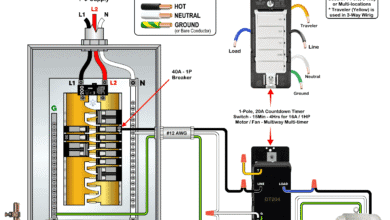 How to Wire a Countdown Timer Switch – 15 Mins to 12Hrs
-
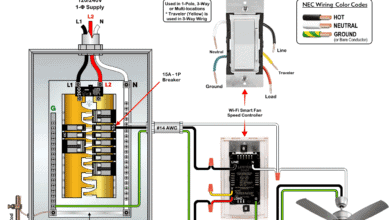 How to Wire a Digital & Smart Fan Speed Controller Switch
-
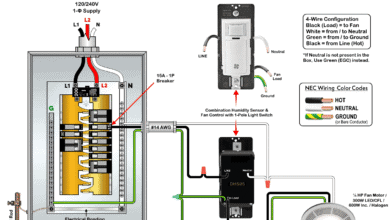 How to Wire Humidity Sensor and Fan Control Switch
-
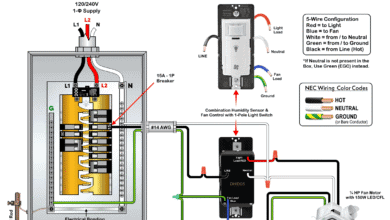 Wiring Combo Humidity Sensor & Fan Control with Light Switch
-
 How to Wire a Smart Motion Sensing Dimmer Switch