Why Can’t We Store AC in Batteries instead of DC?
Why Can’t AC Be Stored in Batteries Like DC?
Batteries are electrochemical devices that store energy in the form of direct current (DC). In DC, the polarity of the terminals remains constant i.e. one terminal is always positive (+) and the other is always negative (−). This matches how a battery naturally works e.g. storing and delivering energy in a fixed direction.
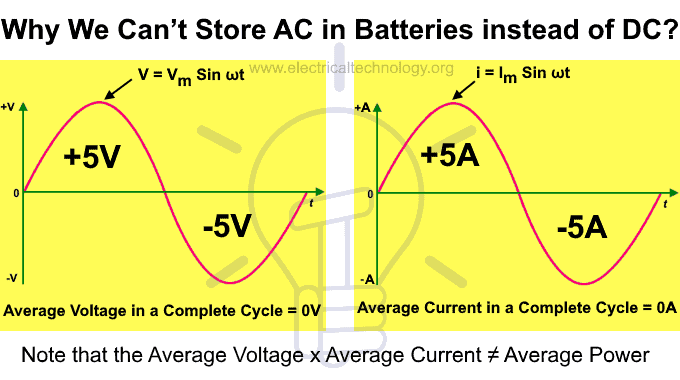
Right to the question, we cannot store AC in batteries because AC continuously changes its polarity i.e. 50 times per second at 50 Hz, or 60 times per second at 60 Hz. This means the battery terminals would need to alternate between positive (+) and negative (−) at the same frequency. However, a battery cannot switch its polarity back and forth at such high speeds, which is why AC cannot be stored directly in batteries.
Furthermore, if a battery is connected directly to an AC supply, it would charge during the positive half cycle and discharge during the negative half cycle. Since the positive half cycle cancels out the negative half cycle, the average voltage or current over one complete cycle becomes zero. Therefore, there is no possibility of storing AC in a battery.
To store AC, it must first be converted into DC using a rectifier (like in chargers and power supplies), and then the battery can store the converted DC energy.
- Related Post: Why Can’t a 12V Car Battery Electrocute You?
Related Posts:
- Why is a Battery Rated in Ah (Ampere hour), Not in VA?
- What Happens if a Battery is Connected to the AC Supply?
- What Happens to the Battery with Reverse Polarity Wiring Connection
- What Happens When an AC Line Touches a DC Line?
- Difference Between a Battery and a Capacitor
- AC or DC – Which One is More Dangerous And Why ?
- Why Do Electronic Circuits Use DC Current instead of AC?
- Is It Dangerous to Carry a Battery in an Elevator?
- How to Calculate the Right Size Battery?



Now i know why there is no ac batteries, thanks
Welcome Dear,,
Yes me too… thanks
If I convert the 110v AC into DC so how much voltage comes in DC 110v or less or more in DC against AC?
First read this post:
According to Ohm’s Law, Current increases, when Voltage increases, (I= V/R), But Current decreases, when Voltage increases according to (P=VI). Explain?
AC to DC is done in RMS if i recall.. 0.707 so 220v AC is 155.54v DC
so to flip it around i guess its 1/0.707=1.414 so 115.54v DC x 1.414=220v AC
110v DC would be 110v x 1.414 = 155.54v AC
Good
Well to keep the resistance value fixed yes when you increase the voltage the current also increase but to keep the power value fixed for sure the relation will be opposite
R=V/I and also P=VI very clear to keep the the R value fixed , if the V value is increasing the I value must also increase but to keep the P value fixed , if the V value increase the I value must decrease
i can see i am learning.Thanks Mr Khan or whoever it is
Thanks for appreciation
can you please refer me to a battery charging circuit.i want to charge a 6v 5.5 Ah battery from a solar panel. or couple of panels in parallel.
We can store ac in capacitor
We can store ac in capacitor
thanks
why transformer not follow ohms law V=IR<br />
Because the overall power is almost constant in that case. That’s why we use P = V x I instead of V = I x R.
Transformer coils are made up of with very low resistive conductors. So resistance is not a much considerable part in transformers. That may be the answer but I'm not sure please let me know if wrong.
Ohm’s law do agree with the linear and purely resistive loads only however, transformer coils are inductive in nature which is non linear hence it doesn’t follow ohm’s law.
What happen if a DC supply mix (short) with AC supply??
A wonderfull forum . lov u admin <br />
Same to U :)
what use perpouse generato……………..?
I won’t one idea i will became a business’s man so please update on idea i done just iti only then i have 3 years’ experience in maitance filed plz help me us
in India why do we use only 50Hz frequency and not 60Hz
Well, electricity was brought by British in india, and they were working on 50 hz even today itself 50 hz is being used in england. And in India all electrical equipment are designed on 50hz. That is why we are using 50hz unlike USA.
Thanks
Cool but this gave me an idea, since the technology we have today can make micro sd cards,<br />that can store atleast FOUR gb, why cant we just cram in lots of powered/charged capacitors with a little chip inside that only lets certain amounts of electricity through? this may work because capacitors CAN store AC and DC or may not work or might for what? 1 minute or less of power? just an idea :)
Is there any chance in the future with the right technology to create a ac powered battery..i mean a battery that supplies ac? I am an electrical engineering students and I was thinking about it lately. Just asking for the possibilities if there is im going to pursue my idea.
I was able to store AC in a new battery that I created. I’m in the process of developing it more… currently I was only able to store .156 Volts AC per cell.
Well explanation thanks.
How i can make pure sine wave inverter?
we use water in battery why?
Very good information thanks
I want the CABLE calculation and voltage drop caculataion. with referance the cable length
Very good information sir.
kkk good to know all
you have sample electrical floor plan having complte .. from start to the end ..discusion? example of commercial building.
Very very useful questions and simple answers enable to understand any common man and reader. We appreciate such simple questions & immediate answers in Electrical technology & its daily uses in our life!!
Why we not using superconductors instead of semiconductors in solar panels?
They produce AC batteries for solar grid systems.
Why do you prefer Dc power supply to batteries –
ac come from a rotating wire in a magnetic field and dc comes from a chemical reaction.
Really appreciate.Thank you.It is very logical.
The reasons you said aren’t coherent. Actually the question is wrong (it doesn’t make sense); the question should be “Why do batteries generate [not store] AC?” And the answer for that is because of the nature of the battery; it’s somewhat similar to a capacitor (consider that as an analogy). An alternator doesn’t “store” AC”, it generates AC, why? Because of the nature: an alternator is a rotating magnetic field with induces sinusoidal EMF and thus sinusoidal current.