Why is a Battery Rated in Ah (Ampere hour), Not in VA?
Why are Batteries and Cells Rating in Ah (Ampere hour) and not in VA or Watts?
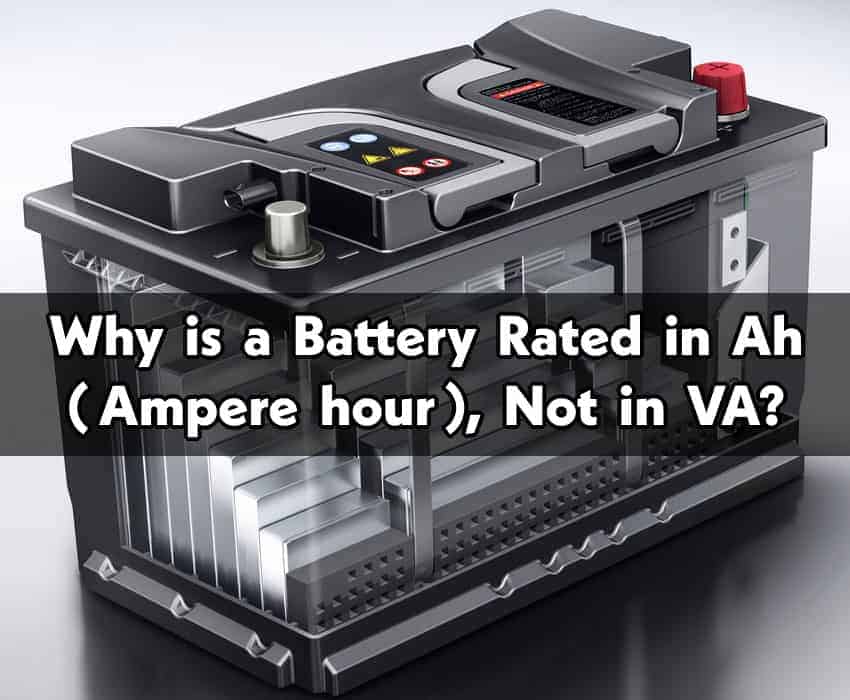
A battery stores energy in the form of chemical energy, which is later converted into electrical energy for use over a period of time. The amount of charge a battery can deliver is known as its capacity, typically expressed in ampere-hours (Ah).
In a charged battery, the chemical reactants (number of molecules) available to sustain electron flow in an electric circuit are limited. As a result, a battery can supply current only for a finite duration, until the chemical reactions are depleted and the battery becomes fully discharged.
- Related Post: Difference Between a Battery and a Capacitor
Technically, we could express a battery’s capacity in terms of the number of flowing electrons over a specific period. However, this would be impractical due to the extremely large number of electrons involved. Instead, we use a more convenient unit (the coulomb (C)) where 1 coulomb equals approximately 6.25 × 10¹⁸ electrons, or 6,250,000,000,000,000,000 electrons.
In addition, 1 ampere (A) is equal to 1 coulomb (C) of charge per second, and:
1 hour (h) = 3600 seconds
Therefore:
1 Ah = (1 A) × (3600 s) = (C/s) × (3600 s) = 3600 C
∴ 1 ampere = 1 coulomb per second (C/s).
But then, you might ask: Why invent a new unit like ampere-hours (Ah) for battery capacity when we already have coulombs? Well, of course, it’s just to make life more “interesting” (read: confusing) for technicians and students! 😉
Just like they do with electricity billing: 1 unit of electricity = 1 kilowatt-hour (kWh) = 1 Board of Trade Unit.
Related Post:
- Types of Batteries and Cells and Their Applications
- How to Calculate the Right Size Battery? Battery Bank Size Calculator
Why Battery is Not Rated in VA (Volt Ampere) or Watts?
VA stands for volt-amperes, which is a measure of apparent power (one of the three types of power in AC circuits). The other two are:
- True (or real) power, measured in watts (W)
- Reactive power, measured in VAR (volt-amperes reactive)
The relationship between these three determines the power factor of a system. A high power factor is desirable in AC circuits because it indicates efficient power usage.
On the other hand, batteries supply DC power, where the power factor is always unity (1), since there is no frequency involved in DC circuits. Therefore, power factor is not applicable to DC systems.
A battery delivers direct current (DC), not alternating current (AC). Due to the absence of frequency and reactance (caused by inductance and capacitance), there are no apparent and reactive power to measure in watts or volt-ampere. That’s why the energy storage capacity of a battery is rated in ampere-hour (Ah).
Moreover, a battery is not a constant voltage source, its voltage drops over time as it discharges. For this reason, we are primarily interested in its capacity, which is rated over a specific period. This is why batteries are rated in ampere-hours (Ah) rather than watt-hours (Wh), watts (W), or volt-amperes (VA).
A battery is essentially an energy storage device, and such devices must indicate how long they can supply current at a given rate. While volt-amperes (VA) represent a unit of power, ampere-hours (Ah) are used to express stored energy capacity, which is more relevant in this case, as it indicates how long the battery can operate before being discharged.
Related Posts:
- Why is a Transformer rated in kVA, not in kW?
- Why is a Motor rated in kW instead of kVA?
- Why is a Generator/Alternator rated in kVA, not in kW?
- Why is an Air-condition (AC) Rated in Ton, not kW or kVA?
- Why is a Power Plant Capacity Rated in MW and not in MVA?
- Why was Circuit Breaker Capacity Rated in MVA and Now in kA and kV?


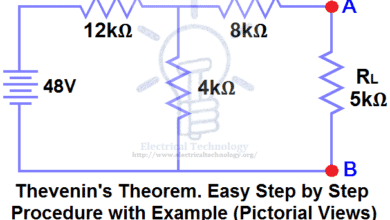

what are the appications of superposition theorem
We will discuss the super position theorem in detail…. (stay tune)
it is use close loop dc circuit
good reason
I really appreciate your sense of humor ………. the last line …..to make tech. student life difficult. ……………..excellent site for tech help and guidance ……sharing knowledge is jut increasing your knowledge.
thanks .
How to calculate battery charge?
Type of motor needed for it and is there a board that I can easily build for it?
Can you maybe guide me to a site or a book that is available?
Thank you!